
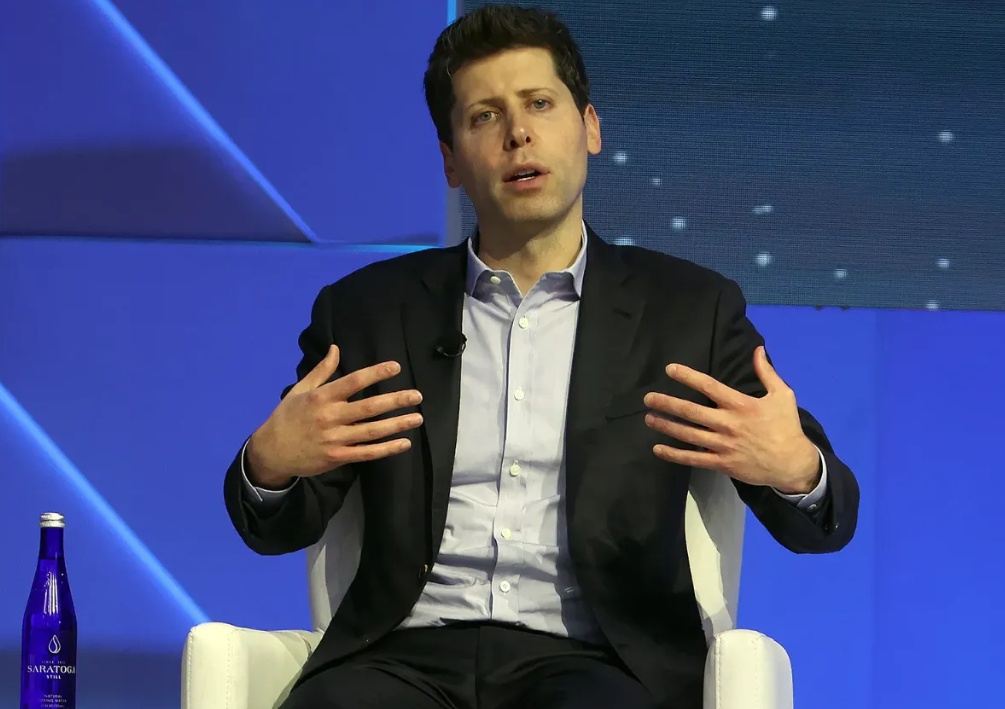
Sam Altman is the CEO of the most talked-about AI company in the world. He earns $76,000 a year doing it. He owns no equity in OpenAI. And somehow, he’s worth several billion dollars.
Sam Altman is known as a big player in OpenAI’s success, but has no stake in the company itself. Altman, who was born in 1985 and grew up in St. Louis, Mo., opted out of an ownership stake when co-founding OpenAI in 2015. He has since confessed that he regretted that, saying he would have liked to have taken “just some little bit” otherwise he would never do to answer questions about it.
So where does the money come from? The answer is venture capital — a career as one of Silicon Valley’s most prolific early-stage investors that predates OpenAI by a decade and now includes stakes in over 400 companies. As of mid-2026, Forbes estimated his net worth at roughly $2 billion. Court filings from the Elon Musk vs. OpenAI trial in May 2026 revealed a portfolio that pushed a revised Forbes estimate above $6.5 billion. The gap between those two numbers tells the whole story of how his wealth actually works.
Sam Altman Net Worth in 2026: What the Numbers Actually Show
Why the estimates vary so widely
If you search Sam Altman’s net worth, you will find figures ranging from $800 million to over $6 billion depending on the source and the date. That’s not sloppy reporting — it reflects something real about how his wealth is structured.
Almost all of Altman’s money sits in private companies: startups that have not gone public, fusion energy firms without revenue, biotech companies working on drugs that don’t yet exist. Private stakes don’t get repriced every day the way public stocks do. They update in steps — when a company raises a new funding round, conducts a secondary sale, or goes public. Between those events, the numbers sit still while the underlying value may be moving significantly in either direction.
Forbes uses a conservative methodology for illiquid private holdings. Before the Musk trial, they placed Altman around $1.9–$2 billion. Then in May 2026, court filings submitted during the Elon Musk vs. OpenAI trial disclosed Altman’s full investment portfolio as of December 31, 2026 — specific stakes, specific valuations. Forbes updated their estimate to more than $6.5 billion in response.
What the Musk trial revealed
The court filing listed Altman’s fair market value in nine companies that had done business with OpenAI. The biggest line item: a $1.7 billion stake in Helion Energy, the nuclear fusion startup he has chaired since 2015. Below that, a $633 million stake in Stripe, a $258 million position in Retro Biosciences, and smaller holdings in Cerebras and others.
The document also confirmed he had sold his Reddit stake — which was worth more than $600 million on Reddit’s IPO day in March 2024 — by the end of 2026.
These weren’t estimates. They were filed under oath.
His Salary and OpenAI Equity: The Unusual Arrangement
The $76,000 salary — and why it’s deliberate
This means that Sam Altman is reported to earn only $76,001 a year from OpenAI, which includes a modest salary and health insurance. It is not frugality, but the original non-profit business model of OpenAI. The organization was created to develop AI for the good of mankind and not to make significant money therefore the executive pay is kept low which was meant to support the mission over money.
For context, the average senior engineer at a comparable San Francisco tech company earns two to three times that amount. The CEOs of most large-cap public companies earn millions annually in salary alone, before stock. Altman’s OpenAI pay is one of the lowest in all of big tech for a leadership role of comparable visibility.
Why he took no equity in 2015
When OpenAI was founded, Altman chose not to take an equity stake in the nonprofit entity. At the time, the rationale was partly philosophical — taking personal equity in a nonprofit designed to benefit humanity created an obvious tension — and partly practical: OpenAI had no clear path to liquidity in 2015 and was structured specifically to avoid the financial pressure of traditional venture-backed companies.
OpenAI later created a “capped profit” arm in 2019 when it partnered with Microsoft and began commercial operations. Altman does hold a small indirect exposure through a Y Combinator fund that has a stake in OpenAI, but this is not a meaningful direct ownership position. He has described it as negligible.
“If I could go back in time, I would have taken it,” he said. “Just some little bit.”
Where His Money Actually Comes From: The Investment Portfolio
Helion Energy — from $9.5M to $1.7B
This is the investment that defines Altman’s portfolio in 2026. He first put money into Helion — a private company working on nuclear fusion power — in 2015, when the company was barely known outside specialist energy circles. His initial stake was $9.5 million.
In 2021, he followed up with a $375 million investment, the largest single personal investment he has ever made. Helion is now valued at $5.4 billion. The court filing put Altman’s stake at $1.7 billion as of December 2026.
In 2024, OpenAI signed an agreement for Helion to supply it with power in the future — a deal that became the centrepiece of the conflict-of-interest hearings in the Musk trial. Altman testified that he had recused himself from the deal on both sides and that OpenAI’s board approved the final terms. He stepped down from Helion’s board in March 2026, while the two companies were discussing a larger agreement.
Stripe — early YC investment, now $633M stake
Altman invested in Stripe through Y Combinator when it was one of the most promising YC-backed fintech startups. His stake, which represents roughly 2% of the company, grew alongside Stripe’s valuation — which reached $70 billion in a November 2024 tender offer. Court filings valued his holding at $633 million as of December 2026.
Reddit — invested via YC, sold by end of 2026
Altman was Reddit’s third-largest shareholder before its IPO in March 2024, holding approximately 8.7% of the company. On the day Reddit went public, that stake was worth more than $600 million. The court filing confirmed he had sold the position by the end of 2026.
Reddit also had a content licensing deal with OpenAI — signed in May 2024 — while Altman held his Reddit stake, a fact that was raised during the trial. Altman said he had recused himself from the negotiations and that other OpenAI staff were present throughout.
Retro Biosciences — $258M anti-aging bet
Retro Biosciences is working on drugs that target the biology of aging. Altman led the company’s $180 million funding round and holds a stake now valued at $258 million per the court filing. The company has not gone public.
The broader 400+ company portfolio
Beyond the headline names, Altman runs multiple small investment vehicles including Hydrazine Capital, co-founded with his brother Max Altman, and Apollo Projects. His total portfolio spans more than 400 companies across AI, energy, biotech, fintech, and consumer technology — including early positions in Airbnb, Instacart, DoorDash, and Asana, mostly made through his years at Y Combinator before 2019.
Sam Altman’s Career: From Stanford Dropout to OpenAI CEO
Loopt (2005–2012)
After two years studying computer science at Stanford, Altman dropped out in 2005 to found Loopt — a location-sharing app that let users share their whereabouts with friends. It was one of the first companies to receive Y Combinator funding. It also attracted more than $30 million from investors including Sequoia Capital.
Loopt never found the user base it needed. In 2012, with smartphones having commoditised the location-sharing feature into every native map app, Green Dot Corporation acquired the company for $43.4 million. The proceeds became the seed capital for everything that followed.
Y Combinator (2011–2019)
Altman joined Y Combinator as a part-time partner in 2011. In 2014, YC co-founder Paul Graham asked him to step into the president role. He accepted, and over the following five years he oversaw the growth of YC from a small accelerator into the premier startup launch pad in the world.
By the time he stepped down in 2019, Y Combinator had helped approximately 1,900 companies — among them Airbnb, DoorDash, Instacart, Reddit, and Twitch. The role gave him first-look access to the best early-stage deals in Silicon Valley, which is the foundation of his investment portfolio today.
OpenAI (2015–present)
In December 2015, Altman co-founded OpenAI alongside Elon Musk, Peter Thiel, and others as a nonprofit organisation backed by $1 billion in initial commitments. He initially served as co-chair while still running Y Combinator.
In 2019, Sam Altman stepped down from Y Combinator to lead OpenAI as its full-time CEO. Under his leadership, the company adopted a capped-profit structure, secured a landmark investment from Microsoft, and launched breakthrough AI models including GPT-3 (2020), DALL·E (2021), and ChatGPT (2022). ChatGPT reached one million users in just five days, accelerating mainstream adoption of AI and reshaping public awareness of the technology.
In November 2023, OpenAI’s board unexpectedly removed Sam Altman as CEO, citing concerns that he had not been “consistently candid” in his communications. The decision sparked a major backlash, with more than 700 of the company’s roughly 770 employees threatening to resign unless he returned. Within a week, Altman was reinstated as CEO, and most of the board members who had voted to remove him stepped down.
Read More:- What Is a Micro-SaaS Business and How Do You Start One in 2026?
The Conflict-of-Interest Questions
The Elon Musk vs. OpenAI trial, which ran into 2026, put Altman’s personal investment portfolio under legal scrutiny for the first time.
The core allegation was that Altman had used his position as OpenAI’s CEO to steer the company into deals with companies in which he personally held stakes. His portfolio overlapped with OpenAI’s vendor relationships in multiple places: Helion (power supply agreement), Reddit (content licensing), Cerebras (a $10 billion computing deal), and others.
Altman’s testimony addressed each case. On Helion: “I was recused from it on both sides. I did not sign the agreement.” On Reddit: “We decided that the board would approve any final terms. I had other people in the room with me. This was a well-discussed standard corporate recusal.”
He also stepped down from chairmanships at both Helion and Oklo — another nuclear energy company he had founded via a SPAC — in the months surrounding the trial, stating the reason was to remove any appearance of conflict as OpenAI discussed potential energy purchases from those firms.
Ten US attorneys general separately asked the SEC to review OpenAI documents before any potential IPO, citing governance concerns.
Personal Life and the Giving Pledge
Altman married Oliver Mulherin, an Australian software engineer, in a private ceremony at their estate in Hawaii in January 2024. The couple welcomed a son in February 2026 and are based in San Francisco.
Sam Altman and his husband, Oliver Mulherin, joined the philanthropic effort of Bill Gates and Warren Buffett, the Giving Pledge, in 2024. They entered the pledge, which meant that they were willing to give most of their assets to charitable organizations while they were still living.
His known real estate holdings include three San Francisco homes purchased in early 2026 for $12.8 million each, a San Francisco property valued at $27 million, a Hawaii estate valued at $43 million, and a Napa Valley ranch purchased in 2020 for $15.7 million.
Read More:- How AI Overviews Work: What Publishers Need to Know in 2026
Frequently Asked Questions
Q.1 What is Sam Altman’s net worth in 2026?
Forbes estimated Sam Altman’s net worth at approximately $3.3 billion as of April 2026. Court filings from the May 2026 Elon Musk vs. OpenAI trial disclosed a portfolio valued above $6.5 billion, prompting Forbes to revise their figure upward. Estimates ranged from $1.9 billion to $2 billion through most of 2026 before the trial disclosures. The variation reflects the difficulty of valuing private, illiquid holdings that are only repriced at significant events.
Q.2 Does Sam Altman own equity in OpenAI?
No. Altman chose not to take an equity stake when OpenAI was co-founded in 2015. He has a small indirect exposure through a Y Combinator fund that holds an interest in OpenAI, but this is not a meaningful direct stake. He has publicly said he regrets the decision and would have taken a small amount of equity if he could go back.
Q.3 How much does Sam Altman earn as CEO of OpenAI?
Altman’s reported annual compensation from OpenAI is approximately $76,001 — a nominal salary plus health insurance. This is intentionally low and reflects OpenAI’s structure as a mission-driven organisation. He does not receive stock options, bonuses, or other equity-linked compensation from OpenAI.
Q.4 How did Sam Altman make his money?
Altman’s wealth comes primarily from venture capital investments made during and after his time at Y Combinator (2011–2019). His most valuable known holdings include a $1.7 billion stake in Helion Energy, a $633 million stake in Stripe, and a $258 million stake in Retro Biosciences, all disclosed in court filings from December 2026. Earlier exits from Reddit (worth $600M+ at IPO) and earlier-stage positions across 400+ companies also contribute. He did not build his fortune through his OpenAI salary or equity.
Q.5 What companies has Sam Altman invested in?
His most significant known holdings as of late 2026 include Helion Energy (nuclear fusion), Stripe (fintech), Retro Biosciences (anti-aging drugs), Cerebras (AI chips), Worldcoin (crypto/digital identity), and Oklo (nuclear fission). Earlier notable investments include Reddit, Airbnb, Instacart, DoorDash, Asana, and Twitch — most made through Y Combinator. He manages investments through several vehicles including Hydrazine Capital and Apollo Projects.
Read More:- How to Use AI Tools for Solopreneurs to Run Business in 2026
The Bottom Line
Sam Altman’s wealth is one of the more unusual wealth stories in Silicon Valley. He runs the world’s most valuable private AI company for a salary most software engineers would turn down. His personal fortune — now estimated well into the billions — comes not from that role but from two decades of early-stage bets made before ChatGPT made OpenAI a household name.
The Helion position alone — from a $9.5 million initial bet in 2015 to a $1.7 billion stake a decade later — illustrates the compounding arithmetic that defines his financial trajectory. The rest of the portfolio follows the same pattern: a long career of picking companies early, holding them patiently, and watching the AI economy he helped create raise the value of everything around it.
Whether that constitutes a conflict of interest is a question courts and regulators are still working through. What isn’t in dispute is the amount, or how it got there.
Sources: Forbes Billionaires profile (April 2026, revised May 2026) · Cryptopolitan — Musk vs. OpenAI trial coverage (May 2026) · Britannica Money — Sam Altman biography (June 2026) · biography.com — Sam Altman profile (August 2026) · 99bitcoins.com — Sam Altman investment breakdown (October 2026) · Finbold — Sam Altman net worth guide (December 2026) · Wikipedia — Sam Altman (current) · NewsNation / Yahoo Finance — Sam Altman net worth (April 2026).