
In February 2026, a solo founder with no technical background launched an AI product using Replit’s coding tools. Within a month it had generated $1.5 million in subscription revenue. By June, Wix had acquired it for $80 million. One person. No team. No investors.
That’s an extreme example, but it reflects something real. According to Fortune and US Census Bureau data, there are now more than 41 million solo businesses operating in the United States alone, contributing roughly $1.7 trillion to the economy. The share of new startups launched by a single founder rose from 23.7% in 2019 to 36.3% by mid-2025, according to Carta’s Solo Founders Report — a 53% increase in six years. The acceleration in 2025-2026 coincides precisely with AI coding assistants and smart AI tools going mainstream.
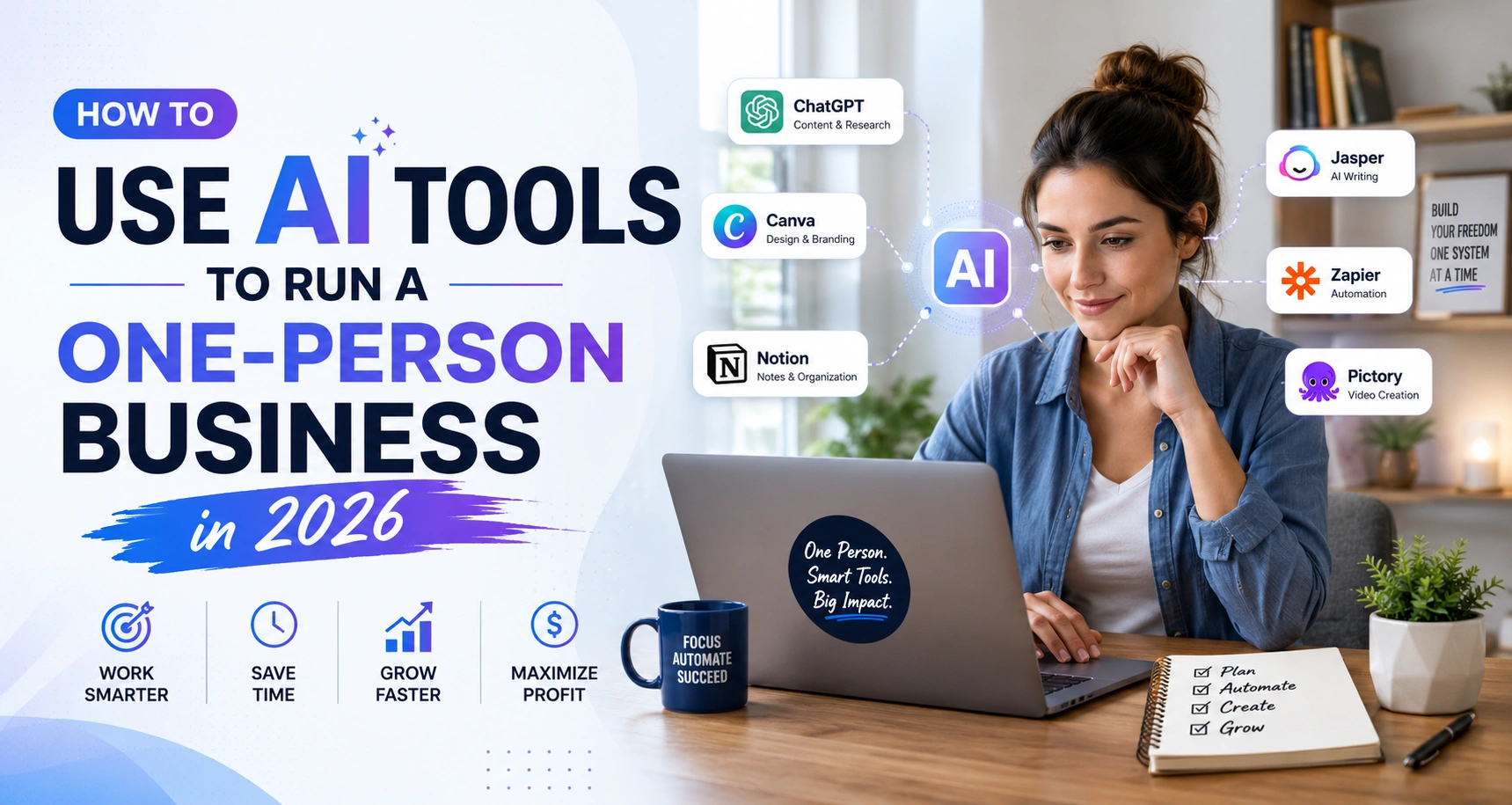
This guide covers how to actually use AI to run a one-person business — not a list of every tool that exists, but a department-by-department stack with specific tools, real costs, and a clear starting point.
Why the One-Person Business Became Viable in 2026
The numbers behind the solopreneur surge
Small businesses are increasingly adopting generative AI, with 58% reporting to the US Chamber of Commerce that they are using it, compared to 23% in 2024. The Salesforce 2026 Small Business Trends Report reveals that 91% of users of said technology say it is increasing their company’s revenue, while 90% state that it is helping them to become more efficient. These aren’t marginal gains. Their input/output structure is a shift in the way one person can produce.
The most striking cost data: a complete AI tools for solopreneurs stack now runs between $3,000 and $12,000 per year. Hiring the equivalent human roles — a virtual assistant, a content writer, a bookkeeper, a support rep, a designer — would cost $60,000 to $120,000 annually. That’s a 95 to 98 percent cost reduction.
What actually changed — from SaaS tools to AI execution
In the SaaS era, tools like Notion, Slack, and Zapier made small teams more efficient. But you still needed humans for execution. In the AI era, the tools themselves execute. A solopreneur in 2023 used Canva to design faster. A solopreneur in 2025 describes what they want and Canva’s AI generates it. That shift — from augmenting humans to replacing specific tasks entirely — is what changed the math.
The new bottleneck: attention, not production
Here’s the insight that most AI tool articles miss. Once AI removes the execution bottleneck, a new one emerges: your attention and judgment.
Research from Taskade’s analysis of one-person companies puts it directly: “AI makes production cheap. That means attention becomes the bottleneck.” The solopreneurs who use AI most effectively aren’t the ones running the most tools — they’re the ones who have figured out where their human judgment adds irreplaceable value, and they’ve used AI to clear everything else out of the way.
The AI Solopreneur Stack: 8 Departments, One Person
Think of yourself as the CEO. Below you, AI fills every department. You set strategy, approve output, and maintain the relationships. Here’s what each department looks like and what it costs.
Department 1: Writing and content AI
Tools: Claude, ChatGPT Plus Monthly cost: $20–$40 What it replaces: content writer, copywriter, email marketer
This is where most AI tools for solopreneurs start and where they get the most immediate return. A good AI writing assistant handles first drafts of blog posts, client proposals, email sequences, and social captions in minutes rather than hours. The key is treating it as a first-draft engine, not a publisher — your voice, your edits, your sign-off.
Claude performs particularly well on long-form business documents and complex analysis. ChatGPT Plus adds access to image generation, code execution, and plugins. Many solopreneurs use one for daily drafting and the other for specialist tasks.
Department 2: Design and visual AI
Tools: Canva AI (Magic Studio), Adobe Firefly, Midjourney Monthly cost: $15–$35 What it replaces: graphic designer, social media designer
Canva’s Magic Studio suite now handles everything from social post generation to presentation layouts from a text prompt. For more customised brand imagery, Midjourney or Adobe Firefly produce professional-quality visuals in seconds. Neither requires design training.
The practical use case: a solopreneur running a consulting business generates their own proposal decks, social graphics, and lead magnet PDFs without ever hiring a designer or opening Adobe Photoshop.
Department 3: Marketing and SEO AI
Tools: Semrush AI Toolkit, Surfer SEO, Perplexity Monthly cost: $30–$130 What it replaces: SEO specialist, marketing analyst
Semrush’s AI tools now handle keyword research, content briefing, and competitor gap analysis at a level that would have required a specialist six months ago. Surfer integrates directly into your writing workflow and scores content against live competitor pages in real time. Perplexity is useful for rapid research synthesis when you need to understand a market or topic quickly without the hallucination risk of closed-model AI.
Combined with AI-generated content, these tools compress the full SEO content cycle from weeks to days.
Department 4: Automation — the connective tissue
Tools: Zapier, Make (formerly Integromat) Monthly cost: $20–$50 What it replaces: operations coordinator, repetitive admin
Automation is the department that makes every other department work better. Tools like Notion AI, Otter, ClickUp, and Zapier didn’t just add AI — they embedded it into the way you already work. A Zapier workflow might automatically send a new client contact to your CRM, trigger a welcome email sequence, create a project folder, and notify you on Slack — all from a single form submission. None of that requires code.
Department 5: Customer support AI
Tools: Intercom Fin, Tidio, Drift Monthly cost: $30–$74 What it replaces: customer support rep, FAQ management
AI now lets one-person businesses offer 24/7 support that doesn’t feel like it’s coming from a bot. Intercom Fin and Tidio both use your existing documentation and knowledge base to answer customer questions, qualify leads, and handle common objections without human intervention. For solopreneurs offering products or services with predictable customer questions, this is the department with the highest immediate leverage.
The result is a support experience that scales with customer volume, not with your availability.
Department 6: Finance and admin AI
Tools: Collective, FreshBooks AI, QuickBooks AI Monthly cost: $25–$49 What it replaces: bookkeeper, accountant (for basic needs), invoice chaser
One founder described Collective as “a virtual CFO that doesn’t charge hourly.” AI-first finance platforms built for solo founders handle expense categorisation, invoice generation, tax preparation, and financial reporting without spreadsheets or an accountant on retainer for day-to-day tasks.
For solopreneurs who dread the numbers — and Simply Business’s 2026 Solopreneur Report found that 61% of solo business owners struggle with managing all business functions alone — this department removes one of the most common sources of business anxiety.
Department 7: Sales and outreach AI
Tools: Apollo.io, HubSpot AI (free tier), Clay Monthly cost: $0–$59 What it replaces: sales development rep, lead researcher
Apollo.io combines a database of 275 million contacts with AI-powered email sequencing. HubSpot’s free AI CRM handles contact management, deal tracking, and email templates. Clay is emerging as the tool of choice for solopreneurs doing personalised outreach at scale — it enriches lead data from dozens of sources and uses AI to write personalised first-line emails automatically.
For a service-based solopreneur, this department can run a consistent outreach pipeline that would previously have required a dedicated sales hire.
Department 8: Build and product AI
Tools: Replit, Cursor, Bubble, Framer Monthly cost: $0–$25 What it replaces: developer, no-code specialist
This is the department that made the Wix acquisition story possible. Replit’s AI coding environment lets non-technical founders build functional web apps through conversation and iteration rather than code. Cursor gives developers AI pair-programming at every step. Bubble handles complex web application logic without code. Framer builds high-quality marketing sites in minutes.
Dana Snyder, founder of Positive Equation, used Replit to build a nonprofit consulting platform that serves the roughly 93% of US nonprofits too small to afford a human consultant — with no technical background and no developer. The platform guides organisations through fundraising strategy step-by-step.
The Total Cost: What a Complete AI Stack Actually Runs Per Year
| AI department | Tool(s) | Monthly cost |
|---|---|---|
| Writing and content | Claude / ChatGPT Plus | $20–40 |
| Design and visuals | Canva AI / Midjourney | $15–35 |
| Marketing and SEO | Semrush / Surfer | $30–130 |
| Automation | Zapier / Make | $20–50 |
| Customer support | Intercom Fin / Tidio | $30–74 |
| Finance and admin | Collective / FreshBooks | $25–49 |
| Sales and outreach | Apollo / HubSpot free | $0–59 |
| Build and product | Replit / Bubble | $0–25 |
| Total | $140–462/month |
At the upper end, a fully deployed solopreneur AI stack costs around $5,500 per year. Hiring the equivalent roles — even part-time — would realistically run $60,000 to $120,000. The gap is the reason solo-founded startups are accelerating fastest precisely when AI tools are maturing.
Where to Start: The 3-Tool Foundation Every Solopreneur Needs First
Most solopreneurs get overwhelmed by the full stack and install everything at once. That’s a mistake. The tools above compound on each other — they work better once you understand what each one is actually doing for your business.
Start here:
Step 1: A core AI assistant (Claude or ChatGPT Plus) This is your thinking partner, first-draft engine, and research assistant. Use it daily, across every kind of task, for two to four weeks before adding anything else. Learn what it does well and where it needs direction.
Step 2: An automation layer (Zapier or Make) Once you’ve been using an AI assistant for a few weeks, you’ll notice the repetitive hand-off tasks that eat time between tools. That’s where Zapier comes in. Set up three to five workflows that eliminate your most common manual steps. This alone recovers five to ten hours a month for most solopreneurs.
Step 3: A customer communication tool (Intercom Fin or Tidio) Once you have customers or leads, adding AI to your support and sales communication means you’re no longer the bottleneck for responses. Even a basic AI chatbot trained on your FAQ reduces your response burden significantly.
In that order. Get each one working before adding the next department.
Real Solo Founders Using AI: What’s Actually Working
Dana Snyder — Positive Equation
Snyder, a nonprofit consultant, used Replit’s AI coding tools to build a software platform that acts as an on-demand consultant for nonprofits — generating fundraising strategies, donor communication plans, and programme names tailored to each organisation. With no technical background, she built the platform over six months and expanded her serviceable market from a few dozen retainer clients to the roughly 93% of US nonprofits too small to afford a human consultant.
Justin Welsh
Welsh, a solo content entrepreneur, openly credits AI tools including ChatGPT for helping him scale his publishing output to the level that supports his $2M+ ARR solo business. His model — one person, one audience, AI-assisted content production — is the clearest working example of the “attention as bottleneck” principle in practice. He doesn’t use AI to replace his voice; he uses it to remove the production friction that would otherwise limit his output.
The Wix acquisition
In February 2025, a solo founder launched an AI product with no team. Within one month it had generated $1.5 million in subscription revenue. By June, Wix had acquired it for $80 million. The product was built on AI coding tools that didn’t exist in meaningful form two years earlier. It’s the clearest data point yet that the solo-to-exit path has fundamentally compressed.
Read More:- 15 Best Side Hustles for Students India That Actually Pay in 2026
The Limits: What AI Still Can’t Do for a Solopreneur
This section matters more than any tool recommendation.
Clients don’t hire you because you use AI. They hire you because they trust you with outcomes. Fortune’s coverage of solo founder success patterns consistently surfaces the same observation: AI removes the execution bottleneck, but the human provides the direction, quality bar, and accountability that no agent can replicate.
The five things AI genuinely can’t do for your solo business:
Relationship depth. AI can write a follow-up email. It can’t replace the trust built over years of consistently showing up for a client.
Taste and judgment. AI generates options. The selection of what’s right for your client, your brand, or this specific moment — that’s a human judgment call.
Accountability. When something goes wrong, your client is calling you. Not your AI stack.
Deep domain expertise. AI synthesises well. It doesn’t replace ten years of knowing exactly what a specific kind of client actually needs.
Trust signals. The reason someone hires a solopreneur over a platform is because they believe the human on the other end cares about the outcome. That signal is human.
Build the AI stack that frees you to do more of the work that requires these things. That’s the full model.
Read More:- What Is a Micro-SaaS Business and How Do You Start One in 2026?
Frequently Asked Questions
Q.1 What AI tools do solopreneurs use most?
Marketing, customer service, and administrative work are the top three uses of AI among small businesses, according to Intuit QuickBooks’s 2025 data. For solopreneurs specifically, content and writing AI (Claude, ChatGPT) and automation tools (Zapier, Make) tend to be the highest-impact starting points because they directly reduce the two biggest time drains: producing output and managing repetitive tasks.
Q.2 How much does a complete solopreneur AI stack cost per year?
A full eight-department AI stack costs between $1,700 and $5,500 per year at current tool pricing. That compares to $60,000 to $120,000 or more annually to hire equivalent human roles even part-time. Research from AutoFaceless and Entrepreneur Loop puts the cost reduction at 95 to 98 percent compared to traditional staffing models.
Q.3 Can AI really replace hiring for a one-person business?
For execution tasks — content drafting, design, bookkeeping, support responses, outreach — AI handles an increasing proportion close to human quality. What it doesn’t replace is relationship management, strategic judgment, domain expertise, and client accountability. The most effective solo businesses use AI to handle production tasks and reserve human time for the five things listed above that AI cannot replicate.
Q.4 What should a solopreneur use AI for first?
Start with a core AI assistant (Claude or ChatGPT Plus) and use it daily across all your tasks for two to four weeks. Then add automation (Zapier or Make) to connect your tools and eliminate manual hand-off steps. Then add customer communication AI (Intercom Fin or Tidio) once you have leads or customers who need responses. In that order, these three tools deliver the highest return before adding any specialist department tools.
Q.5 Is it realistic to run a $100K+ business alone with AI tools?
Yes, with qualifications. Simply Business’s 2026 Solopreneur Report found that 20% of solo business owners earn between $100,000 and $300,000 annually without hiring staff, and 77% reach profitability in their first year. AI significantly improves both the ceiling and the speed of reaching it — but 78% of solo businesses still generate under $50,000 annually, and the gap between average and high earners usually comes down to business model selection and pricing strategy, not tool adoption alone.
Read More:- Best AI-Powered Note-Taking Apps 2026 (Tested and Ranked)
The Bottom Line
The one-person business is no longer a lifestyle choice with a ceiling. It’s a structural model that AI has made genuinely competitive with small-team businesses across most service and product categories.
The founders winning with this model share a pattern: they’re not using AI to do everything. They’re using it to clear the execution work so they can spend more time on the judgment, relationships, and domain expertise that clients actually pay for. The AI stack is the infrastructure. The human is still the business.
Start with three tools. Get each one working. Add departments as the business demands them. The $3,000 to $12,000 annual investment in this stack is the most asymmetric bet available to an early-stage solo founder in 2026.
Sources: US Census Bureau — Non-Employer Statistics (2023 release) · Carta 2025 Solo Founders Report (via Bloomberg, July 2025) · Fortune — Solo founders and AI scaling (May 2025) · Salesforce Small Business Trends Report 2025 · US Chamber of Commerce Small Business AI Survey 2025 · Simply Business Power of One: 2025 Solopreneur Report · Intuit QuickBooks Small Business Insights 2025 · AutoFaceless solopreneur statistics 2026 · Taskade — One-person company research (2026) · Entrepreneur Loop — AI tools to scale solo business (2026).