

Your rankings haven’t changed. Your content is just as good as it was a year ago. But your search traffic has dropped — and you’re not sure why.
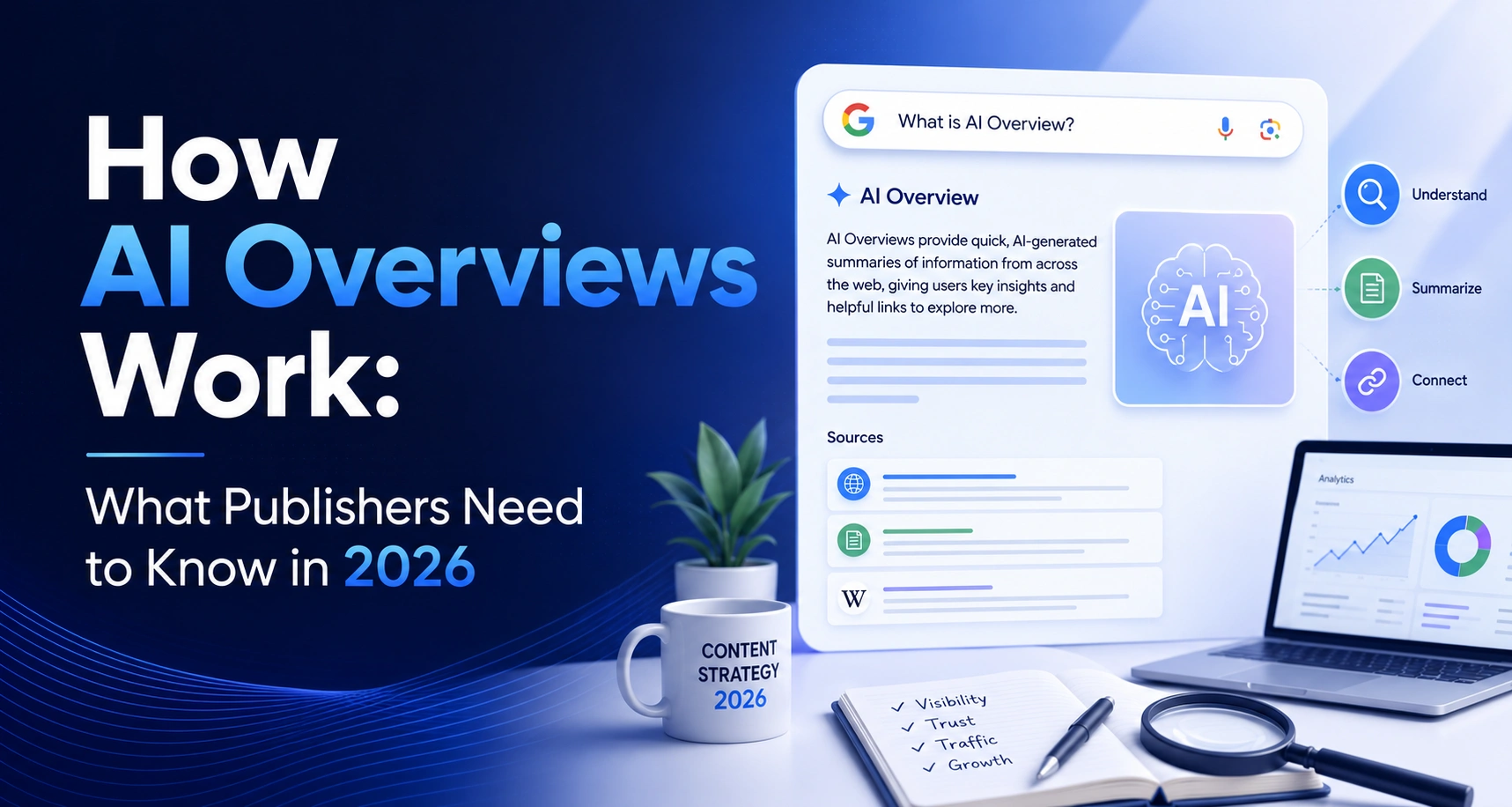
For a growing number of publishers, the answer is AI Overviews. An AI Overview is an AI-generated summary that Google places above traditional search results, answering a query directly using information pulled from multiple web sources. As of mid-2026, AI Overviews appeared on somewhere between 13% and 25% of all Google searches, depending on the month measured, and they’re concentrated almost entirely in the exact content category most publishers built their business on: informational, how-to, and definitional queries. This guide explains exactly how AI Overviews work, what the real traffic data shows, and what you can actually do about it.
What Is a Google AI Overview?
From Search Generative Experience to AI Overviews — a brief timeline
Google first announced this feature as the Search Generative Experience (SGE) at Google I/O in May 2023, testing it as an opt-in labs feature. It rolled out broadly to all U.S. users as “AI Overviews” in May 2024, then expanded to over 200 countries and 40 languages by May 2026. By late 2026, AI Overviews were serving more than 2 billion monthly users, according to Google’s own disclosures — making this one of the fastest and broadest changes to search results since Google introduced featured snippets in 2014.
How AI Overviews differ from featured snippets
Featured snippets pull a single passage from a single source and display it with a clear link. An AI Overview is fundamentally different: it synthesises information from multiple sources into a new, generated paragraph, often citing three to five sources in small linked tiles beneath the summary. The user gets a complete answer without needing to click anywhere. That distinction — synthesis from multiple sources versus extraction from one — is the core reason AI Overviews have a much larger effect on publisher traffic than featured snippets ever did.
How AI Overviews Work Actually : Query Fan-Out Explained
What query fan-out means
This is the mechanism most explanations of AI Overviews skip entirely, and it’s the single most useful concept for understanding why some content gets cited and most doesn’t.
When you search a query, Google’s system doesn’t just match it against an index of pages. It performs what’s known as query fan-out: it expands your single query into multiple related sub-queries, searches across all of them, and then synthesises an answer that pulls from the strongest source for each sub-question. If you search “how to optimize content for AI Overviews,” Google’s system internally decomposes that into sub-queries covering content formatting, schema markup, E-E-A-T signals, content freshness, and measurement — then builds the final summary from whichever pages answer each piece best.
Why this rewards comprehensive content over single-answer pages
The practical consequence is significant. A page that thoroughly answers only one sub-query competes for a single citation slot out of five or more. A page — or a connected cluster of pages — that addresses ten or fifteen of the sub-queries within a topic multiplies its citation surface area across the entire fan-out. This is why the traditional SEO instinct of “one focused page per keyword” increasingly underperforms in an AI Overview environment. Comprehensive topic clusters, where a pillar page links out to detailed supporting articles covering each sub-topic, now have a structural advantage that single-page content doesn’t.
How Google decides which pages to cite
Good rank in search results is essential for AI Overview citation, but it’s not all that. According to Ahrefs and other studies, 76% – 92% of citations to AI Overview are on pages that are already ranked in the top 10 results on Google for the same query, so the basics of good SEO continue to hold significant importance. However, in the top 10 list, AI Overviews seem to lean toward pages that have a higher degree of structure, a more powerful voice and content that directly and succinctly answers the question, rather than pages that rank similarly well but answer the question in lengthy introductions.
The Real Impact on Publisher Traffic in 2026
The click-through rate collapse, by the numbers
The most rigorous data on this comes from the Pew Research Center, which tracked 68,879 actual Google searches conducted by 900 U.S. adults in March 2026. The findings were stark: only 8% of users who encountered an AI Overview clicked through to a traditional search result, compared to 15% when no AI summary appeared on the page — roughly a 47% reduction in click-through rate. Separately, 26% of searches with an AI Overview present ended with no click at all, compared to 16% for standard results pages. Less than 1% of users clicked a link inside the AI Overview itself.
Ahrefs’ analysis of 300,000 keywords, comparing December 2023 data to December 2026, found that for keywords triggering AI Overviews, the position-one click-through rate fell from 7.3% to just 1.6% — a decline of roughly 58% after controlling for general search trends.
Which content types are hit hardest
Semrush’s analysis of more than 10 million keywords found that 88.1% of queries triggering AI Overviews are informational in nature — precisely the how-to guides, explainers, and definitional content that have traditionally driven the bulk of organic traffic for content publishers. Industry-level trigger rates reported by BrightEdge show healthcare content affected at an 88% rate, education at 83%, and B2B tech at 82%. Commercial and transactional queries are affected far less, though that gap has been narrowing — commercial-query AI Overview triggers grew from roughly 8% to 18% of such queries through 2026.
The damage at individual publishers has been substantial. Similarweb data shows Business Insider’s organic search traffic fell 55% between April 2022 and April 2026. Forbes and HuffPost both recorded traffic declines of roughly 50% year-over-year. CNN’s traffic dropped between 27% and 38% depending on the measurement period. Educational platform Chegg reported a 49% decline in non-subscriber traffic in the year following AI Overviews’ broader rollout, citing AI summaries answering homework questions directly.
Which publishers and content types are still growing
The picture is not uniformly negative, and this part of the story is consistently underreported. Content that earns an actual citation within an AI Overview sees meaningfully higher click-through rates than content that ranks well but isn’t cited — increases of 35% to 80% have been reported, with some individual cases showing gains as high as 219%. Some publishers have grown significantly through this period: Men’s Journal and People.com are both cited examples of sites gaining traffic even as the broader news and publishing sector contracted. The pattern across winners is consistent — they tend to be specialised, deeply sourced, and structured in ways that make extraction and citation easy, rather than general-interest sites competing on broad informational queries.
SEO vs. AEO: Why Ranking Well Isn’t Enough Anymore
The 12% gap — why Google rankings and AI citations diverge
Research analysing citation patterns across ChatGPT, Perplexity, and Microsoft Copilot found that only 12% of the URLs these tools cited actually ranked in Google’s top 10 for the matching query — and roughly 80% didn’t appear anywhere in Google’s top 100 results at all. This is a genuinely important distinction for publishers to understand: optimising for Google’s traditional algorithm and optimising for citation by AI assistants are related disciplines, but they are not the same discipline, and a page can succeed at one while failing at the other.
This is the practical difference between SEO (search engine optimization, which asks “will a crawler rank this page?”) and what’s increasingly called AEO, or answer engine optimization (which asks “can an AI system extract a specific, citable answer from this page?”). Google’s own AI Overviews sit closer to the SEO end of that spectrum, since they draw heavily from already-ranking pages. Standalone AI assistants like ChatGPT and Perplexity sit further toward the AEO end, drawing from a meaningfully different and broader pool of sources.
What AI engines actually evaluate
Across both Google’s AI Overviews and standalone AI assistants, a consistent pattern emerges in what gets cited: clear, self-contained sections that answer a question directly; visible authorship and credibility signals; structured data that removes ambiguity about what a page contains; and content that has been updated recently enough to be trusted as current. Microsoft’s Fabrice Canel confirmed at SMX Munich in March 2026 that structured data specifically helps Microsoft’s own AI systems understand content — an unusually direct statement from inside one of the major platforms.
How to Get Your Content Cited in AI Overviews: A 6-Point Checklist
1. Lead with a direct answer (BLUF)
BLUF stands for Bottom Line Up Front — placing the direct answer to the implied question within the first 50 to 70 words of a page or section. AI systems scan for extractable fragments, and content that answers immediately, before elaborating, is substantially more likely to be pulled as a citable source. This applies at both the page level and the individual H2 level: every major section should open with a sentence that would make sense read entirely on its own.
2. Structure for extraction
Short paragraphs of two to four sentences, clear H2 and H3 headings phrased as questions where natural (“What is X,” “How does X work”), numbered steps for any process, and real HTML tables rather than images of tables. AI systems read HTML tables directly and can extract structured comparisons from them; a table embedded as an image cannot be parsed the same way.
3. Add FAQPage and Article schema in JSON-LD
FAQPage schema marks up question-and-answer content explicitly, and is widely considered the most direct structural path to AI Overview inclusion for question-based queries. Article schema with full author details supports the E-E-A-T signals AI systems use to assess credibility. JSON-LD is the recommended implementation format, since it sits cleanly separated from the page’s HTML and is easier for systems to parse reliably than older microdata formats.
4. Build named authorship and E-E-A-T signals
Pages with a named author, a linked bio, and visible credentials are consistently more likely to be treated as trustworthy sources by both Google’s quality systems and AI citation engines. A page with no byline, or a generic “Staff Writer” credit with no further detail, is at a structural disadvantage regardless of how good the underlying content is.
5. Cover the full topic cluster, not just one query
Given how query fan-out works, a single comprehensive pillar page connected to several detailed supporting articles will outperform an equivalent amount of content split across unrelated, disconnected pages. Look at the “People also ask” box and related questions for your target keyword, and make sure your content — or your connected cluster of content — addresses each one somewhere.
6. Keep content fresh with visible update dates
AI systems appear to weight recency as a meaningful tiebreaker in competitive topic areas, particularly for fast-moving subjects. A visible “last updated” date, combined with actually revisiting and updating statistics and recommendations on a regular cadence, measurably improves citation odds over static content that hasn’t changed in years.
How to Track Whether You’re Being Cited
Measuring AI Overview performance is currently more difficult than measuring traditional search performance. As of June 2026, Google Search Console includes AI Overview interactions under the general “Web” search type in its performance reports, but it does not separate AI Overview impressions and clicks from standard organic results — so the data is blended rather than broken out.
In practice, this means combining two approaches. The first is manual sampling: periodically searching your target keywords yourself and noting whether your pages appear as a cited source within the AI Overview. The second is third-party AI visibility tracking, with tools like Semrush’s AI Toolkit and Otterly.AI built specifically to monitor citation frequency across AI Overviews and standalone AI assistants. Neither approach is perfect, but together they give a reasonably clear picture of whether your optimization efforts are translating into actual citations.
Read More:- Claude vs ChatGPT vs Gemini in 2026: Which AI Is Actually Better for Daily Use?
Frequently Asked Questions
What percentage of Google searches show an AI Overview?
The figure has fluctuated significantly through 2026. Semrush’s analysis of over 10 million keywords found AI Overview coverage rose from 6.49% of queries in January 2026 to a peak near 25% in mid-2026, before settling to roughly 15–16% by November 2026. Coverage is heavily concentrated in informational queries, which account for 88.1% of all AI Overview triggers.
Do AI Overviews hurt all websites equally?
No. The impact varies significantly by content type and query category. Informational, how-to, and definitional content is affected most severely, since these are exactly the queries AI Overviews target most often. Commercial and transactional queries, branded searches, and content from highly specialised or subscription-supported publishers tend to be more resilient. Some publishers and content categories have grown during this period, particularly those producing deeply sourced, well-structured content that earns actual citation within the AI Overview itself.
Can I opt out of AI Overviews?
Not in a targeted way. Publishers cannot opt out of AI Overviews specifically while remaining in standard Google Search results — the only mechanism available is blocking Googlebot entirely via robots.txt, which removes a site from both AI Overviews and traditional search results together. This has left publisher trade organizations including the News/Media Alliance and Digital Content Next actively lobbying regulators for a more granular opt-out option.
What is the difference between SEO and AEO?
With SEO (search engine optimization), the goal is to improve a page’s position in a traditional search engine. AEO involves optimizing web content for AI tools like Google AI Overviews, ChatGPT, and Perplexity to enable them to identify a specific, quote-worthy answer and confidently cite your source as the authority. The overlap is high, as the majority of AI Overview citations are found on already ranking pages; however, research reveals that only approximately 12% of citations for pages on a standalone AI assistant like ChatGPT are on the top 10 ranking pages for that page’s query on Google, suggesting that good SEO does not equate to good AI Overview.
Does schema markup guarantee an AI Overview citation?
No. Schema markup does not directly cause AI systems to cite a page, and Google has confirmed structured data isn’t a direct ranking factor. What it does is make a page’s content significantly easier for AI systems to parse, understand, and cite with confidence once the underlying content is already strong. Research has found that pages with well-implemented structured data see meaningfully higher visibility in AI-generated results, but schema is a multiplier on good content, not a substitute for it.
Read More:- What Is an AI Agent? Here’s What It Actually Means
The Bottom Line
AI Overviews represent the most significant structural change to search since featured snippets launched in 2014, and the traffic data backing that claim is no longer speculative — it’s measured, repeated, and consistent across multiple independent research efforts. For publishers whose business model depends on click-through traffic, that’s a genuinely difficult adjustment.
But the data also shows this isn’t a uniform extinction event. Content that’s well-sourced, clearly structured, and genuinely comprehensive on its topic is still earning citations — and citations carry a real click-through premium over content that merely ranks. The publishers most exposed are the ones producing thin, single-answer content optimised purely for the old SEO playbook. The path forward isn’t abandoning SEO fundamentals; it’s adding the structural layer — BLUF formatting, schema, named authorship, and topical depth — that determines whether your already-ranking content gets pulled into the answer, or quietly passed over for a competitor’s.
A note on the data in this article: AI Overview trigger rates and publisher impact figures moved substantially within 2026 alone, and will likely continue to shift. The statistics above reflect the most recent reliable research available as of June 2026 and should be treated as a snapshot of a fast-moving landscape rather than a fixed baseline.