

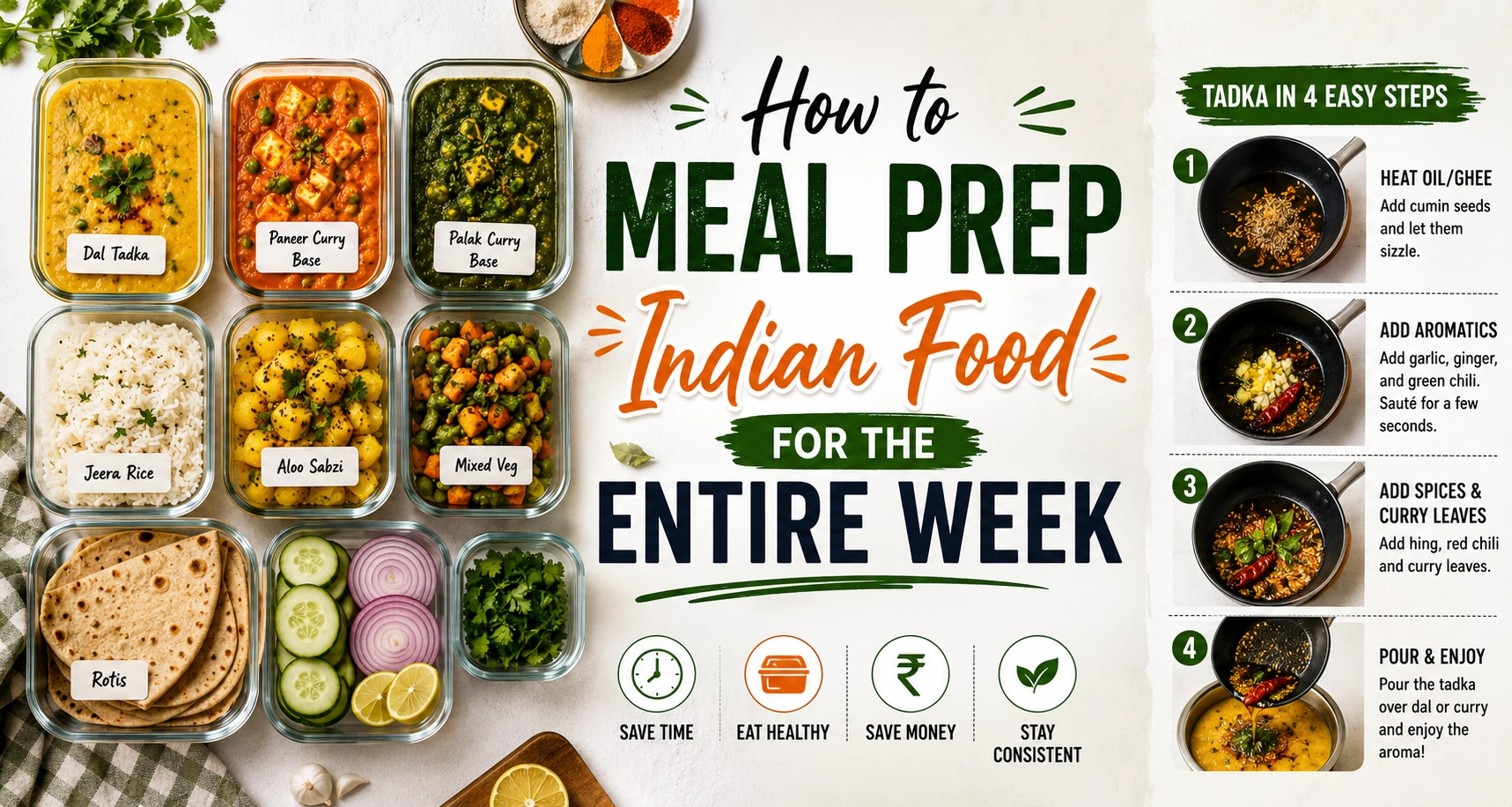
Indian food has a genuine advantage that most meal prep guides overlook: it actually improves with a day or two of rest. Dal, rajma, and most gravies taste more cohesive after the spices have had time to settle in — which makes Indian cuisine unusually well-suited to batch cooking, once you prep it the right way.
Quick answer: The most efficient way to meal prep Indian food is to cook in modular components — a base dal, a curry gravy, a batch of rice or rotis, and a couple of proteins — rather than fully assembled dishes. Spend 2–3 hours on a Sunday cooking these components, store them separately in airtight containers, and mix and match them into different meals through the week. Most dals and gravies keep well in the fridge for 4–5 days and in the freezer for 2–3 months.
Why the Modular Method Works Better Than Prepping Full Meals
The mistake most people make when they first try meal prepping Indian food is cooking seven complete, finished dishes on Sunday — which sounds efficient but actually locks you into eating the exact same thing every day, and some components (rice, tempering) genuinely don’t hold up as well pre-assembled.
The better approach treats Indian cooking the way it’s naturally built: from separate parts. A base dal, a curry gravy, cooked rice, roti dough, and one or two proteins can be recombined into several different meals across the week just by varying the pairing — chana masala with rice one day, the same gravy turned into a paneer curry the next, rotis with a fresh sabzi another day. You get real variety from a small number of prepped components, rather than seven identical containers.
Container Guide: What You Actually Need
| Container Type | Best For | Why |
|---|---|---|
| Glass containers with airtight lids | Curries, dals, gravies | Microwave-safe, resists turmeric staining, doesn’t hold onto smells |
| Compartmentalized tiffin boxes | Packed lunches | Keeps components separate so nothing goes soggy |
| Zip-lock freezer bags | Chopped vegetables, roti dough, curry paste | Flat freezing saves space and thaws quickly |
| Small steel or silicone containers | Single-serving frozen curry bases | Easy to thaw exactly what you need without waste |
| Parchment or butter paper | Between stacked rotis/parathas | Prevents sticking when frozen or refrigerated |
A mix of glass (for anything going straight into the microwave) and good-quality BPA-free plastic (for freezer storage) covers most needs — you don’t need to buy an entire specialty system to get started.
A 3-Hour Sunday Prep Plan
Hour 1 — Get the slow-cooking items going Start a big batch of dal or rajma in a pressure cooker or Instant Pot — this needs the least hands-on attention, so let it run while you move to the next step.
Hour 2 — Chop, cook the base, and prep proteins While the dal cooks, chop vegetables for the week (store dry, wrapped with a paper towel to absorb moisture) and build an onion-tomato curry base you can split across two or three different dishes. Boil or pan-cook your proteins for the week — paneer, tofu, chickpeas, or chicken — so they’re ready to drop into whatever you’re making.
Hour 3 – Rice, Rotis, and Portioning: Prepare a large quantity of rice and portion into eating sized containers. Make the roti dough and partially cook the dough (about 90%) and then finish cooking it fresh on the tawa or freeze the roti dough in small portions. Wait until the rice and rotis have come to room temperature before sealing the containers as steam may be trapped and the rice may get moist and lose freshness.
How Long Indian Food Actually Stays Good
| Dish Type | Fridge | Freezer |
|---|---|---|
| Dal, rajma, chana masala | 4–5 days | 2–3 months |
| Curry gravies (base, not yet combined with protein) | 4–5 days | 2–3 months |
| Cooked rice | 3–4 days | 1 month |
| Rotis/parathas (stacked with parchment) | 3–4 days | 2 weeks |
| Dry sabzi (stir-fried vegetables) | 3 days | Not recommended — texture suffers |
| Raita, fresh chutneys | 2–3 days | Not recommended |
Rice dishes are best stored separately from curries when possible — rice sitting in gravy over several days tends to turn mushy faster than the two stored apart and combined fresh.
A Sample 5-Day Meal Rotation From One Prep Session
- Monday: Dal tadka + jeera rice + stir-fried bhindi (freshly made from prepped, chopped vegetables)
- Tuesday: Curry base turned into aloo matar + roti + cucumber raita
- Wednesday: Same curry base turned into paneer curry + rice
- Thursday: Rajma + rice + fresh salad
- Friday: Roti wraps with paneer bhurji (made from prepped paneer and spices) + pickle
Notice the same two or three base components — dal, one curry gravy, rice, roti — show up across almost every meal, just recombined differently. That’s the entire trick to modular Indian meal prep.
The Tadka Trick: Making Prepped Food Taste Freshly Made
Even food that’s a few days old can taste freshly cooked with one simple habit: make a fresh tadka (tempering) right before serving. A quick sizzle of ghee or oil with cumin seeds, mustard seeds, and curry leaves, poured over reheated dal or sabzi, revives the aroma and flavor in under two minutes — it’s a small step that makes a genuinely noticeable difference.
Reheating Tips
- Curries and Dal: Reheat over medium low heat, add a little water if necessary, on the stove to get the best texture and taste. This method of reheating gravies is usually more effective than reheating in the microwave.
- Rice: sprinkle a little water before microwaving to prevent it from drying out.
- Rotis and parathas: reheat directly on a hot tawa rather than the microwave for a texture closer to freshly made.
- Dry sabzis: reheat gently and briefly — these lose texture fastest with repeated reheating, so eat them earlier in the week rather than saving them for day five.
Common Meal Prep Mistakes to Avoid
- Sealing containers while food is still hot. This traps steam and condensation, which speeds up spoilage and can affect texture.
- Storing rice mixed into curry rather than separately. They keep better and taste fresher combined right before eating.
- Over-preparing dry sabzis for the whole week. These hold up the worst of any Indian dish type — cook these more frequently in smaller batches rather than a week’s worth at once.
- Skipping labels. A container of unlabeled gravy in the freezer becomes a guessing game by week three — a simple strip of tape with the dish and date solves this entirely.
- Trying to prep too many different dishes in one session. Start with two or three base components (one dal, one curry base, rice or roti) rather than attempting a full week of distinct dishes on your first attempt.
Adjusting the System for Your Household
The 3-hour plan above assumes cooking for 2–3 people; scale batch sizes up or down based on your household rather than the number of containers. For a single person, cooking the same components in smaller quantities but stretching them across a longer window (5–6 days instead of a strict 5-day rotation) often works better than halving every recipe, since some dishes are genuinely easier to cook well in a slightly larger batch. For a larger family, consider splitting prep into two shorter sessions — one on Sunday for dal, curry base, and proteins, another quick 30-minute session midweek to refresh rice and rotis — rather than trying to cook an entire week’s grains and breads in one sitting, which tends to strain both your schedule and your fridge space.
If you have household help available, dividing tasks (someone chopping vegetables while another manages the stovetop) can cut the total prep time meaningfully, but even solo, the modular method scales down fine — just plan for slightly more frequent rice and roti batches rather than one large weekly cook.
Frequently Asked Questions
Q.1 How long does Indian food actually last in the fridge?
Most dals, curries, and gravies stay good for 4–5 days refrigerated in an airtight container. Dry sabzis and fresh accompaniments like raita have a shorter window, generally 2–3 days.
Q.2 Can Indian curries be frozen?
Yes — dal, rajma, chana masala, and most gravy-based curries freeze well for 2–3 months. Dry sabzis and raita don’t freeze well and are better cooked fresh or in smaller batches.
Q.3 What’s the best container for Indian meal prep?
A mix works best: glass containers with airtight lids for anything reheated in the microwave (they resist turmeric staining), and freezer-safe zip-lock bags or small containers for anything going into the freezer.
Q.4 How much time does Indian meal prep actually take?
Most people can prep a full week of modular components — a dal, a curry base, rice, and roti dough — in about 2–3 hours on a weekend, with the biggest time-saver being cooking the dal or rajma while chopping and prepping other components in parallel.
Q.5 Should I freeze rotis or keep them refrigerated?
Both work, but freezing extends freshness significantly longer — stacked with parchment paper between each one, frozen rotis stay good for about two weeks, compared to 3–4 days refrigerated.
Conclusion
Meal prepping Indian food doesn’t mean eating the same container of leftovers five days in a row. Cook in modular components — a dal, a curry base, rice, and roti — store them separately, and recombine them into different meals throughout the week with the help of a fresh tadka. For more balanced meal ideas to build into your rotation, check out our guide to 7 Healthy & Easy Indian Breakfast Recipes, or explore the full Indian Nutrition & Diet Guide.