

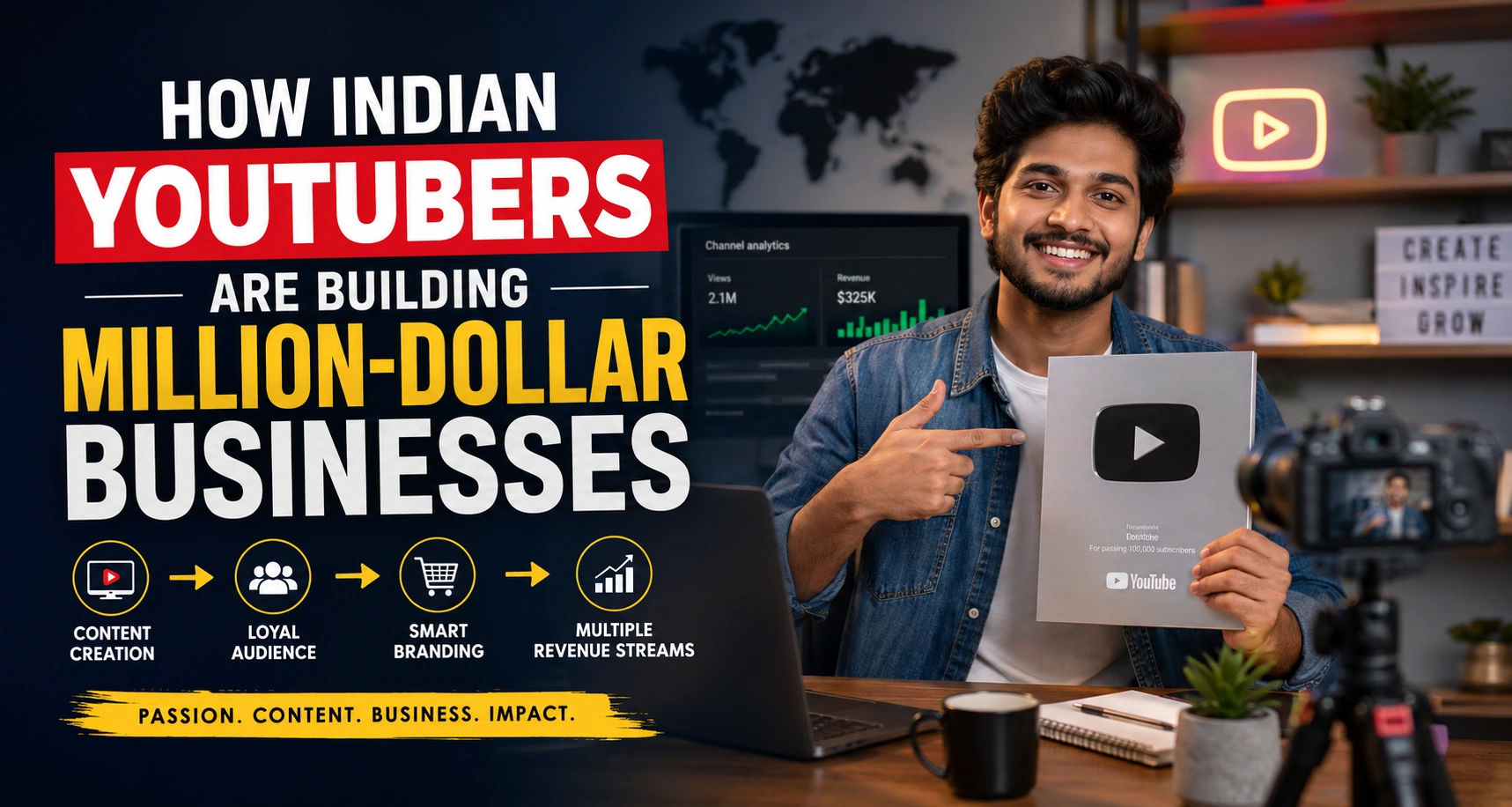
India has one of the largest YouTube audiences in the world, and one of the lowest ad rates — Indian CPMs typically run at a fraction of what US creators earn for the same view count. By pure ad revenue math, that should make India a tough place to build serious creator wealth. Instead, some of the country’s biggest YouTubers have built genuinely large businesses anyway, by treating YouTube as a distribution channel rather than the business itself.
Quick answer: Successful Indian YouTubers build million-dollar businesses primarily by diversifying beyond YouTube ad revenue into brand sponsorships (often their largest single income stream), branded products or courses, OTT and music deals, merchandise, and in some cases direct startup investments. Ad revenue alone rarely accounts for the bulk of a top Indian creator’s earnings — it functions more as the audience-building engine that makes everything else possible.
Why Ad Revenue Alone Doesn’t Explain These Businesses
India’s YouTube economics make the diversification strategy almost a necessity rather than a choice. Indian CPMs generally range from roughly ₹40–₹150 per 1,000 views, compared to rates 5–10 times higher in the US for equivalent view counts — meaning an Indian creator with US-scale viewership still earns a fraction of what a comparable American channel makes from ads alone. Niche matters significantly within that range too: finance and business-focused channels reportedly command notably higher ad rates than general entertainment content, since financial advertisers pay a premium for that audience.
This gap is exactly why the creators who’ve built the largest businesses in India didn’t get there through ad revenue growth alone — they got there by using their audience as a distribution engine for other revenue streams entirely.
The Revenue Diversification Pattern
| Revenue Stream | What It Looks Like | Why It Matters |
|---|---|---|
| YouTube ad revenue (AdSense) | Payments based on ad impressions and views | The foundation, but rarely the largest single income source for top creators |
| Brand sponsorships | Paid product integrations within videos | Frequently the largest single revenue stream — top-tier creators reportedly command roughly ₹50 lakh–₹1.5 crore per integration |
| Owned products/courses | Self-hosted courses, workshops, or paid content | Removes the platform middleman entirely; margins can be substantial at scale |
| OTT, music, and media deals | Web series, music releases, streaming platform content | Extends a creator’s reach and revenue beyond YouTube’s ecosystem |
| Merchandise | Branded apparel and products sold to a loyal audience | Works best for creators with strong personal brand identity |
| Startup investment or ownership | Equity stakes or ownership in businesses adjacent to their content | Turns audience trust into longer-term wealth beyond content income |
How This Plays Out: Real Creator Examples
A few well-known Indian creators illustrate different versions of this same underlying pattern:
Bhuvan Bam (BB Ki Vines) built his initial audience through solo multi-character comedy sketches, then expanded into music releases, an OTT web series, and brand partnerships with major FMCG and lifestyle companies. His story is a clear example of the “compound consistency” pattern — no single deal explains the scale of the business; it’s the accumulation of multiple revenue streams built on a long-running, loyal audience.
Gaurav Chaudhary (Technical Guruji) identified an underserved niche early — serious tech and gadget reviews in Hindi, at a time when few creators were doing that seriously — and built a business around YouTube ad revenue, brand sponsorships, and international tech partnerships. His example highlights how spotting a genuine content gap, rather than competing in an already crowded niche, can be a durable long-term advantage.
Sandeep Maheshwari represents a distinctly different model: rather than treating YouTube ad revenue as a primary income source, he built a business around paid self-help and business courses and large seminars, sold directly to an audience built through free YouTube content. In this model, YouTube functions almost entirely as a marketing funnel for a separate, higher-margin education business.
Tanmay Bhat rebuilt his public career after the shutdown of his earlier venture (AIB) into a broader media business — spanning comedy content, digital media production, reaction and commentary content, and reported involvement in startup investing and brand strategy work. His case illustrates a creator functioning more as a media entrepreneur who happens to also produce YouTube content, rather than a YouTuber first.
Samay Raina built a large following through a genuinely unconventional niche — chess content and live streaming — growing from a stand-up comedy background into one of India’s most-watched streamers, with sponsorships, merchandise, and affiliate earnings cited as major revenue sources. His trajectory is a useful reminder that niche selection in the creator economy doesn’t have to follow an obvious, already-proven category to work.
Net worth and earnings figures for these creators vary significantly across publicly available sources — some estimates for the same individual differ by more than 50%. Treat the ranges above as broadly indicative of scale, not precise, verified figures.
What These Creators Have in Common
A few patterns show up consistently across successful Indian creator businesses, regardless of niche:
- YouTube is the top of the funnel, not the whole business. The creators with the largest total earnings consistently treat their channel as an audience-building tool feeding other revenue streams, not as the primary product.
- Niche selection matters more than most beginners assume. Whether it’s an underserved category (tech reviews in Hindi) or an unconventional one (chess streaming), differentiated content tends to build more durable, loyal audiences than crowded, copycat niches.
- Consistency compounds. Several of these creators built their initial audience over years, not months — long-running channels with sustained upload consistency show up repeatedly among India’s highest earners.
- Direct-to-audience products carry the best margins. Courses, own products, and owned media (rather than pure ad-dependent content) let creators capture more value per audience member than advertising alone ever could.
- Brand trust becomes a genuine business asset. Once a creator has built real audience trust, that trust becomes monetizable well beyond traditional sponsorships — from product lines to startup equity.
What Aspiring Creators Can Learn From This
- Don’t wait for ad revenue to fund your ambitions. Most large Indian creator businesses were built despite ad revenue limitations, not because of generous ad rates — plan your monetization strategy assuming diversification from early on, not as an afterthought once you’re already large.
- Pick a niche you can own, not just one that’s popular. A smaller, well-defined audience that trusts you deeply is often more monetizable than a larger, more generic one.
- Think about what you can sell directly, not just what you can advertise. A course, product, or service tied to your content’s expertise tends to scale better long-term than sponsorship income alone.
- Expect it to take years, not months. Nearly every example in this piece involved years of consistent output before the business side scaled meaningfully.
Frequently Asked Questions
Q.1 Do Indian YouTubers actually make most of their money from YouTube ads?
Generally, no — for top-tier Indian creators, brand sponsorships, owned products, and other ventures typically account for a larger share of total earnings than YouTube ad revenue alone, given India’s comparatively low CPM rates.
Q.2 Why do Indian YouTubers earn less from ads than American YouTubers with similar views?
Indian CPM (cost per thousand views) rates are significantly lower than US rates — often 5–10 times lower for comparable content — which is a structural feature of the Indian digital advertising market, not a reflection of audience size or content quality.
Q.3 What’s the most common way Indian YouTubers scale their income beyond ads?
Brand sponsorships are frequently the largest single revenue stream, but owned products and courses, OTT and music deals, and merchandise are the most common ways creators build a more diversified, higher-margin business over time.
Q.4 Is niche selection really that important for YouTube income in India?
Yes, meaningfully — finance and business-focused content reportedly commands substantially higher ad rates than general entertainment content due to advertiser demand, and a well-chosen, underserved niche can also build a more loyal, monetizable audience than a crowded category.
Q.5 How long does it typically take to build a significant YouTube-based business in India?
Most of the creators commonly cited as top earners built their audiences over several years of consistent content before their businesses reached significant scale — this is generally a long-term compounding process, not a fast path to income.
Conclusion
The Indian creators building genuinely large businesses on YouTube aren’t primarily winning through ad revenue — they’re winning by treating their channel as the foundation for a broader media business: sponsorships, owned products, and ventures that extend well beyond the platform itself. For creators or aspiring creators studying these patterns, the throughline is consistent: build a loyal, well-defined audience first, then diversify revenue deliberately rather than waiting for YouTube’s own economics to make you wealthy. For another creator-economy business model built on very different fundamentals, see our piece on the MrBeast Business Model, or explore the full Biography & Success Stories Guide.