

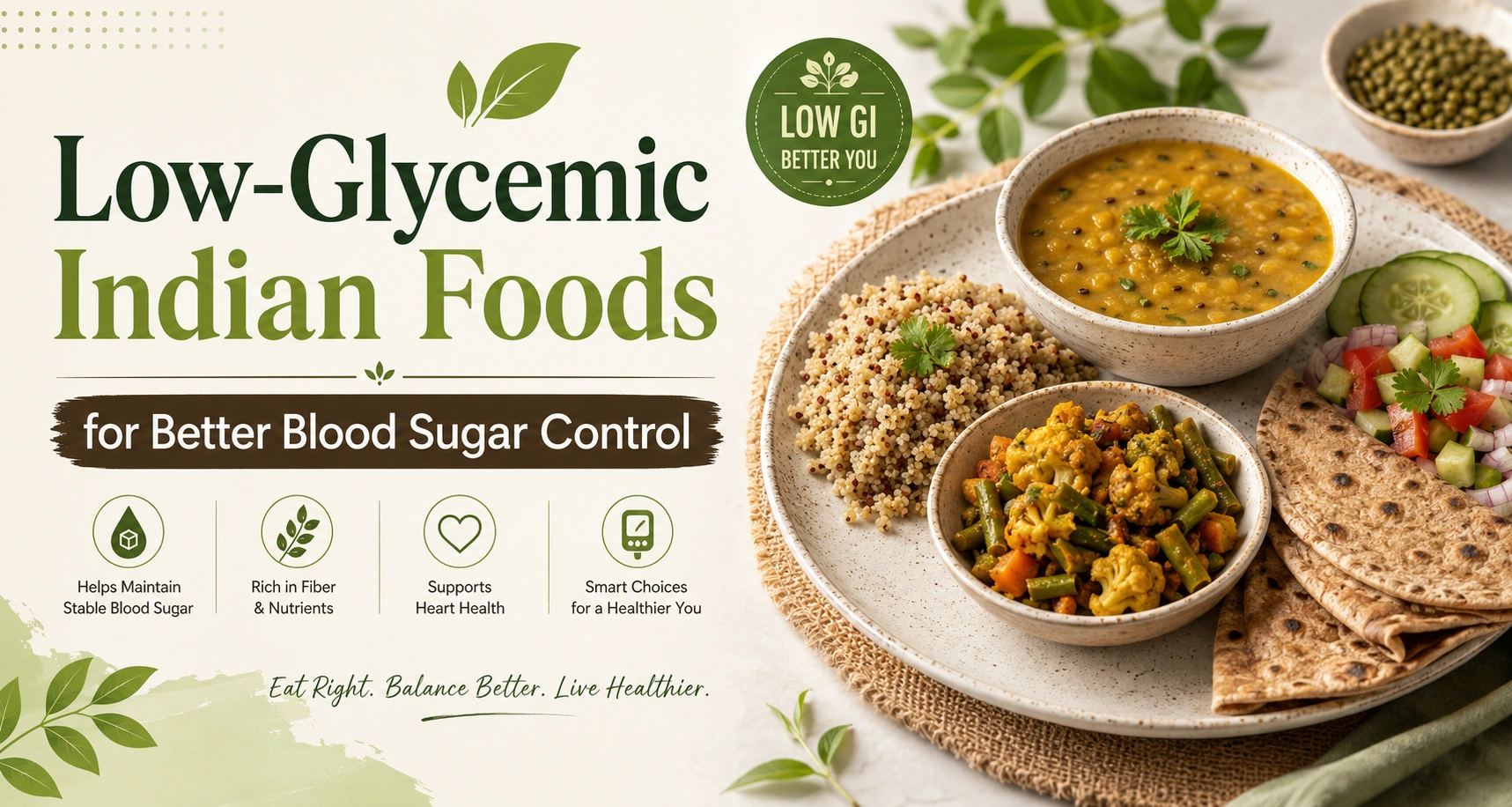
The same plate of food can affect two people’s blood sugar completely differently — but there’s a genuinely useful, well-studied tool for predicting how a food is likely to behave: the glycemic index. And the good news for anyone eating an Indian diet is that some of the most traditional staples — dals, whole grains like jowar and bajra, most vegetables — already sit comfortably in the low-GI range.
Quick answer: Low glycemic Indian foods include most lentils and dals (moong, chana, urad), whole grains like jowar, bajra, and oats, non-starchy vegetables, paneer, and most whole fruits eaten in moderation. These digest slowly and release glucose gradually, which helps avoid the sharp blood sugar spikes associated with high-GI foods like white rice, maida-based items, and sugary drinks. Foods with a GI of 55 or below are considered low GI, 56–69 is moderate, and 70+ is high.
This article is for general informational purposes and isn’t medical or dietary advice. If you have diabetes, prediabetes, or another condition affecting blood sugar, work with a doctor or registered dietitian to build a plan suited to your specific situation.
What the Glycemic Index Actually Measures
The glycemic index (GI) is a tool that is used to compare how fast the carbohydrates in a food increase blood sugar levels with the effect of pure glucose (which is given the score of 100). Foods are normally classified into three bands:
| GI Range | Category | What It Means |
|---|---|---|
| 0–55 | Low GI | Digests slowly, causes a gradual blood sugar rise |
| 56–69 | Moderate GI | Digests at a moderate pace |
| 70–100 | High GI | Digests quickly, can cause a sharp blood sugar spike |
It’s worth understanding one important limitation upfront: GI only tells you how fast a food raises blood sugar, not how much, because it doesn’t account for portion size. That’s where glycemic load (GL) comes in — it factors in both the GI and the actual carbohydrate content of a typical serving. Watermelon, for example, has a relatively high GI but a low GL, since a serving contains relatively few actual carbs — which is why GI alone can be a misleading way to judge a food in isolation.
Low-GI Indian Foods by Category
| Category | Low-GI Options |
|---|---|
| Dals and legumes | Moong dal, chana dal, urad dal, rajma, chickpeas, soybeans |
| Whole grains | Jowar, bajra, ragi, steel-cut oats, quinoa, whole wheat (in moderation) |
| Vegetables | Bhindi, spinach, cauliflower, tomatoes, broccoli, most leafy greens |
| Fruits | Apple, guava, pear (whole fruit, not juiced) |
| Dairy and protein | Paneer, curd/yogurt (unsweetened), eggs |
| Zero-GI foods | Water, most vegetables, meat, fish, eggs (contain no carbohydrates, so GI doesn’t apply) |
GI values can vary based on ripeness, cooking method, and portion size — treat this table as a general planning guide, not exact clinical figures, and check a current GI database for precise values if needed.
What to Limit or Watch Portion Size On
| Food | Why It’s Higher GI |
|---|---|
| White rice | Refined starch digests quickly |
| Maida-based items (white bread, most bakery items) | Highly refined flour with little fiber |
| Sugary drinks and packaged juices | Rapid sugar absorption with no fiber to slow it |
| Potatoes (especially boiled or mashed) | Moderate-to-high GI with a notably high glycemic load |
| Fully ripe bananas and mangoes | GI rises significantly as fruit ripens |
This doesn’t mean these foods are strictly off-limits — portion size, pairing, and preparation method all meaningfully change their real-world impact, which is the next section’s focus.
Practical Ways to Lower the Glycemic Impact of Your Meals
- Pair high-GI foods with protein, fat, or fiber. Rice eaten alongside dal and vegetables digests more slowly than rice eaten alone — this is a big part of why traditional Indian thali-style meals, when portioned sensibly, tend to work better for blood sugar than a single starch-heavy dish.
- Choose whole grains over refined ones. Swapping white rice for brown rice, or maida roti for jowar or bajra roti, meaningfully lowers the glycemic impact of a meal.
- Mind ripeness with fruit. A slightly under-ripe fruit generally has a lower GI than a fully ripe one — this is a small but real lever, especially for bananas and mangoes.
- Don’t skip fiber-rich vegetables. Adding a fiber-dense vegetable side to any meal slows overall digestion and blunts the blood sugar response of the rest of the plate.
- Watch portion size even with low-GI foods. Glycemic load matters — a large portion of a low-GI food can still meaningfully raise blood sugar; GI describes speed, not total impact.
Low-GI Indian Breakfast Options
Most people unwittingly begin the day with a blood sugar surge at breakfast — for example, refined-flour parathas, sugary cereal or white bread toast. Some low-GI options that make for a good Indian breakfast:
- Moong dal chilla — protein-rich, made from ground lentils, a genuinely strong low-GI breakfast option.
- Vegetable upma made with steel-cut oats — swaps refined semolina for a slower-digesting grain base.
- Multigrain or jowar/bajra roti with vegetable sabzi — a traditional, filling option with meaningfully better glycemic impact than a maida-based paratha.
- Besan (chickpea flour) cheela — another lentil-flour-based option, naturally high in protein and fiber.
- Curd with a small portion of fruit and nuts — simple, low-effort, and gentle on blood sugar compared to sweetened cereal or juice.
A Sample Low-GI Day (For Planning Reference)
| Meal | Example |
|---|---|
| Breakfast | Moong dal chilla with mint chutney |
| Mid-morning | A small apple or a handful of soaked almonds |
| Lunch | Multigrain roti, chana dal, a vegetable sabzi, and a side salad |
| Evening | Roasted chana or a small bowl of curd |
| Dinner | Jowar roti with palak paneer and a cucumber salad |
This is a general planning template, not a prescribed diet — actual portions and food choices should be adjusted to your individual health needs, ideally with guidance from a doctor or dietitian, particularly if you’re managing diagnosed diabetes or prediabetes.
Common Mistakes People Make With Low-GI Eating
- Relying on GI alone and ignoring portion size. A large serving of a low-GI food can still meaningfully raise blood sugar — glycemic load, which accounts for quantity, matters just as much.
- Assuming all low-GI foods are automatically healthy. Some low-GI foods (certain fried snacks, for instance) are still poor overall choices despite a lower GI ranking — GI is one factor among several, not the only one.
- Eating starches in isolation. A plain bowl of white rice digests very differently from the same rice eaten alongside dal, vegetables, and a protein source.
- Overcorrecting into a very restrictive diet. GI is a useful planning tool, not a reason to eliminate entire food groups — an overly narrow diet can create its own nutritional gaps.
- Ignoring how cooking method changes GI. Overcooking starchy foods (very soft rice or overcooked pasta, for example) tends to raise their glycemic impact compared to a firmer preparation.
Frequently Asked Questions
Q.1 What is considered a low glycemic index food?
A food with a GI value of 55 or below is generally considered low GI. These digest more slowly and cause a more gradual rise in blood sugar compared to moderate (56–69) or high (70+) GI foods.
Q.2 Is rice bad for blood sugar control?
White rice has a relatively high GI, but its overall impact can be moderated by portion size and pairing it with protein, fat, and fiber-rich foods like dal and vegetables — a common feature of traditional Indian thali-style meals.
Q.3 What are good low-GI breakfast options in India?
Moong dal chilla, vegetable upma made with steel-cut oats, multigrain or jowar/bajra roti with sabzi, and besan cheela are all solid low-GI Indian breakfast choices.
Q.4 Is glycemic index enough to plan a diabetic-friendly diet?
Not entirely on its own — glycemic load (which factors in portion size), along with your individual insulin sensitivity, activity levels, and overall diet quality, all matter alongside GI. It’s a useful tool, not a complete diet plan by itself.
Q.5 Can I still eat fruit if I’m watching my blood sugar?
Yes, in moderation — whole fruits like apples, guava, and pears are generally low GI, though ripeness affects their glycemic impact, and fruit juice (which lacks fiber) behaves very differently from whole fruit.
Conclusion
A low-glycemic approach to Indian food doesn’t mean giving up dal, roti, or rice — it means leaning on whole grains, pairing starches with protein and fiber, and being mindful of portion size alongside GI. For more ways to support steady energy and blood sugar through the day, our guide to Best Detox Drinks at Home India is a useful companion, or explore the full Indian Nutrition & Diet Guide.