

Walking into a gym for the first time can feel overwhelming. Rows of machines, heavy barbells, and people who seem to know exactly what they’re doing. Here’s the good news: you don’t need any of that to get stronger. A pair of dumbbells and a little floor space are enough to start changing your body.
This dumbbell exercise program for beginners breaks everything down into plain steps. You’ll learn which moves to do, how many reps to aim for, how to pick the right weight, and how to avoid the mistakes that sideline most newcomers.
Why Dumbbells Are Perfect for Beginners
Dumbbells are one of the most forgiving and flexible tools in fitness. Here’s why they work so well when you’re just starting:
- They’re affordable. A basic adjustable set costs far less than a gym membership.
- They save space. Apartment living? No problem.
- They build balance. Each arm and leg works independently, so your stronger side can’t cover for the weaker one.
- They’re joint-friendly. Dumbbells move naturally with your body, which often feels better on wrists and shoulders than a fixed bar.
- They scale easily. You can go from light to heavy as you progress.
Before You Start: Choosing the Right Weight
Picking a weight is where many beginners go wrong. Too light and you won’t progress. Too heavy and your form falls apart.
Follow this easy rule: select a weight that you can lift for 10-12 reps at the last two reps it is difficult but not impossible.
As a general starting point for adults:
- Women: 5 to 15 lbs for upper body, 10 to 20 lbs for lower body
- Men: 10 to 25 lbs for upper body, 15 to 30 lbs for lower body
These are only rough guides. Everyone’s starting point is different, so trust how the set feels over any chart. If you can only afford one purchase, an adjustable dumbbell set is the smartest option.
The 4-Week Beginner Dumbbell Workout Plan
This plan uses a full-body routine three days a week, such as Monday, Wednesday, and Friday. Rest days let your muscles recover and grow, so don’t skip them.
The Weekly Schedule
- Day 1: Full-body workout
- Day 2: Rest or a light walk
- Day 3: Full-body workout
- Day 4: Rest
- Day 5: Full-body workout
- Days 6 and 7: Rest, stretching, or easy activity
The Core Dumbbell Exercises
Perform 3 sets of 10–12 reps, resting 60–90 seconds between sets. For the plank, hold for 20–30 seconds and gradually increase the time.
- Goblet Squat — Legs & Glutes: Hold one dumbbell at your chest, squat down with your chest lifted, then drive through your heels to stand.
- Dumbbell Romanian Deadlift — Hamstrings & Glutes: Hold dumbbells in front of your thighs, push your hips back while keeping your back neutral, then squeeze your glutes to stand.
- Dumbbell Chest Press — Chest & Triceps: Lie on a bench or floor, press dumbbells upward from chest level, then lower them slowly.
- One Arm Dumbbell Row — Back & Biceps: Lift dumbbell, while holding onto a bench, towards hip, then slowly lower the weight.
- Dumbbell Shoulder Press — Shoulders & Triceps: Start with dumbbells at shoulder height, press overhead, then slowly return to the starting position.
- Reverse Lunge — Legs & Balance: Hold dumbbells at your sides, step backward into a lunge, then push through your front heel. Do 8–10 reps per leg.
- Plank — Core: Keep your body straight from head to heels, brace your core and glutes, and hold for 20–30 seconds.
How to Progress Week by Week
Progress is what turns a routine into results. This is called progressive overload, and it simply means gradually asking your body to do a little more.
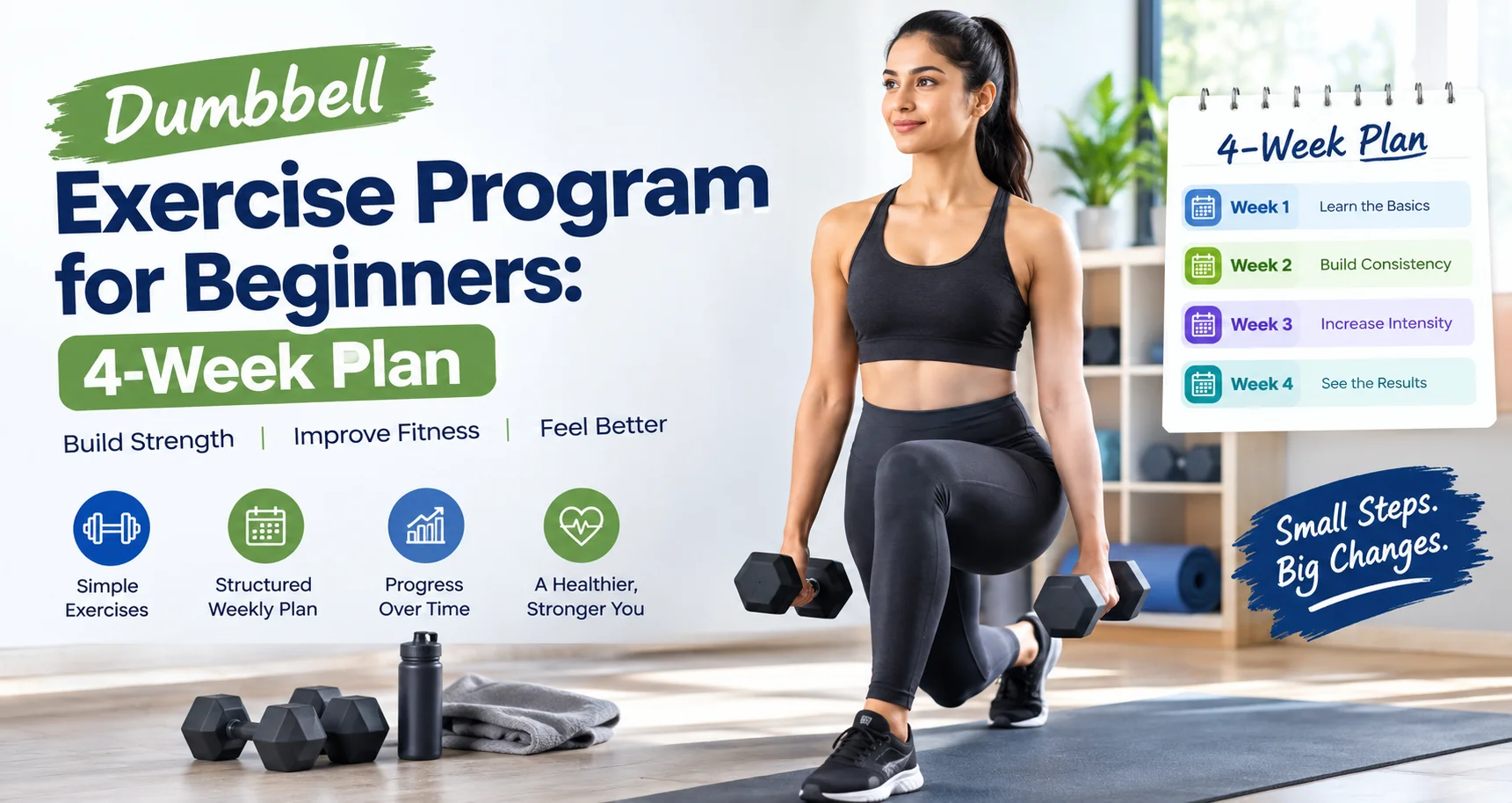
- Week 1: Focus on learning the movements. Use lighter weights and perfect your form.
- Week 2: Add a few reps to each set if the weight feels easy.
- Week 3: Increase the weight by about 2 to 5 lbs.
- Week 4: Aim for the top of the rep range with the heavier weight, then repeat the cycle.
Keep a simple workout log in a notebook or your phone. Seeing your numbers climb is one of the best motivators there is.
Warm-Up and Cool-Down Tips
Spend five minutes warming up before every session. Try arm circles, bodyweight squats, hip hinges, and marching in place. This raises your heart rate and prepares your joints.
Afterward, cool down with gentle stretches for your legs, chest, back, and shoulders. Hold each for 20 to 30 seconds. It won’t magically prevent soreness, but it helps you wind down and stay flexible.
Common Beginner Mistakes to Avoid
Even a great plan can fall short if these habits sneak in:
- Lifting too heavy too soon. Ego lifting is a fast route to injury.
- Rushing through reps. Slow, controlled movement builds more strength.
- Skipping rest days. Muscles grow during recovery, not during the workout.
- Ignoring nutrition and sleep. Protein, whole foods, water, and 7 to 9 hours of sleep matter as much as the workout itself.
Staying Consistent
The best dumbbell exercise program for beginners is the one you actually follow. Start small. Schedule your workouts like appointments. Celebrate small wins, like finishing a full week or adding a rep.
For more practical health and lifestyle ideas, you can explore the latest articles at Magzilla Trends.
Frequently Asked Questions
1. How often should a beginner do dumbbell workouts?
Three non-consecutive days per week is ideal. This gives your muscles at least a day to recover between sessions while keeping you consistent.
2. Is it possible to lose weight using a dumbbell exercise program for beginners?
Yes. Weight training increases lean muscle mass and consequently helps to burn more calories when sitting on the couch. For optimal fat burning, team up your exercise regimen with a healthy eating plan, plus walking.
3. How many dumbbells do I need to start?
Two pairs are plenty: a lighter pair for shoulders and arms, and a heavier pair for legs and back. An adjustable set covers both in one purchase.
4. How long does it take to see results?
Most people notice improved strength and energy within 3 to 4 weeks. Visible changes in muscle tone usually appear after 8 to 12 weeks of steady training and good nutrition.
5. Is it safe to do dumbbell exercises without a trainer?
For most healthy adults, yes, provided you start light and prioritize form. Watch tutorial videos, practice in front of a mirror, and talk to your doctor first if you have injuries or health conditions.
Conclusion
You don’t need a fancy gym or years of experience to get stronger. With a pair of dumbbells, three short workouts a week, and a willingness to progress slowly, you can build strength, boost your energy, and feel more confident in your body.
Begin with the plan above, maintain good posture and take your time. You will thank yourself for starting today!