

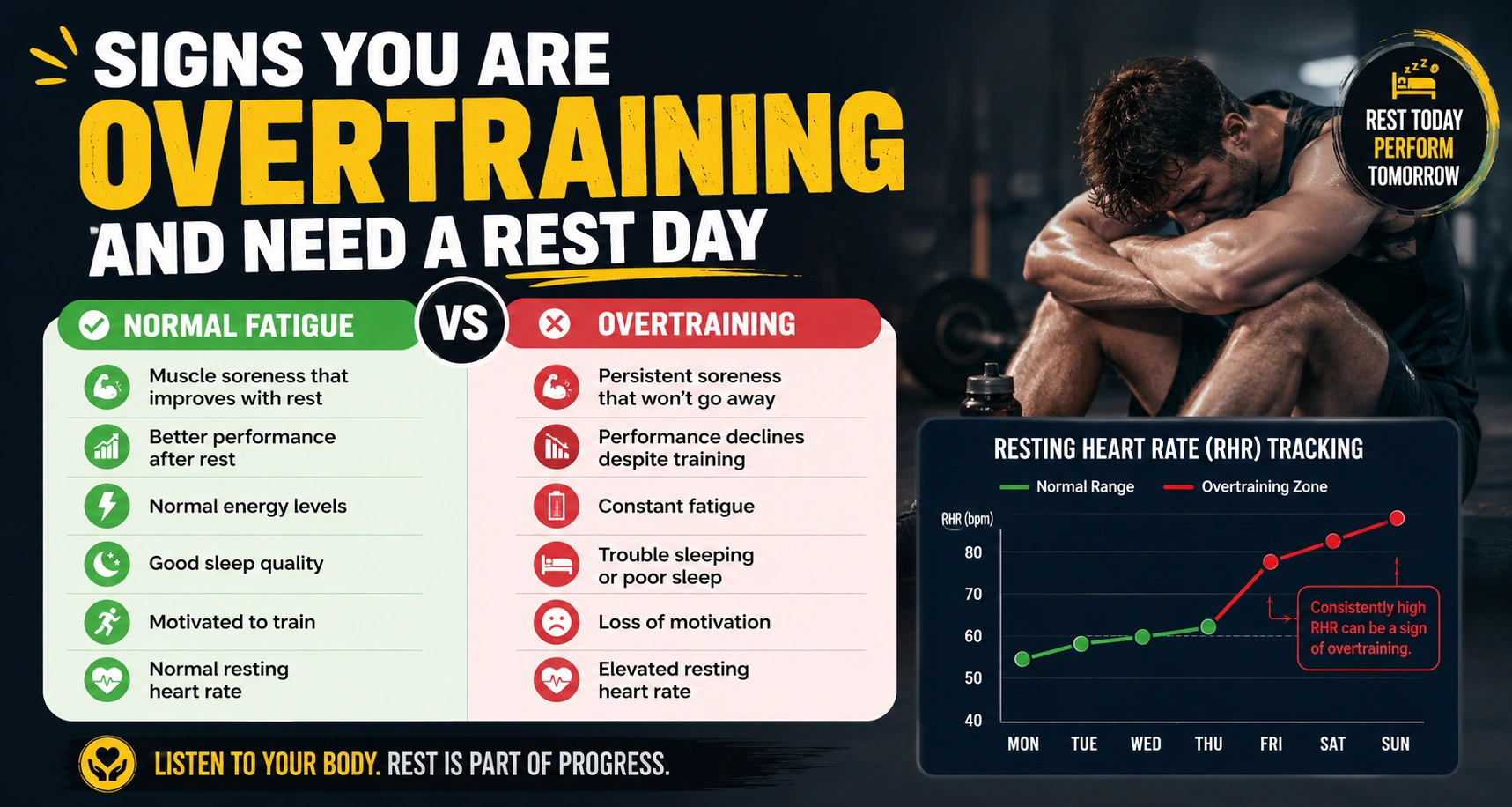
“No pain, no gain” is bad advice more often than people realize. Push past ordinary muscle soreness for long enough, without giving your body real recovery time, and you don’t get faster progress — you get overtraining syndrome, a condition where continuing to train harder actually makes your performance worse, not better.
Quick answer: Key signs of overtraining include performance that’s declining instead of improving despite consistent training, fatigue that doesn’t resolve with a day or two of rest, disrupted sleep, elevated resting heart rate, mood changes like irritability or low motivation, and getting sick more often than usual. The core difference from normal workout fatigue: ordinary soreness resolves within 24–72 hours, while overtraining symptoms persist for weeks and don’t improve with a single rest day.
Normal Fatigue vs. Overtraining: How to Tell the Difference
This is the distinction most people miss, and it matters because the two require completely different responses.
| Factor | Normal Training Fatigue | Overtraining Syndrome |
|---|---|---|
| Duration | Resolves in 24–72 hours | Persists for weeks, sometimes months |
| Response to rest | A day or two of rest fixes it | Doesn’t improve with short rest periods |
| Performance | Continues to improve over time | Plateaus or actively declines |
| Mood | Normal, maybe mildly tired | Irritability, low motivation, flatness |
| Sleep | Generally unaffected | Disrupted, even when exhausted |
| Illness frequency | Normal | Noticeably more frequent |
If what you’re feeling resolves with a rest day or two, that’s ordinary fatigue — a normal, expected part of training. If it doesn’t, and it’s been building for weeks, that’s a different problem entirely.
The Two Stages: Overreaching and Overtraining Syndrome
Overtraining syndrome doesn’t usually appear overnight. It typically develops in two stages:
Stage 1 — Overreaching: You feel unusually intense soreness after several consecutive hard training days, but you push through and keep training instead of backing off. Overreaching alone is often reversible within a week or two of easier training, and many athletes cycle through short overreaching periods intentionally as part of structured training blocks.
Stage 2 — Overtraining syndrome (OTS): If overreaching continues without proper recovery, it can progress into full overtraining syndrome — a more serious, longer-lasting condition that doesn’t resolve with a few easy days and can take weeks to months to fully recover from.
10 Signs You Might Be Overtraining
| Sign | What It Looks Like |
|---|---|
| Performance decline | Weights feel heavier, times get slower, despite consistent training |
| Persistent fatigue | Tiredness that doesn’t lift after a normal night’s sleep |
| Elevated resting heart rate | Your morning resting heart rate is noticeably higher than your usual baseline |
| Disrupted sleep | Trouble falling or staying asleep, despite feeling exhausted |
| Mood changes | Irritability, flatness, or unusually low motivation to train |
| Frequent illness | Catching colds or infections more often than normal |
| Extended muscle soreness | Soreness that lingers well past the usual 24–72 hour window |
| Heavy, unresponsive legs | Legs feel dense or sluggish even during lower-intensity sessions |
| Overuse injuries | Shin splints, tendon pain, or joint issues appearing or worsening |
| Loss of appetite or unintentional weight change | Reduced hunger, or noticeable weight change without a diet change |
A single one of these on its own usually isn’t cause for concern — everyone has a rough training week occasionally. Several of these together, persisting for more than a couple of weeks, is the pattern worth taking seriously.
What Causes Overtraining
Overtraining isn’t only about training too much — it’s about training that consistently outpaces your body’s ability to recover, which can stem from a few different directions:
- Too much volume or intensity, too soon. Rapidly increasing training load without a gradual buildup is one of the most common triggers.
- Not enough rest days between hard sessions. Training the same muscle groups or energy systems hard, repeatedly, without adequate recovery windows.
- Inadequate nutrition. Not eating enough overall calories, protein, or carbohydrates to support your training load is a frequently overlooked contributor — recovery needs fuel, not just rest.
- Poor sleep. Sleep is when most physical recovery and adaptation actually happens; consistently short sleep undermines recovery even when training itself is well-structured.
- Life stress outside of training. Work stress, poor sleep, and emotional strain all add to your body’s total stress load — training doesn’t happen in isolation from the rest of your life.
Preventing Overtraining Before It Starts
Prevention is far easier than recovery, and it mostly comes down to structure rather than willpower:
- Follow a periodized training plan that alternates harder and easier weeks, rather than training at maximum intensity every single session.
- Schedule rest days as non-negotiable, not optional. Treat a planned rest day with the same commitment as a planned workout, rather than skipping it whenever motivation is high.
- Increase training volume or intensity gradually. A common guideline is limiting weekly increases to a modest percentage rather than large jumps, giving your body time to adapt.
- Monitor how you feel, not just what’s on the calendar. If a workout that used to feel manageable suddenly feels unusually hard for several sessions in a row, that’s worth listening to before it becomes a bigger problem.
How to Recover From Overtraining
- Reduce training volume and intensity significantly, don’t just take one day off. A single rest day helps ordinary fatigue; true overtraining generally needs a deload period of reduced training lasting one to several weeks, depending on severity.
- Prioritize sleep. Aim for consistent, adequate sleep — this is where most of the actual physical recovery happens, and it’s often the most neglected variable.
- Eat enough to support recovery. Make sure you’re getting adequate calories, protein, and carbohydrates — under-eating relative to your training load is a common, fixable contributor to overtraining.
- Add active recovery, not complete inactivity. Light walking, gentle mobility work, or easy Zone 2-style cardio can support recovery better than doing absolutely nothing, without adding meaningful additional stress.
- Track your resting heart rate and mood, not just your workouts. A consistently elevated morning heart rate or persistently low mood are useful early-warning signals that recovery isn’t yet complete.
- Reintroduce training gradually. Once symptoms improve, ease back into your previous training load over one to two weeks rather than jumping straight back to where you left off.
How Long Does Recovery Take?
This varies significantly by severity. Mild overreaching often resolves within one to two weeks of reduced training. Full overtraining syndrome is a different matter — recovery timelines commonly range from several weeks to a few months, depending on how long the overtraining pattern continued before it was addressed. This is exactly why catching the early signs matters: the earlier you back off, the shorter your recovery period tends to be.
When to See a Doctor
Most cases of overreaching resolve with self-managed rest, nutrition, and sleep adjustments. It’s worth seeing a doctor if you experience a significant, unexplained performance decline that doesn’t improve after two or more weeks of reduced training, persistent mood changes or symptoms of depression, an unusually high resting heart rate that doesn’t come down, or missed menstrual cycles — since some of these symptoms can overlap with other medical conditions that deserve proper evaluation rather than a guess.
Frequently Asked Questions
Q.1 How is overtraining different from normal workout soreness?
Normal soreness typically resolves within 24–72 hours and doesn’t affect your performance long-term. Overtraining symptoms persist for weeks, don’t improve with a day or two of rest, and are usually accompanied by other signs like mood changes, sleep disruption, and more frequent illness.
Q.2 Can I be overtrained even if I’m not a competitive athlete?
Yes. Overtraining syndrome can affect anyone who trains too hard for too long without adequate recovery — you don’t need to be training at an elite level to develop it.
Q.3 Is one rest day enough to recover from overtraining?
For ordinary fatigue, usually yes. For true overtraining syndrome, no — recovery typically requires a more sustained reduction in training volume over one to several weeks, not a single day off.
Q.4 Does diet actually matter for recovering from overtraining?
Yes, significantly. Under-eating relative to your training load — not getting enough calories, protein, or carbohydrates — is a well-documented contributor to overtraining, and correcting it is often part of an effective recovery plan.
Q.5 Should I keep training through symptoms of overtraining?
No. Continuing to train hard while experiencing overtraining symptoms generally prolongs recovery and increases the risk of injury or a more severe, longer-lasting version of the condition.
Conclusion
Overtraining isn’t a sign you’re not tough enough — it’s a sign your recovery hasn’t kept pace with your training. Learn to tell the difference between normal fatigue that resolves in a couple of days and the more persistent pattern of overtraining, and don’t be afraid to scale back when several of these signs show up together. If you’re looking for a lower-intensity way to stay active during a recovery period, our guide to Zone 2 Training is a useful next read, or explore the full Fitness & Workout Guide for more.