

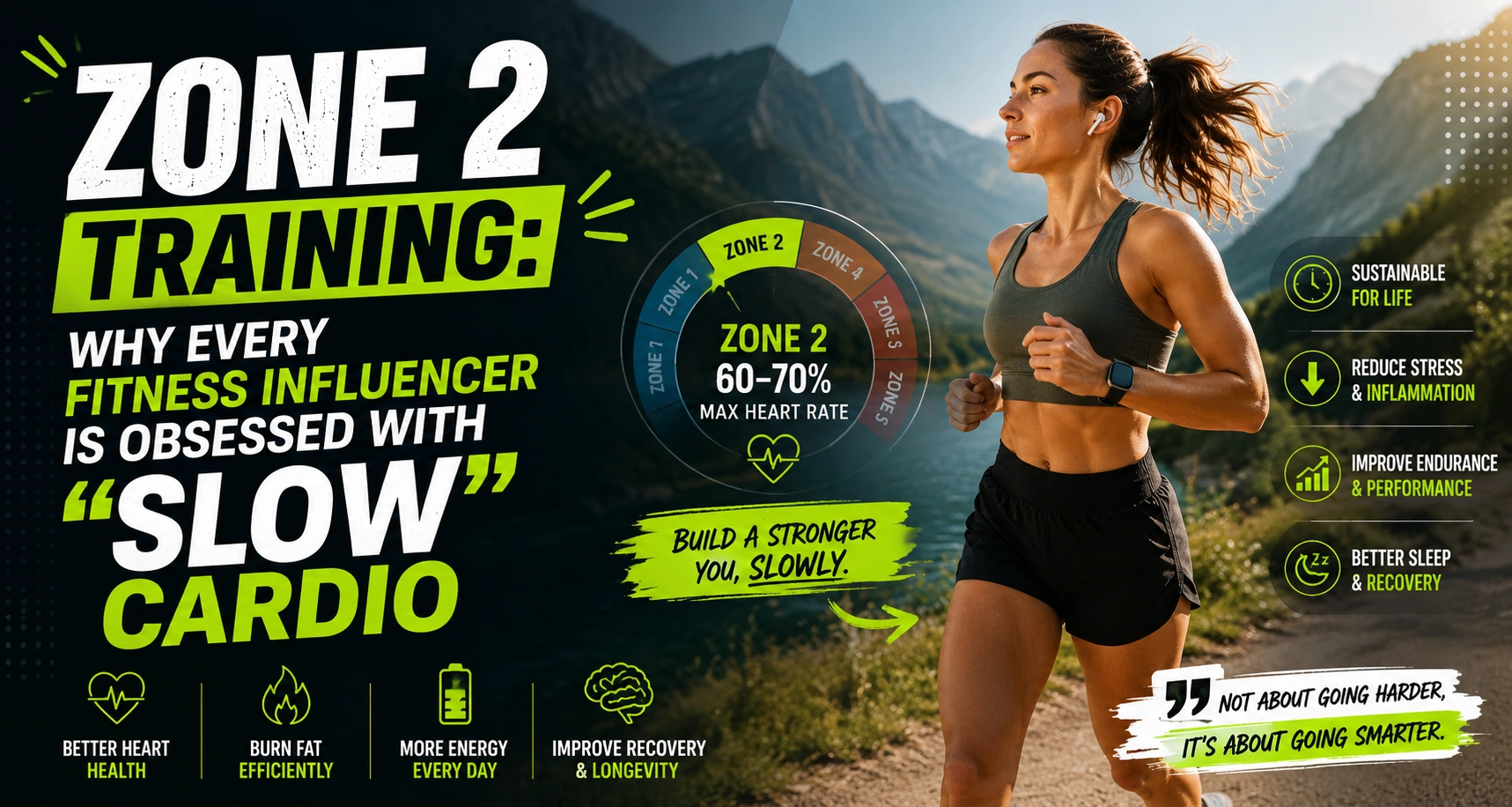
Somewhere between the 6am HIIT class and the guy sprinting intervals at the gym, a quieter revolution has been happening. It involves walking fast, cycling at a comfortable pace, or jogging slowly enough to hold a full conversation — and the people doing it are getting genuinely remarkable results.
Zone 2 training has gone from sports science research labs to mainstream fitness culture faster than almost any other concept in recent memory. Physicians like Dr. Peter Attia have popularised it with a global audience, endurance athletes have sworn by it for decades, and now recreational exercisers in the US, UK, Australia, and Canada are discovering what “slow” cardio actually does to the body.
This guide explains exactly what zone 2 training is, why it works, and how to do it correctly starting this week.
📌 FEATURED SNIPPET TARGET Zone 2 training training is low intensity aerobic training at 60-70% of maximum heart rate where you can hold a full conversation without gasping. Here, your body is using fat as its primary fuel and is adapting to changes in your mitochondria and cardiovascular system that it can’t do as efficiently with higher intensity exercise.
What Is Zone 2 Training? The Five Heart Rate Zones Explained
Exercise physiologists divide cardiovascular intensity into five zones based on percentage of maximum heart rate. Each zone produces different physiological adaptations and uses different fuel sources. Here’s how they map out:
| Zone | % Max Heart Rate | How It Feels | Primary Fuel Source | Talk Test |
|---|---|---|---|---|
| Zone 1 | 50–60% | Very easy — active recovery | Fat (~90%) | Full sentences, easily |
| Zone 2 ★ | 60–70% | Comfortable but purposeful — conversational | Fat (~80–85%) | Can talk in sentences |
| Zone 3 | 70–80% | Moderate — slightly breathless | Fat + carbs (50/50) | Short sentences only |
| Zone 4 | 80–90% | Hard — challenging to sustain | Carbs (~80%) | Single words |
| Zone 5 | 90–100% | Maximum effort — unsustainable | Carbs (~95%) | Cannot speak |
Zone 2 is highlighted because it sits at the sweet spot where fat oxidation is maximised and mitochondrial adaptations — the changes to your cells’ energy-producing engines — are most effectively triggered. It’s intense enough to create a training stimulus but gentle enough to sustain for extended periods without accumulating the kind of cellular stress that requires long recovery.
Your estimated maximum heart rate is approximately 220 minus your age. So a 35-year-old has an estimated max heart rate of 185 bpm, putting their zone 2 target range at roughly 111–130 bpm. For a more precise individual target, consider a lactate threshold test or use the talk test: if you can hold a comfortable conversation in full sentences, you’re in zone 2. If you start losing words, you’ve drifted higher.
Benefits of Zone 2 Training: What the Science Actually Shows
Zone 2 cardio has attracted serious scientific attention over the past decade, and the evidence backing its benefits is unusually strong for a fitness trend. Here’s what the research consistently demonstrates:
- Mitochondrial density increases: Zone 2 training is one of the most potent stimulants for mitochondrial biogenesis — the process by which your body creates new mitochondria and makes existing ones more efficient. More mitochondria means greater capacity to produce energy aerobically, which improves performance at all intensity levels.
- More superior fat oxidation: 80-85% of the energy used is from fat at zone 2 intensity. This makes your metabolic system more efficient at utilising and burning fat reserves, not only during the workout, but throughout the day.
- Cardiovascular adaptation: When you consistently work in zone 2, your stroke volume (the amount of blood you pump out per beat) will increase, which will eventually decrease your resting heart rate and make your heart work more efficiently. This adaptation is the reason for low resting heart rates of endurance athletes.
- Zone 2 cardio for fat loss: Because it can be sustained for long durations and creates minimal recovery debt, zone 2 enables a high total weekly training volume that accumulates significant calorie and fat expenditure without the cortisol spike and appetite disruption that often accompany high-intensity training.
- Reduces cardiovascular disease risk: Low intensity steady state cardio performed consistently is one of the most reliable interventions for reducing resting blood pressure, improving lipid profiles, and lowering VO2 max decline with age.
- Minimal recovery cost: Unlike HIIT sessions that demand 24–48 hours of recovery, zone 2 sessions can be repeated daily if needed. This makes it stackable with strength training without interfering with recovery.
🔬 RESEARCH NOTE: Research published in the Journal of Applied Physiology (2023) confirmed that 4 weeks of consistent zone 2 training produced significant increases in mitochondrial enzyme activity in both trained and untrained participants — independent of the total calorie burn of the sessions. The adaptations are uniquely tied to the specific intensity band, not just the volume of movement.
- For the complete picture, see our fitness guide.
Why Peter Attia Talks About Zone 2 So Often
If you’ve spent any time in the longevity or performance wellness space, you’ll have encountered Dr. Peter Attia’s sustained advocacy for zone 2 training. Attia — a physician and longevity-focused author — has made zone 2 a cornerstone of his framework for long-term health and performance, and his detailed explanations have probably done more to bring the concept to mainstream audiences than any other single source.
“Zone 2 is the training modality that I think gives the most benefit for the least risk over the course of a lifetime. It’s the one thing I would never take out of anyone’s program.” — Dr. Peter Attia, The Drive Podcast
His argument, supported by his collaboration with exercise scientists including Dr. Iñigo San Millán, is that zone 2 training is particularly important for metabolic health — and that most recreational exercisers chronically undertrain it while overtraining the moderate-intensity “zone 3” range that produces inferior adaptations at greater recovery cost.
How to Start Zone 2 Training: A Step-by-Step Guide
Zone 2 training doesn’t require special equipment or gym membership. Here’s how to do it correctly from week one:
- Calculate your zone 2 heart rate range. Use 220 minus your age to estimate your maximum heart rate. Multiply by 0.60 and 0.70 to find the bottom and top of your zone 2 range. Example: a 40-year-old has an estimated max of 180 bpm, and a zone 2 range of 108–126 bpm.
- Get a heart rate monitor or smartwatch. Perceived exertion is useful but unreliable, especially for beginners who tend to push too hard. A chest strap (most accurate) or wrist-based monitor gives you real-time feedback to stay within your zone. Garmin, Apple Watch, and Polar devices all work well for this.
- Choose your activity. Zone 2 training works with walking (brisk), cycling (outdoor or stationary), rowing, swimming, hiking, or light jogging. Choose the activity you can sustain for 30–60 minutes without motivation issues — consistency matters more than the specific mode.
- Start with 3 sessions per week, 30–45 minutes each. Many beginners find this intensity deceptively easy, especially if they’re coming from a HIIT background. Resist the urge to speed up. If your heart rate climbs above your zone 2 ceiling on hills or inclines, slow down or walk.
- Keep the talk test running. Every few minutes, speak a sentence aloud (or in your head if you’re not comfortable talking to yourself in public). Full sentence with comfortable breath = zone 2. Breaking the sentence or losing words = slow down.
- Increase duration gradually. Add 5–10 minutes per week until you reach 45–60 minutes per session. Most research and practitioner recommendations converge on 3 hours of zone 2 per week as the target for meaningful long-term adaptation.
- Track over time. A meaningful metric to track is your pace or speed at the same heart rate over weeks. As your aerobic base builds, you’ll move faster at the same heart rate — a reliable indicator that the mitochondrial adaptations are accumulating.
💡 PRO TIP: If you’ve been doing mostly HIIT or strength training, your first few zone 2 sessions may feel frustratingly slow — you may need to walk or cycle at a pace that feels unproductive. This is normal and temporary. Within four to six weeks, your pace at the same heart rate will increase noticeably as your aerobic system develops.
- Related reading: Top 5 Wearable Health Trackers That Monitor Stress In Real Time.
Common Mistakes to Avoid in Zone 2 Training
❌ COMMON MYTH: “Zone 2 isn’t real exercise — you need to feel the burn.” This is the most common misconception. Zone 2 produces mitochondrial adaptations that HIIT simply cannot replicate as efficiently, and it enables training volumes that high-intensity work cannot sustain without injury or overtraining.
- Drifting into zone 3. This is the most prevalent error. Zone 3 is similar to zone 2, but the adaptations are not as good and recovery requirements are more. It is sometimes referred to as the “grey zone” as it is too easy to be in zone 4 benefits and too difficult to be in zone 2 benefits. This is a problem that a heart rate monitor can fix.
- Doing all cardio in zone 2 and skipping higher-intensity work entirely. Zone 2 is the foundation — ideally making up 80% of total weekly cardio volume. The remaining 20% should include some zone 4 or 5 work for VO2 max maintenance. A purely zone 2 programme is still excellent, but the 80/20 model is what elite endurance athletes and longevity practitioners like Attia recommend.
- Expecting rapid visible changes in the first two weeks. Zone 2 produces internal adaptations — mitochondrial density, cardiac output, fat oxidation capacity — that precede visible body composition changes. The timeline for meaningful physiological adaptation is four to eight weeks minimum. Quitting before this window closes is the primary reason people conclude it “doesn’t work.”
- Starting sessions too fast. Many people set their treadmill or bike speed by feel and end up in zone 3 for the entire session. Always check your heart rate in the first five minutes and adjust accordingly before settling into your pace.
- Skipping rest and recovery. Zone 2’s low recovery demand is an advantage, not an invitation to train seven days a week indefinitely. Two rest days per week and adequate sleep remain non-negotiable for any adaptation to take hold.
🔗 READ MORE: What Is Cortisol Belly? The Science Behind Stress Weight Gain
Expert Tips and Best Practices for Zone 2 Training
- Do your zone 2 sessions in a fasted state if fat loss is a primary goal. Research suggests fasted low-intensity cardio increases fat oxidation further compared to fed-state zone 2 — though both produce adaptation. A 30-minute morning zone 2 walk before breakfast is one of the most effective and accessible implementations of this.
- Combine zone 2 with strength training intelligently. Perform strength sessions first if doing both on the same day, and use zone 2 as a separate session or cooldown. Doing zone 2 before heavy lifting blunts the strength adaptation; doing it after or separately preserves both.
- Use podcasts, audiobooks, or music deliberately. One of zone 2’s underrated advantages is that you can consume long-form content during sessions without distraction — turning 45 minutes of cardio into productive learning time. Many people report that zone 2 becomes their most consistent training habit specifically because it’s mentally enjoyable.
- Treat long zone 2 sessions as social time. Walking, cycling, or hiking in zone 2 with a friend or partner is one of the few exercise modalities you can do while genuinely conversing. The social element significantly improves long-term adherence, which is the most important variable in any fitness outcome.
- Be patient with the numbers. If your resting heart rate is 60 bpm today, consistent zone 2 training can bring it to 52–55 bpm over six to twelve months. That seven-to-eight beat reduction represents a significantly more efficient cardiovascular system working less hard to keep you alive — one of the most meaningful biomarkers of long-term health.
🔗 READ MORE: Best Sleep Supplements in 2026: Magnesium, Ashwagandha & What Actually Works
Final Thoughts
Zone 2 training isn’t a shortcut or a trend with a short shelf life — it’s a fundamental principle of how the human body builds aerobic fitness. The attention it’s received from physicians like Dr. Peter Attia and coaches working with elite endurance athletes isn’t hype; it’s the sports science community finally delivering decades of research to a mainstream audience that was ready to hear it.
For recreational exercisers in the US, UK, Australia, and Canada who have been grinding through HIIT sessions five days a week and wondering why they feel perpetually tired and not noticeably fitter, zone 2 training is often the missing piece. Three hours per week at conversational pace — walks, cycles, light jogs — is all it takes to start building the aerobic engine that makes everything else easier. Start this week, check your heart rate, slow down, and stay consistent. The results come.
- For related tips, see our guide on Gym Workout Plan For Women At Home.
Frequently Asked Questions (FAQs)
Q1. What heart rate is zone 2 training?
The 2 zone training is done at 60-70% of MHR. Calculate your max HR by taking 220 – age. For a 35 year old, the max is estimated to be 185 bpm, so zone 2 would be from 111 to 130 bpm. A good non-device test is the talk test; if you are able to speak in full comfortable sentences, you are probably in zone 2.
Q2. How long should a zone 2 training session be?
Most exercise scientists and practitioners recommend zone 2 sessions of 30–60 minutes, with a target of accumulating three or more hours per week across multiple sessions. Beginners can start with 20–30 minute sessions three times weekly and build duration gradually. Shorter sessions still provide benefit — the adaptation is dose-dependent, meaning more time in zone 2 produces more adaptation, up to a practical ceiling.
Q3. Is zone 2 training good for fat loss?
Yes — zone 2 cardio for fat loss works through two mechanisms. First, at zone 2 intensity, 80–85% of fuel burned comes from fat, training your metabolic system to oxidise fat more efficiently. Second, because zone 2 can be sustained daily without significant recovery demand, total weekly calorie and fat expenditure accumulates significantly. It’s most effective for fat loss when combined with consistent strength training and adequate protein.
Q4. Can I do zone 2 training every day?
Zone 2’s low intensity means it can technically be done daily, and some endurance athletes do exactly that. However, two rest days per week are recommended for most people, particularly those also doing strength training. Practical adherence — doing it consistently three to five times per week — produces better long-term results than daily sessions that eventually lead to burnout or motivation loss.
Q5. What is the difference between zone 2 training and HIIT?
There are different and complementary adaptations to zone 2 and HIIT. Zone 2 fosters mitochondrial density and fat oxidation capacity and cardiac efficiency, which are basic aerobic fitness. HIIT increases anaerobic capacity, speed, and VO2 max. The 80/20 rule for most practitioners today is 80% of the cardio done in zone 2 and 20% in zones 3, 4 and 5. It is also quite a common mistake to do all HIIT and none in the zone 2 which reduces the fitness potential of the person doing the workout.