

You end the day having done a lot and felt very little of it. Meetings, messages, tasks — ticked off, forgotten, replaced by more. You’re productive by every measure and somehow still exhausted.
That feeling is not unusual. According to Wellhub’s 2026 workplace data, nearly 85% of workers reported experiencing burnout or exhaustion — and 47% were forced to take time off for mental health reasons. Two-thirds of employees now report burnout at what researchers are calling a critical peak. Chronic job stress is now linked to approximately 120,000 deaths per year in the United States alone.
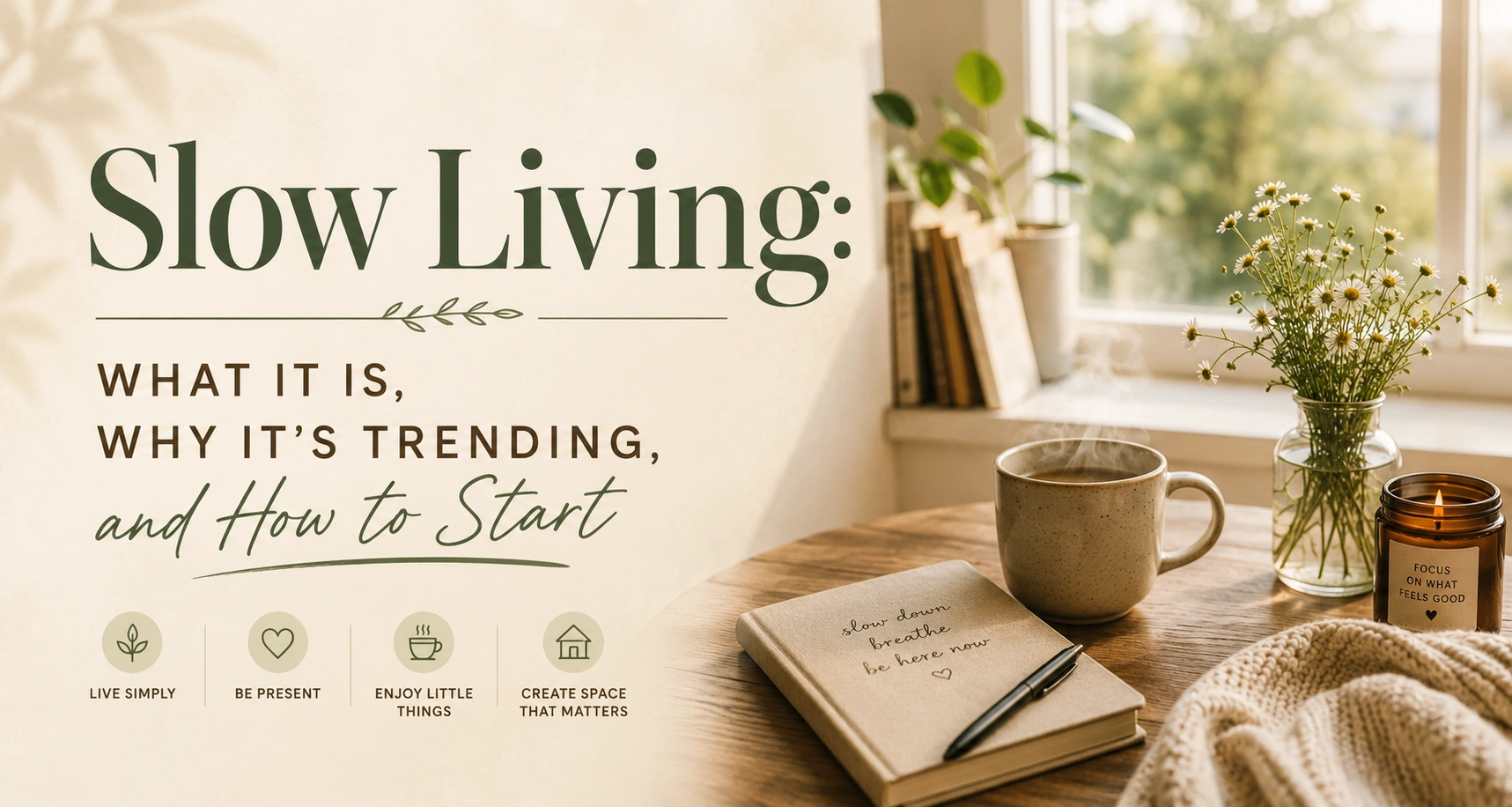
Slow living Lifestyle is a direct response to this. Not a radical one — it doesn’t require quitting your job, moving to the countryside, or overhauling your life. It’s a shift in how you relate to the things you already do. This guide covers what it actually means, where it came from, why it’s growing so fast, and how to start — starting this week, without spending anything.
What Is Slow Living?
Slow living is a lifestyle philosophy that prioritises doing fewer things more intentionally, rather than optimising for speed, productivity, or output.
That’s the one-sentence version. The longer version is that slow living is less about pace and more about presence — choosing where your attention goes, rather than having it pulled in every direction simultaneously. Author Carl Honoré, whose 2004 book In Praise of Slowness helped bring the movement to a mainstream audience, puts it this way: it’s not about doing everything slowly, but doing everything at the right speed.
What slow living is NOT
Slow living is not laziness. It’s not anti-ambition. It’s not a rejection of work, technology, or modern life. People who practise slow living still have careers, commitments, and goals. What changes is the relationship to those things — less reactive, more intentional.
It’s also not a permanent retreat. You don’t have to give up your phone, start baking bread, or move to rural France (though none of those things are off the table). The practice works in ordinary urban and suburban life, inside normal working schedules, without a significant budget requirement.
Slow living vs. minimalism — how they differ
These two ideas are often used interchangeably and they’re not the same thing. Minimalism is primarily about objects — owning fewer things, keeping only what serves a clear purpose, simplifying your physical environment. Slow living is primarily about time and attention — how you move through your day, where your focus lands, what you choose to do versus what you let happen to you by default.
They overlap in places. Both push back against overconsumption. Both favour quality over quantity. But you can practise slow living in a full house, and you can be a minimalist who rushes through everything they own. They’re complementary, not the same.
Where Slow Living Came From
The slow food movement (1986, Rome)
The origin story matters because it explains why slow living is more than an aesthetic trend.
In 1986, an Italian journalist named Carlo Petrini led a group of activists in protest against the opening of a McDonald’s at the Piazza di Spagna in Rome. Their argument wasn’t just about fast food — it was about what fast food represented: the industrialisation of pleasure, the erosion of local culture, the replacement of experience with efficiency.
The movement they founded, Slow Food International, spread quickly across Europe and eventually the world. It argued that how you eat matters as much as what you eat — that a meal shared slowly, with local ingredients and good company, is not just more enjoyable but more human.
From food to a full lifestyle philosophy
By the early 2000s, the “slow” prefix had expanded well beyond food. Slow travel encouraged spending longer in fewer places rather than rushing between landmarks. Slow fashion challenged the fast-fashion model of disposable clothing. Slow parenting pushed back against hyper-scheduled childhoods. Each of these movements shared a common argument: speed is not automatically progress, and efficiency is not automatically good.
How the pandemic changed the conversation
The COVID-19 pandemic forced a global pause that most people hadn’t chosen — and many found, to their own surprise, that parts of the slower pace were genuinely better. Less commuting. More cooking. Fewer obligations. The pandemic didn’t create the slow living movement, but it accelerated it significantly by demonstrating at scale that a different pace was possible.
Why Slow Living Is Trending in 2026
The burnout epidemic is driving the shift
The timing of slow living’s rise is not coincidental. It’s a direct cultural response to documented, measurable burnout at an unprecedented level.
Two-thirds of employees now report burnout, according to 2026 research from TeamOut. The Mind Share Partners and Qualtrics 2026 Mental Health at Work Report found that workers now rate good work-life balance and flexibility as the most valuable thing an employer can offer — above pay, benefits, and career development. Work-life balance now outranks pay. That’s a meaningful shift, and it has a cultural downstream effect.
Gen Z and Millennials are leading the rejection of hustle culture
The BBC reported that the #SlowLiving hashtag has been used more than six million times on Instagram, driven heavily by younger users. The same demographic pioneered quiet quitting — doing one’s job competently without going beyond its scope — and what some have called “lazy girl jobs”: roles chosen specifically for reasonable hours and low stress rather than status or salary.
These aren’t failures of ambition. They’re considered rejections of a model that promised fulfilment through productivity and delivered exhaustion instead. Slow living offers a different metric of success.
The irony of performative slow living
Here’s a tension worth naming directly: the curated version of slow living on Instagram and TikTok often replicates the pressures it claims to reject.
The Science of Retail’s August 2026 analysis put it plainly: the curation of a “simple life” is often time-consuming, expensive, and tightly controlled. A perfectly arranged linen-and-ceramics morning scene, filmed in golden-hour light, requires as much effort and curation as any hustle-culture productivity post. The performance of calm can be its own form of stress.
Genuine slow living doesn’t photograph particularly well. It looks like eating dinner without filming it, taking a walk without optimising it, doing one thing at a time without documenting the process. The movement is most useful when it’s invisible.
What Slow Living Actually Looks Like in Practice
In your mornings
The morning is where slow living has the most leverage, because it sets the tempo for the rest of the day. Most people begin their mornings reactively — reaching for a phone, checking messages, and immediately entering a state of response.
A slow morning doesn’t have to be long. It just has to have a period — even fifteen minutes — that belongs entirely to you before the demands of the day arrive. That might be coffee without a screen, a walk without headphones, or sitting with a book. The specific activity matters less than the principle: something begins before the noise does.
In how you eat
Slow food in practice means eating at least one meal a day without a screen in front of you. Not every meal — one is enough to start. Research consistently shows that distracted eating increases calorie intake and reduces satisfaction. Eating slowly and paying attention to what you’re eating tends to improve both digestion and the experience of the meal itself.
In how you use technology
Slow living doesn’t require a digital detox or deleting social media. It requires making technology intentional rather than ambient. Concrete examples: keeping your phone in a different room while you sleep, designating specific times to check messages rather than responding instantly to every notification, turning off push notifications for everything except calls.
City Live Glasgow’s 2026 reporting on the movement describes this shift as replacing mindless scrolling with purposeful online time. The distinction is not how much you use technology but whether you chose to use it or simply defaulted to it.
In how you work
For most people, work is the hardest place to practise slow living — and the place where it would have the most impact. Small, applicable changes: doing one task at a time rather than multitasking (which research consistently shows reduces quality and increases errors), taking a genuine break rather than eating lunch at your desk, finishing one thing before starting another.
A 2024 Slack study found that when employees were required to take regular breaks instead of powering through, productivity increased by 21% and their ability to manage stress increased by 230%. Slowness, in this context, is not a concession to laziness — it’s a performance strategy.
In how you spend money
Slow consumption means buying fewer things, buying them better, and buying them more deliberately. This is the point where slow living and minimalism overlap most directly. It doesn’t require spending more money — in most cases it involves spending less, but more intentionally. Choosing one secondhand item before buying new, waiting 48 hours before making a discretionary purchase, and asking “will I use this in a year?” before adding something to a cart are all concrete applications.
How to Start: 7 Small Changes That Actually Stick
None of these cost anything. All of them can begin today.
- Designate one meal a day as phone-free. Start with breakfast or lunch. Put the phone in another room for that one meal. Do nothing else differently.
- Choose one morning task to do slowly and without multitasking. Making coffee, brushing teeth, eating breakfast — pick one and do only that thing, at whatever pace feels natural.
- Block one hour per week as unscheduled. No plans, no tasks, no productivity. If you fill it with something enjoyable, great. If you sit with boredom for part of it, that’s also fine. Boredom has been shown to increase creative thinking.
- Cancel one recurring commitment that drains rather than restores. One is enough. Not every obligation is worth its cost in energy. Identify the one that leaves you more depleted than it should and see what happens when you remove it.
- Replace 30 minutes of scrolling with one analogue activity. Reading a physical book, cooking something new, writing by hand, walking without a destination. The specific activity doesn’t matter — what matters is choosing it rather than defaulting to a screen.
- Buy one thing secondhand before buying it new. This applies to anything: clothing, furniture, kitchen equipment, books. The friction of secondhand shopping is itself a form of slowness — it requires more deliberation and usually results in better decisions.
- Take one route somewhere the slow way. Walk instead of driving. Take the scenic route. Let yourself arrive slightly later and pay attention to what you pass through rather than what you’re heading toward.
Addressing the Privilege Critique
It’s worth being direct about this: slow living is sometimes presented in ways that assume financial and social privilege. Spending a morning cooking a slow breakfast requires not having to rush to a 6am shift. Taking a long walk requires not being the only person available to care for children. Choosing a “lazy girl job” assumes you have job options.
Advocates of the movement — including City Live Glasgow’s 2026 analysis — acknowledge this directly. They argue that slow living isn’t about the whole picture; it’s about small, intentional shifts, even if that’s just finding five quiet minutes in a busy day. The seven habits above are designed precisely around this: they are available to people in demanding jobs, in small apartments, with limited time and budgets.
Slow living as an aspirational aesthetic is a lifestyle product. Slow living as a behavioural philosophy is available to anyone who can eat one meal without a phone.
Read More:- Signs Your Gut Health Is Off
Frequently Asked Questions
Q.1 What is the slow living lifestyle?
Slow living Lifestyle philosophy that prioritises intentional, present-focused living over speed and productivity. It encourages doing fewer things more fully — choosing where your attention goes rather than having it constantly pulled elsewhere. It traces back to the slow food movement founded by Carlo Petrini in 1986 and has since expanded into slow travel, slow fashion, slow parenting, and everyday lifestyle practices.
Q.2 Is slow living the same as minimalism?
They overlap but are not the same thing. Minimalism is primarily about physical objects — owning fewer of them, simplifying your environment. Slow living is primarily about time and attention — how you move through your day and what you choose to focus on. You can practise slow living in a full house. You can be a committed minimalist who still rushes through everything. They’re compatible, but they’re addressing different problems.
Q.3 Can you practise slow living while working full-time?
Yes. Most people who practise slow living work full-time. The habits that make the biggest difference — eating one meal without a screen, doing one task at a time, blocking one unscheduled hour per week — take no additional time. They change the quality of time you’re already spending, not the amount of time you have available.
Q.4 Is slow living only for people with money?
This critique has merit when applied to slow living as an aesthetic — the ceramics, the linen, the organic farm box. But slow living as a behavioural philosophy requires no particular income. Eating without your phone, walking without headphones, and doing one thing at a time are all free. The movement’s most accessible version is also its most genuine one.
Q.5 What is the difference between slow living and quiet quitting?
Quiet quitting — doing your job well without going beyond its stated scope — is one specific professional application of a broader anti-hustle-culture shift that slow living sits within. Slow living is wider: it applies to mornings, meals, relationships, technology, and consumption, not just the boundary between work and life. Quiet quitting is a professional strategy; slow living is a lifestyle orientation. They share the same cultural moment and many of the same values.
Read More:- High-Protein Breakfast Ideas That Keep You Full Until Lunch
The Bottom Line
Slow living Lifestyle is not a retreat from life. It’s a reorientation toward it — a deliberate choice to be present for what’s actually happening rather than optimising perpetually toward what’s next.
The burnout data makes clear that the current pace isn’t sustainable for most people. The slow living movement doesn’t offer a cure for that — but it offers a genuinely different way of relating to time, attention, and daily experience. One that doesn’t require a budget, a lifestyle overhaul, or a particularly photogenic morning routine.
The entry point is smaller than most people expect. One meal without your phone. One hour without a schedule. One thing done slowly, for its own sake.
That’s enough to start.
Sources: Wellhub — U.S. Work-Related Stress in 2025; TeamOut — 25 Employee Burnout Statistics 2026; Mind Share Partners and Qualtrics — 2025 Mental Health at Work Report; BBC / Spa Executive — #SlowLiving and Gen Z trend data; Science of Retail — The Soft Life Movement and Its Cultural Impact (August 2025); City Live Glasgow — The Rise of Slow Living in 2025; Slack study on break-taking and productivity (2024).