

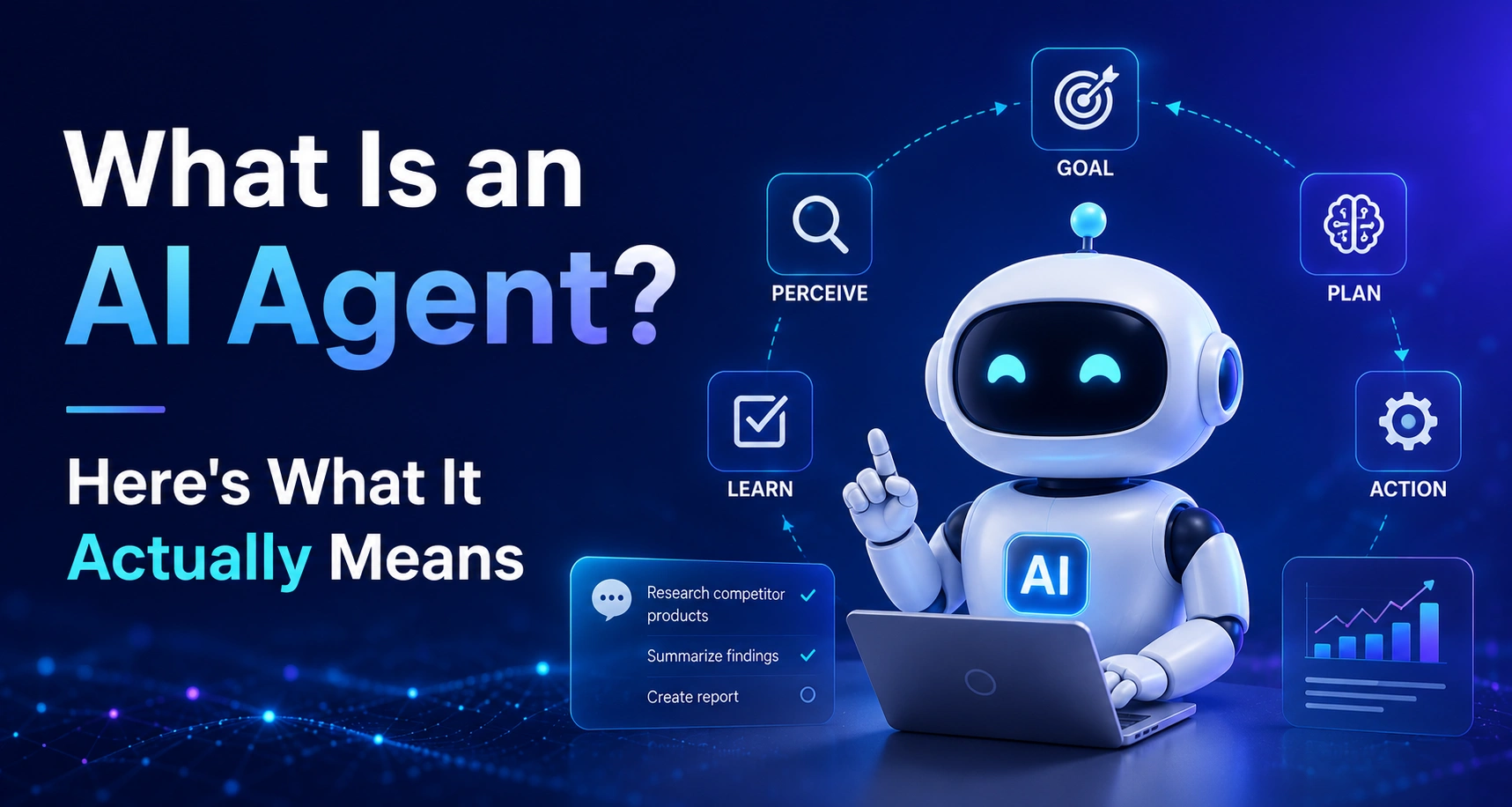
what is an AI agent is a software program that receives a goal, figures out how to achieve it on its own, and then takes action — without needing a human to guide it through every step. Unlike a chatbot that waits for your next question, an AI agent goes off and does things.
That’s the short version. But there’s a lot more going on under the hood, and understanding it will help you make sense of the biggest technology shift of 2026.
The Simplest Way to Think About an AI Agent
Imagine you ask a friend to plan your birthday dinner. A regular chatbot would say, “Here are five restaurants in your city.” Done. Ball back in your court.
An AI agent would check your calendar, look up your dietary restrictions, read reviews, compare prices, make a reservation, add it to your calendar, and send a confirmation to your group chat.
Same starting point. Completely different outcome.
What Makes It “Agentic”
The word “agentic” is derived from agency, which is the capacity to act without relying on another. An AI is agentic if it can:
- Use a strategy of breaking down a big goal into smaller steps.
- Complete those steps from outside tools (such as search, calendar, database, etc.)
- Decisions without permission are made along the way
- Modify its plans if something occurs that is not in the plan.
This is the essence that distinguishes an AI agent from its predecessors.
How Does an AI Agent Actually Work?
Most AI agents follow a four-step loop. It runs constantly until the job is done.
Step 1 — It Gets a Goal
You give it a task. It could be something simple (“summarize these five emails”) or complex (“research competitors and write a market report”). The agent treats this as its mission.
Step 2 — It Makes a Plan
The agent breaks your goal into subtasks. To write that market report, it might plan to search the web, read competitor websites, pull financial data, and then organize everything into a draft.
Step 3 — It Uses Tools
This is where AI agents become powerful. They can connect to search engines, spreadsheets, emails, APIs, and other software. Instead of just generating text, they interact with the real world.
A customer service AI agent does far more than simply notify a customer that an order has been delayed. It can instantly check the order status, communicate with the shipping provider, and automatically send the customer real-time updates—all without requiring human intervention.
Step 4 — It Learns and Adjusts
If something doesn’t work, the agent tries a different approach. It uses what it just learned to improve the next step. Over time, many agents improve based on past interactions.
AI Agent vs Chatbot: What’s the Real Difference?
This trips a lot of people up. ChatGPT is not technically an AI agent on its own — it’s a chatbot. A very smart one. But there’s a key distinction.
| Chatbot | AI Agent | |
|---|---|---|
| Waits for input | Yes — every turn | No — works toward a goal |
| Takes action | No — generates text | Yes — uses tools and systems |
| Multi-step tasks | Limited | Built for them |
| Examples | ChatGPT, basic Siri | Claude Code, Salesforce Agentforce, Cursor |
| Human needed? | Every step | Just at the start (and end) |
Put simply: a chatbot responds. An AI agent does.
That said, the line is blurring fast. ChatGPT now has agent-like features when connected to tools. Claude can operate as an agent through its API. The technology is evolving weekly.
Real-World AI Agent Examples You Already Know
AI agents aren’t new. You’ve been using them for years without realizing it.
Netflix and Spotify Recommendations
Every time Netflix decides what to show on your homepage, that’s an AI agent at work. It perceives your watch history, reasons about what you’ll likely enjoy, acts by placing certain titles front and center, and learns from whether you actually watch them. That’s the same loop all agents follow.
Your Roomba
A robot vacuum is a physical AI agent. It has a goal (clean the floor), makes decisions (where to go next), uses sensors to avoid obstacles, and adjusts when furniture is in the way. Basic? Yes. But it’s agentic.
Customer Service Agents That Actually Resolve Issues
If you’ve ever had a support bot that could actually look up your order, issue a refund, and send a follow-up email without transferring you to a human — that’s an AI agent. Companies like Salesforce have built entire platforms (Agentforce) around this. As of 2026, Agentforce has over 18,500 business customers.
AI Coding Tools Like Cursor and Claude Code
Developers have arguably experienced the biggest impact from AI agents. Modern tools like Cursor and Claude Code go far beyond simple code autocompletion. They can analyze your entire codebase, understand the application’s context, generate and modify files, run tests, identify bugs, and even fix them automatically. Instead of assisting with individual tasks, they handle complete development workflows—making them true AI agents in action.
Types of AI Agents (Explained Simply)
There are a handful of distinct types, though most real-world agents combine several.
Reactive agents act on rules. A spam filter is a great example — it sees an email, checks it against patterns, and makes an instant call. No memory. No planning.
Goal-based agents work toward an outcome. Your Roomba qualifies here. So does a travel planning agent that books a full trip from a single instruction.
Learning agents improve over time. Netflix gets better at recommending the more you watch. Fraud detection systems get sharper as they see more transactions.
Multi-agent systems involve several AI agents working together — each specialized for a different task — coordinating to complete something none could do alone. This is the frontier of where the technology is heading in 2026.
Where Are AI Agents Being Used in 2026?
The growth of AI agents is gaining significant momentum. According to Gartner, 40% of enterprise applications are expected to feature task-specific AI agents by the end of 2026, compared with fewer than 5% in 2025. This trend is mirrored in the market’s expansion, with the global AI agent industry growing from $7.6 billion in 2025 to a projected value of more than $50 billion by 2030.
Here’s where you’ll find them right now:
Healthcare — AI agents help with treatment planning, patient scheduling, and processing medical records. During natural disasters, some systems can locate individuals in need of rescue by scanning social media in real time.
Finance — Agents analyze market data, spot fraud, optimize trading strategies, and generate financial summaries. They process information at a scale and speed no human team can match.
Customer service — Companies use agents to handle routine support, freeing human staff for complex issues. The agent can check orders, process returns, update accounts, and send follow-ups without any human in the loop.
Software development — Coding agents write, test, and debug code. Some teams report completing tasks in hours that previously took days.
Business operations — AI agents now automate everything from drafting reports to managing email workflows. MIT Sloan researchers describe agents as moving from “ask and answer” to “observe and act.”
Are AI Agents Safe?
It’s a fair question. When software can take actions on your behalf without asking permission, the stakes are higher than a chatbot that gives a wrong answer.
A few things worth knowing:
Most serious AI agent deployments include human checkpoints for high-stakes actions. A financial agent might execute small trades autonomously but require human approval above a certain dollar amount.
There are also new governance standards emerging. Organizations are setting up audit logs, access controls, and approval gates so every action an agent takes can be reviewed.
The technology is also still maturing. Gartner predicts that over 40% of agentic AI projects will be cancelled by 2027 — not because agents don’t work, but because organizations rush deployment without proper governance. The companies seeing real results are the ones going slowly and carefully.
The bottom line: used well, with oversight, AI agents are powerful tools. Used carelessly, they can create problems that are harder to undo than a bad chatbot response.
Frequently Asked Questions
Q.1 How is an AI agent different from ChatGPT?
ChatGPT is a chatbot — it responds to your messages with text. An AI agent can actually go and do things: search the web, update a spreadsheet, book a meeting, or send an email. ChatGPT becomes more agent-like when it’s connected to external tools, but a standalone chatbot and a true agent are different in scope and capability.
Q.2 How can we see AI agents in everyday life?
Netflix suggest the next binge-worthy series, a Roomba autonomously finding your way around the house, and a customer support chatbot that can solve your problem without even engaging a human agent—these are all different ways AI agents are operating behind the scenes.
Q.3 Are AI agents dangerous?
They carry risks if deployed without proper oversight. The main concerns are unauthorized actions, data privacy, and errors that are difficult to undo. Well-designed agents include human checkpoints, audit logs, and clear access limits. The risks are manageable with good governance.
Q.4 What is agentic AI?
There is a tendency to interchange between agentic AI and AI agent. Agentic” means AI that can act more independently, it can pursue goals, make decisions, tools and create responses to prompts.
Q.5 Which companies are leading in AI agents?
As of 2026, the major players include Anthropic (Claude and Claude Code), OpenAI (GPT-based agents), Salesforce (Agentforce), Google (Gemini agents), Microsoft (Copilot agents), and Amazon (Bedrock Agents). There are also a growing number of specialized startups building agents for specific industries.
Q.6 Do I need to be technical to use an AI agent?
No. Consumer-facing AI agents are increasingly accessible to everyday users. Tools like Salesforce Agentforce are used by business teams without coding knowledge. The complexity lives under the hood — users interact through plain language instructions.
The Bottom Line
AI agents represent the biggest shift in how we interact with technology since the smartphone. They’re moving AI from something you talk to into something that works for you.
You’ve already been using simple versions of them for years. The more sophisticated agents — the ones that can manage your calendar, draft your reports, or handle your customer service — are now mainstream and accelerating fast.
If you want to stay ahead of this wave, the best place to start is understanding what you’re working with. Now you do.
Sources
- IBM Think: What Are AI Agents?
- MIT Sloan Management Review: Agentic AI, Explained
- Gartner Strategic Technology Trends 2026
- AWS: What Are AI Agents?
- The Conversation / TechXplore: AI Agents Arrived in 2025
- Salesforce: AI Agents Definition