

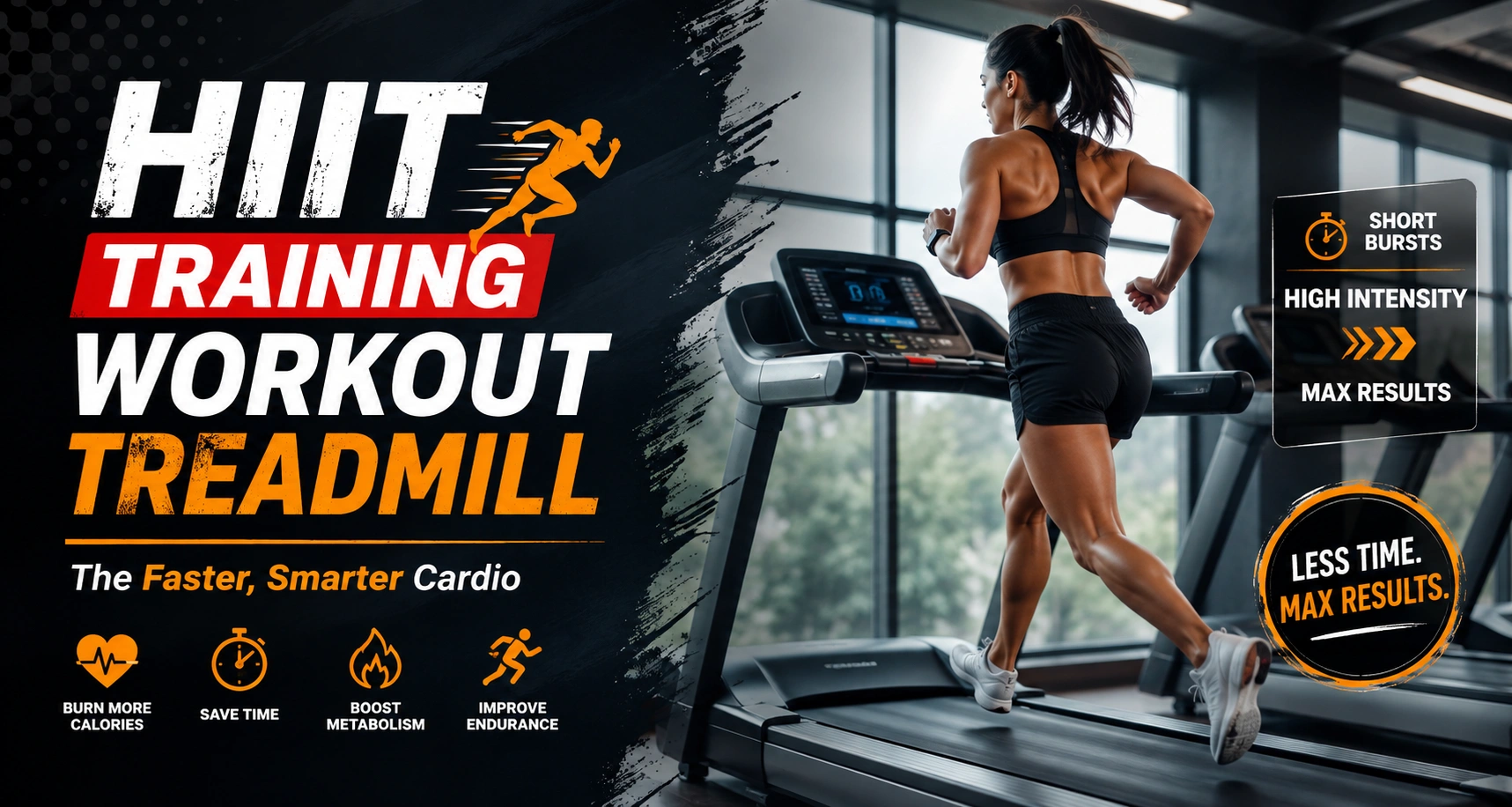
If your cardio routine has started to feel like a chore — 45 minutes of steady jogging while staring at the wall — it might be time to switch things up. A HIIT training workout treadmill routine can deliver better results in a fraction of the time, torching calories, improving cardiovascular fitness, and keeping your metabolism elevated long after you’ve stepped off the belt.
Whether you’re a complete beginner, specifically looking for a HIIT Training Workout Treadmill for weight loss, or searching for a High-Intensity Interval Training workout treadmill for beginners that won’t leave you overwhelmed, this guide covers everything you need to get started safely and effectively.
What Is HIIT and Why Does It Work So Well on a Treadmill?
The treadmill happens to be one of the most beginner-friendly tools for this style of training because:
- Speed and incline are fully controllable, letting you adjust intensity precisely
- It’s low-impact compared to sprinting outdoors, especially with proper footwear
- Sessions are shorter but highly effective, often 15–25 minutes total
- It works well indoors, regardless of weather or time constraints
Research consistently shows that interval-based cardio can improve cardiovascular endurance and support fat loss more efficiently than steady-state cardio alone, making a High-Intensity Interval Training workout treadmill routine a smart choice for busy schedules.
Benefits of a HIIT Treadmill Workout
1. Efficient Calorie Burn
You’re doing them both high intensity and low intensity, so your body is still burning calories at a higher rate after you’re done with the workout, which is known as excess post-exercise oxygen consumption (EPOC), or “afterburn effect.
2. Improved Cardiovascular Health
Interval training challenges your heart and lungs more dynamically than steady-state cardio, which can lead to measurable improvements in VO2 max and overall endurance over time.
3. Time-Saving Structure
A well-designed HIIT training workout treadmill for beginners can be completed in as little as 15–20 minutes, making it ideal for people balancing work, family, and other commitments.
4. Versatility for All Fitness Levels
By adjusting speed, incline, and interval length, the same basic structure can be scaled from a gentle beginner session to an advanced, high-intensity workout.
Getting Started Safely: What You Need to Know
Before jumping into intervals, a few preparation steps matter.
- Warm up properly — Never start intervals cold. A 5-minute walk or light jog prepares your joints and muscles.
- Know your treadmill’s incline and speed controls — Being able to adjust these quickly mid-workout keeps intervals smooth.
- Wear proper footwear — Supportive running shoes help absorb impact during high-intensity bursts.
- Stay hydrated — Even short HIIT sessions can lead to significant sweat loss.
- Listen to your body — Especially as a beginner, mild breathlessness is expected, but dizziness or sharp pain is a sign to stop.
HIIT Training Workout Treadmill for Beginners
If you’re new to interval training, easing in gradually is key to building confidence and avoiding burnout or injury.
Beginner Sample Routine (Total: 20 Minutes)
Warm-Up (5 minutes)
- Walk at a comfortable pace (2.5–3.5 mph)
Intervals (10 minutes — repeat 5 times)
- 1 minute at a brisk walk or light jog (4.0–4.5 mph)
- 1 minute at a slightly faster pace or slight incline increase (5.0–5.5 mph)
Cool Down (5 minutes)
- Gradually reduce speed back to a comfortable walking pace
As a beginner, the goal isn’t to sprint immediately — it’s to get comfortable shifting between effort levels while maintaining good form and steady breathing.
HIIT Training Workout Treadmill for Weight Loss
For those specifically focused on fat loss, slightly longer or more intense intervals — combined with incline work — can maximize calorie burn.
Weight Loss-Focused Sample Routine (Total: 25 Minutes)
Warm-Up (5 minutes)
- Light jog at 3.5–4.0 mph
Intervals (15 minutes — repeat 5 times)
- 1 minute high-intensity run (6.5–8.0 mph, adjusted to fitness level)
- 2 minutes recovery walk or light jog (3.5–4.0 mph)
Incline Finisher (3 minutes)
- Increase incline to 8–10%, maintain a brisk walking pace
Cool Down (2 minutes)
- Slow walk with incline reduced to flat
Adding incline work is particularly effective for weight loss goals, as it increases calorie expenditure without requiring significantly faster speeds — making it more joint-friendly for sustained fat-burning sessions.
HIIT Training Workout Treadmill for Female Athletes and Beginners
While HIIT principles apply broadly regardless of gender, many women specifically search for a HIIT training workout treadmill female-focused routine due to differences in training goals, hormonal considerations, or simply wanting a structured starting point.
Key Considerations
- Cycle-aware training — Some women find it helpful to schedule higher-intensity HIIT sessions during the follicular phase (post-period) when energy levels tend to be higher, and opt for lighter sessions closer to or during menstruation.
- Strength-supportive cardio — Pairing treadmill HIIT with strength training 2–3 times weekly supports lean muscle maintenance alongside fat loss goals.
- Recovery emphasis — Adequate rest between HIIT sessions (at least one full day) helps prevent overtraining, which can affect hormonal balance and energy levels.
Sample Female-Focused Routine (Total: 22 Minutes)
Warm-Up (5 minutes)
- Brisk walk at 3.0–3.5 mph
Intervals (14 minutes — repeat 7 times)
- 30 seconds fast-paced run (6.0–7.5 mph)
- 90 seconds recovery walk (3.0–3.5 mph)
Cool Down (3 minutes)
- Gradual pace reduction with light stretching afterward
This structure balances intensity with adequate recovery, making it sustainable for regular, ongoing training rather than an occasional burnout session.
How Often Should You Do Treadmill HIIT?
For most people, 2 to 3 sessions per week is an effective and sustainable frequency. Because HIIT places significant demand on your cardiovascular system and muscles, doing it daily often leads to fatigue or diminished returns rather than faster progress.
On non-HIIT days, consider:
- Light steady-state cardio (walking, easy cycling)
- Strength training sessions
- Active recovery like stretching or yoga
This balance supports better long-term results than high-intensity training alone, every single day.
Common Mistakes to Avoid
- Skipping the warm-up — Jumping straight into high intensity increases injury risk significantly.
- Going too hard, too soon — Beginners often overestimate their starting intensity, leading to early burnout mid-session.
- Ignoring incline as a tool — Incline adjustments can boost intensity without needing faster speeds, which is often safer for joints.
- Neglecting recovery days — HIIT is tough and rest is needed to improve and prevent injuries.
- Holding onto handrails during intervals — This reduces workout effectiveness and can throw off your natural running form.
Tracking Progress Over Time
Since a HIIT training workout treadmill routine is typically short but intense, tracking progress helps ensure you’re actually improving rather than just repeating the same effort level.
- Monitor heart rate during high-intensity intervals to ensure you’re reaching an effective training zone
- Track speed and incline progression over several weeks
- Note recovery time — as fitness improves, your heart rate should return to baseline more quickly between intervals
- Pay attention to how sessions feel, not just the numbers, since subjective effort matters too
Conclusion
A HIIT Training Workout Treadmill routine offers one of the most time-efficient ways to improve cardiovascular fitness, support weight loss, and break up the monotony of steady-state cardio. Whether you’re just starting out, specifically targeting fat loss, or looking for a female-focused training approach, the key principles remain the same: warm up properly, push hard during intervals, prioritize recovery, and progress gradually.
Start with a beginner-friendly structure, listen to your body, and adjust intensity as your fitness improves. With consistency, a well-structured treadmill HIIT routine can become one of the most effective — and time-saving — parts of your fitness routine.
Also Read:- The Complete Fitness & Workout Guide (2026)
Frequently Asked Questions (FAQs)
Q.1 How long should a HIIT training workout treadmill session last for beginners?
Beginners should aim for 15–20 minutes total, including warm-up and cool-down, with short, manageable intervals of 1 minute effort followed by 1 minute recovery to build confidence safely.
Q.2 Is HIIT training on a treadmill effective for weight loss?
Yes, a HIIT Training Workout Treadmill for weight loss can be highly effective due to the afterburn effect, which keeps your metabolism elevated after the workout, combined with efficient calorie burn during high-intensity intervals.
Q.3 How many days a week should I do treadmill HIIT workouts?
Most people benefit from 2 to 3 HIIT sessions per week, allowing adequate recovery time between sessions to prevent overtraining and support consistent long-term progress.
Q.4 Can beginners do HIIT on a treadmill safely?
Yes, beginners can safely start HIIT on a treadmill by using lower intensity intervals, proper warm-ups, and gradually increasing speed or incline as fitness improves over several weeks.
Q.5 Does incline make a treadmill HIIT workout more effective?
Yes, adding incline increases calorie burn and workout intensity without requiring faster speeds, making it a joint-friendly way to boost the effectiveness of a treadmill HIIT session.