

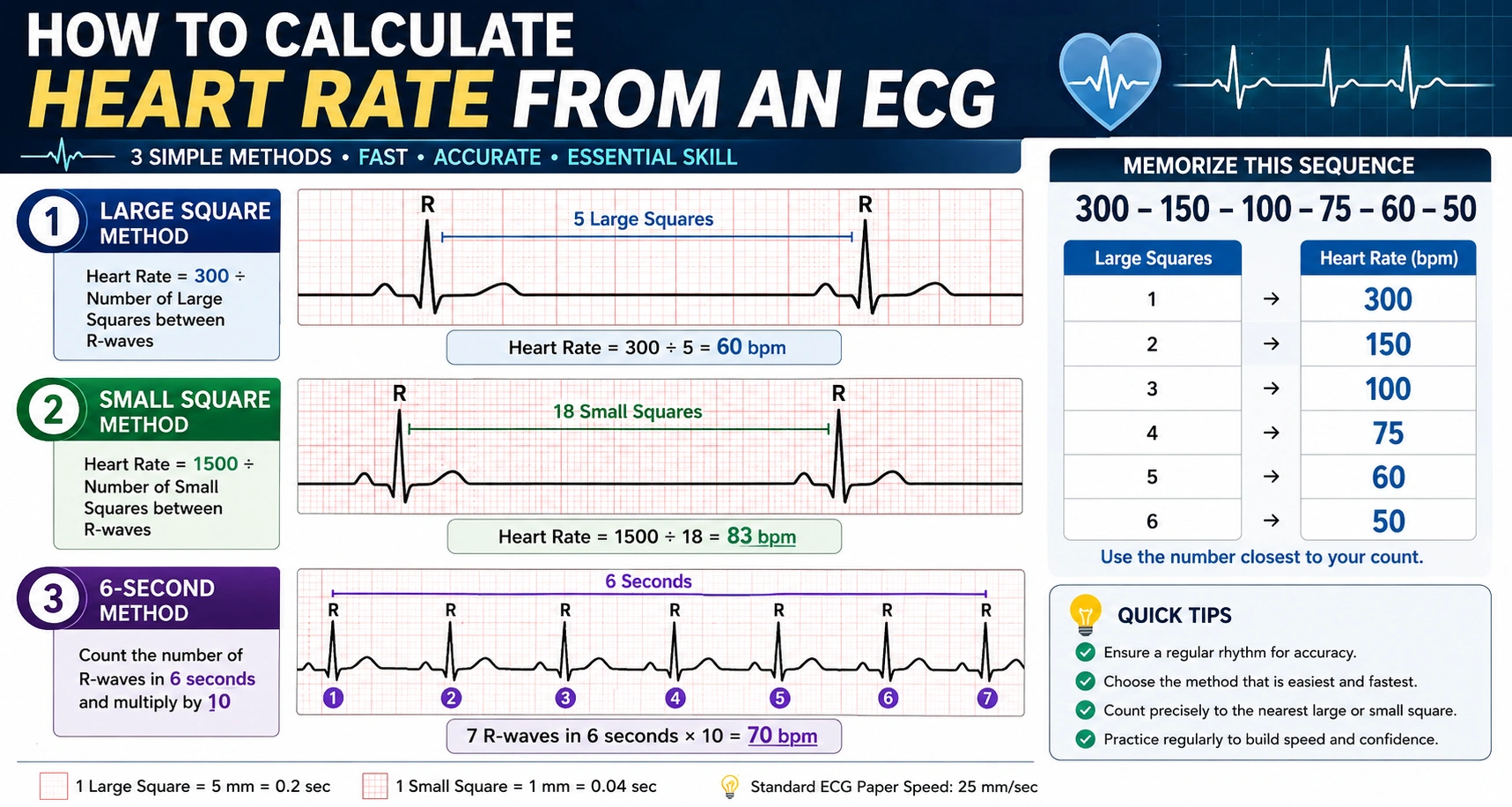
How To Calculate The Heart Rate From ECG strip is one of the first practical skills every nursing and medical student learns, and it sounds simpler than it turns out to be in practice — the “right” method actually depends on whether the rhythm in front of you is regular or irregular. Get that call wrong, and even a mathematically correct calculation can give you a misleading number.
Quick answer: Count the number of large squares between two R waves, then divide 300 by that number (the “300 method”), or small squares, then divide 1500 by that number in between the R waves (the “1500 method”) to get a more accurate answer for a regular rhythm. If the rhythm is irregular, count the number of QRS complexes in a 6 second strip of ECG paper and multiply by 10. This is the most accurate way to determine the rate if the rhythm is irregular, as averaging the rate over a longer period will smooth out beat to beat variation.
This article is written as an educational review of standard ECG calculation methods for students and trainees. It isn’t a substitute for supervised clinical training, and ECG interpretation in an actual patient care setting should always be performed or verified by a qualified, trained professional.
ECG Paper Basics You Need First
Every method below depends on understanding How To Calculate The Heart Rate From ECG paper is structured, so this is worth locking in before anything else:
- Standard ECG paper runs at 25mm per second.
- This means 5 large squares equal 1 second of recording time.
- Each large square is made up of 5 small squares, so 1 large square = 0.2 seconds, and 1 small square = 0.04 seconds.
Every calculation method that follows is really just a shortcut built on this same underlying timing relationship — they’re different ways of answering “how many of these R-R intervals would fit into one minute.”
Method 1: The 300 Method (Large Square Method)
Best for: regular rhythms, quick bedside estimation.
Count the number of large squares between two consecutive R waves, then divide 300 by that number.
Formula: Heart rate = 300 ÷ (number of large squares between R waves)
Worked example: if there are 4 large squares between two R waves, the heart rate is 300 ÷ 4 = 75 bpm.
Most clinicians memorize the sequence for whole-number square counts, since it turns this into instant recognition rather than mental math:
| Large Squares Between R Waves | Heart Rate (bpm) |
|---|---|
| 1 | 300 |
| 2 | 150 |
| 3 | 100 |
| 4 | 75 |
| 5 | 60 |
| 6 | 50 |
This sequence (300-150-100-75-60-50) is worth memorizing outright — it turns the 300 method from a calculation into a glance.
Method 2: The 1500 Method (Small Square Method)
Best for: regular rhythms where you want more precision than the 300 method offers, especially for faster heart rates where large-square counting gets imprecise.
Count the number of small squares between two consecutive R waves, then divide 1500 by that number.
Heart rate = 1500 / (num. of little squares between R waves)
Worked example 2: 20 small squares 300 milliseconds apart between the R waves means 1500 ÷ 20 = 75 bpm — the same as the previous example above (300 = 4 large squares, which is 20 small squares).
The 1500 method becomes especially useful when an R wave doesn’t land neatly on a large square gridline, which happens more often than textbook examples suggest. In that situation, counting small squares gives you a more accurate figure than rounding to the nearest large square would.
Method 3: The 6-Second Method (For Irregular Rhythms)
Best for: irregular rhythms — atrial fibrillation, sinus arrhythmia, or any rhythm with beat-to-beat variability where the 300 and 1500 methods would give a misleading single-beat snapshot.
Count the number of QRS complexes within a 6-second strip (30 large squares), then multiply by 10.
Formula: Heart rate = (number of QRS complexes in a 6-second strip) × 10
Worked example: if there are 9 QRS complexes in a 6-second strip, the heart rate is 9 × 10 = 90 bpm.
This method works for regular rhythms too, but it’s specifically valuable for irregular ones because it averages the rate over a longer stretch of tracing rather than relying on a single R-R interval that might not represent the overall pattern.
Related Variants Worth Knowing
- 10-second method: count R waves across a full 10-second strip and multiply by 6. Functionally similar to the 6-second method, just averaged over a slightly longer window.
- 3-second method: count QRS complexes across 3 seconds (15 large squares) and multiply by 20. This is faster but less accurate than the 6-second method, since it averages over a shorter stretch — useful for a quick triage glance, less reliable for a documented rate.
Which Method Should You Actually Use?
| Situation | Recommended Method | Why |
|---|---|---|
| Regular rhythm, quick estimate needed | 300 method | Fastest, good enough for most regular rhythms |
| Regular rhythm, higher precision needed | 1500 method | More accurate, especially at faster rates |
| Irregular rhythm (e.g., atrial fibrillation) | 6-second method | Averages over multiple beats, avoiding a misleading single-interval snapshot |
| Very fast rhythm where large squares are hard to count | 1500 method | Small squares give finer resolution when large-square counting gets imprecise |
| Quick triage-level estimate | 3-second method | Fastest, at the cost of some accuracy |
The step that matters most, before choosing any method: look at the rhythm strip globally first. Is it regular or irregular? That single observation determines which calculation method will actually give you a meaningful number — running the 300 method on a clearly irregular rhythm will produce a mathematically valid but clinically misleading result.
Step-by-Step Walkthrough
- Assess regularity first. Scan the strip — are the R-R intervals consistent, or do they vary noticeably?
- If regular: count large squares between two R waves and apply the 300 method, or count small squares for the 1500 method if you want more precision.
- If irregular: count QRS complexes across a 6-second strip (30 large squares) and multiply by 10.
- Sanity-check your answer. A resting heart rate roughly in the 60–100 bpm range is typical for adults; a number wildly outside that range is worth double-checking your square count before assuming it’s correct.
- Cross-reference with the overall tracing, not just the isolated rate number — heart rate is one part of ECG interpretation, not the whole picture (rhythm regularity, QRS width, and P wave presence all matter for a complete read).
Common Mistakes to Avoid
- Using the 300 or 1500 method on an irregular rhythm. This produces a single-interval snapshot that doesn’t represent the actual average rate — use the 6-second method instead.
- Miscounting when an R wave doesn’t land on a gridline. This is genuinely common and is exactly why the 1500 method (or careful fractional counting) exists — don’t just round to the nearest large square when precision matters.
- Forgetting standard paper speed can vary. Most ECG paper runs at 25mm/sec, but some settings use different speeds — always confirm the paper speed before applying these formulas, since they assume the 25mm/sec standard.
- Treating heart rate as the full interpretation. Rate is one component of a complete ECG read — rhythm, axis, intervals, and morphology all matter for a full clinical picture.
FAQs
Q.1 What’s the fastest way to calculate heart rate on an ECG?
The 300 method is the fastest for regular rhythms — count the large squares between two R waves and divide 300 by that number, or use the memorized sequence (300-150-100-75-60-50) for instant recognition at whole-square counts.
Q.2 Which method should I use for atrial fibrillation or other irregular rhythms?
The 6-second method — count the QRS complexes in a 6-second strip and multiply by 10. This averages over multiple beats, which is essential for irregular rhythms where a single R-R interval wouldn’t represent the true average rate.
Q.3 What’s the difference between the 300 method and the 1500 method?
Both work for regular rhythms, but the 1500 method (counting small squares) gives more precision than the 300 method (counting large squares) — particularly useful for faster heart rates or when an R wave doesn’t land cleanly on a large square gridline.
Q.4 Does standard ECG paper speed always stay the same?
Most commonly, yes — 25mm per second is the standard used in most clinical settings, which is what all the formulas above assume. Some settings use different paper speeds, so it’s worth confirming before applying these calculations.
Q.5 Is a normal heart rate always between 60 and 100 bpm?
That’s the typical reference range for a resting adult heart rate, though normal ranges can vary by age, fitness level, and clinical context — a number outside this range isn’t automatically abnormal, but it’s worth interpreting alongside the full clinical picture rather than in isolation.
Conclusion
How To Calculate The Heart Rate From ECG the three core methods — 300, 1500, and 6-second — cover the vast majority of real ECG heart rate calculations, and the single most important decision is choosing the right one based on whether the rhythm is regular or irregular before you start counting squares. Practice on real strips until the 300-150-100-75-60-50 sequence becomes automatic, and always sanity-check your result against the full tracing rather than treating the rate as the whole interpretation.
Read More Article