

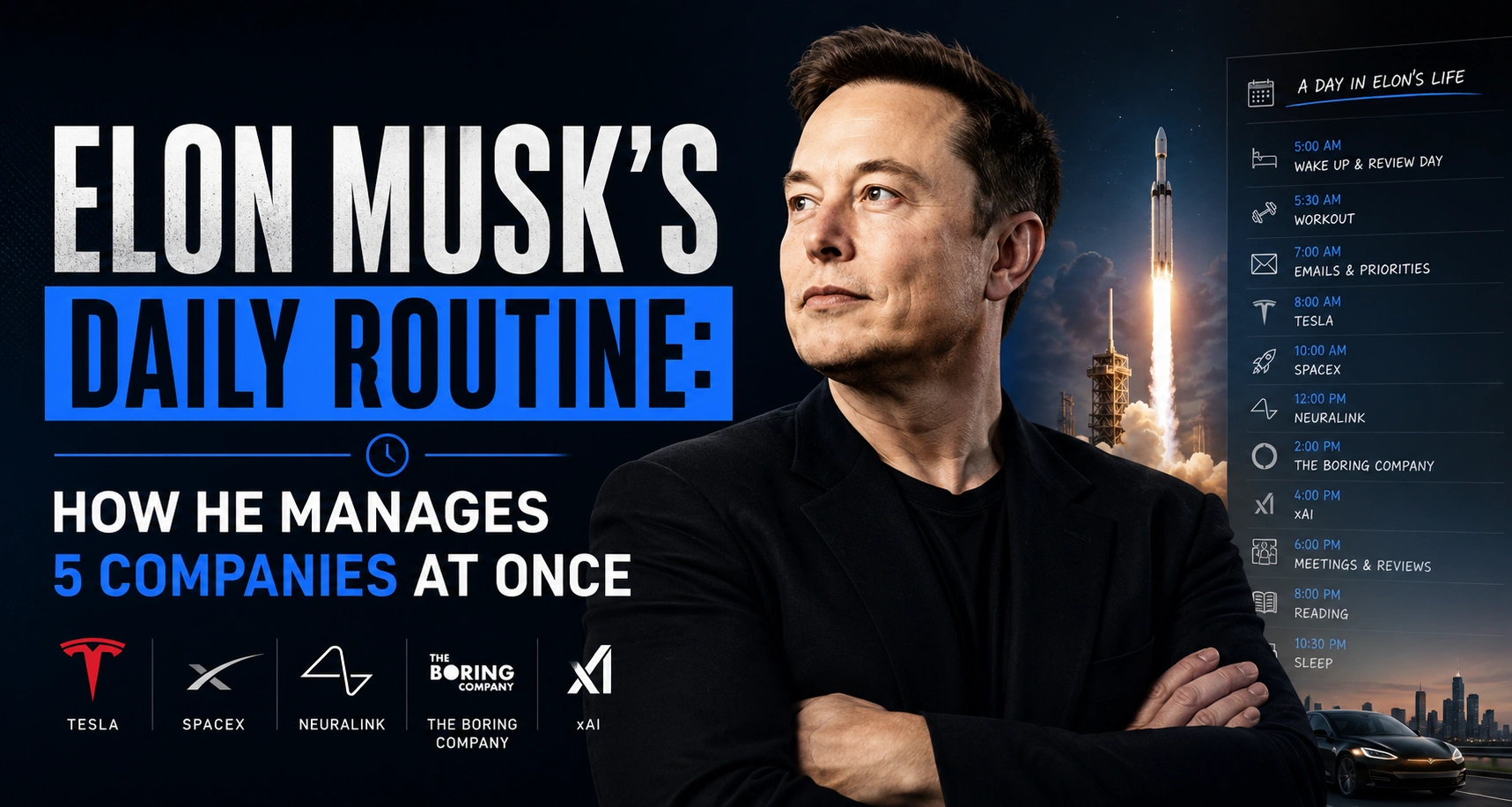
Most people struggle to manage one job, one inbox, and one to-do list.
Elon Musk runs five companies.
Tesla. SpaceX. X (formerly Twitter). xAI. Neuralink. Together, these companies span electric vehicles, rocket launches, social media, artificial intelligence, and brain-computer interfaces. Their combined value runs into the trillions. Their combined workforce numbers in the hundreds of thousands.
And at the center of all of it is one man, working what he describes as 80 to 100 hours a week, sleeping roughly six hours a night, and operating on a schedule so tightly engineered it makes most people’s days look like free time.
So how does he actually do it?
This article breaks down Elon Musk daily routine, hour by hour, along with the productivity systems, mental frameworks, and management philosophies that make the whole thing run. Some of it is genuinely worth copying. Some of it is frankly not sustainable for most humans. We’ll tell you which is which.
The Empire He’s Managing in 2026
Before diving into the daily schedule, it’s worth understanding the scale of what Musk is juggling in 2026:
- Tesla — Electric vehicles, Full Self-Driving (FSD), the Optimus humanoid robot, and the A15 AI inference chip. Musk is CEO.
- SpaceX — Rocket launches, Starlink internet (10.3 million subscribers as of Q1 2026), and the broader mission to colonize Mars. Musk is CEO and chief engineer.
- xAI — Musk’s artificial intelligence company, which absorbed the social platform X in 2025 and was itself acquired by SpaceX in February 2026. Home of the Grok AI model.
- Neuralink — Brain-computer interface technology. The company has implanted devices in over 10 paralyzed patients, enabling real-time communication.
- The Boring Company — Infrastructure tunneling and urban transportation projects.
Until May 2025, Musk was also heading DOGE (the Department of Government Efficiency) under President Trump’s second administration — before stepping down to refocus on his businesses.
This is the workload his daily routine is engineered to support.
Elon Musk Daily Routine: Hour by Hour
9:00 AM — Wake Up (Phone First)
Musk typically goes to bed around 3:00 AM and wakes up around 9:00 AM, getting roughly six hours of sleep. He has said publicly that getting enough rest is important for maintaining cognitive sharpness and sound decision-making — though his schedule makes truly adequate sleep a constant challenge.
The first thing he reaches for is his phone.
In 2022, Musk described checking his phone immediately upon waking as “a terrible habit” he hoped to break. By 2023 — and most evidence suggests through 2026 — he still does it, scanning for emergencies and critical alerts before getting out of bed.
“Some days I wake up and look at Twitter to see if it’s still working,” Musk told biographer Walter Isaacson. Given that he owns the platform, the concern is both literal and symbolic.
His first scroll isn’t passive. Musk is one of the most active users on X, posting at odd hours of the night and early morning. Whether that constitutes productive time management or a distraction is a matter of debate.
9:30 AM — Breakfast: Steak, Eggs & Coffee
Musk’s breakfast habits have shifted over the years. In a December 2025 podcast appearance on The Katie Miller Podcast, he gave an updated glimpse into his morning meal: “steak and eggs and coffee.”
This replaced an earlier reputation for donuts — Musk joked on X in 2023 that he eats “a donut every morning,” though he also said his brain neural network “quantizes it down to zero donuts.” Whether that was humor or genuine self-deprecation is characteristically ambiguous.
His caffeine of choice throughout the day is Diet Coke — multiple cans daily. He has openly admitted this is not an optimal health choice:
“I’m a bit addicted to Diet Coke. I’ve tried to give it up. I’ll probably die on Diet Coke hill. It’s a character flaw I accept.”
9:30–10:00 AM — Shower (His Most Important Habit)
Among all his daily practices, Musk has described his morning shower as the single most impactful habit for his productivity and creative thinking. He credits it not just with physical freshness but with generating some of his best ideas.
This isn’t unusual — many high performers report that the shower’s combination of relaxation, warm temperature, and minimal stimulation creates ideal conditions for the brain’s default mode network to activate, producing spontaneous, creative insights.
10:00 AM – 12:00 PM — Email, Critical Decisions & Morning Briefings
Musk’s productive day officially kicks in mid-morning with what amounts to a high-speed decision sprint.
He processes critical emails and messages, reviews overnight developments across his companies, and handles what he calls “urgent-first” prioritization — identifying the single most important problem that needs solving today and attacking it directly.
He famously avoids phone calls. Musk prefers written communication (email and direct message) because it’s faster, documented, and async — meaning he can batch responses rather than being pulled into real-time conversations that consume far more time. He reportedly maintains a deliberately low-profile email address to minimize spam and unsolicited contact.
He also uses Grok — xAI’s AI model — for research and information gathering throughout his day, integrating his own AI product into his workflow.
12:00 PM – 6:00 PM — Deep Work: Engineering, Product, and Company Time
This is where the bulk of Musk’s actual professional output happens.
Rather than managing each company every single day, Musk divides his week into company-specific rotational blocks. He has described alternating his time between Tesla and SpaceX on roughly weekly cycles, with X and xAI integrated more fluidly throughout.
“I have to be careful about how I allocate my time. I basically time-box everything,” Musk has said publicly.
The afternoon hours are reserved for his most demanding work — and he runs them using a system that has made him famous in productivity circles:
The 5-Minute Time Block Method.
Elon Musk’s 5-Minute Time Block System Explained
This is the scheduling framework at the core of how Musk manages an 80–100 hour workweek.
How it works: Every hour of his day is pre-planned and divided into 5-minute increments. Each block is assigned a specific task, company, or activity. There is no unscheduled time. There are no vague “work on Tesla stuff” entries. Every block has a defined purpose.
This approach is known as time blocking — a method also used by Bill Gates and Cal Newport — but Musk takes it to an extreme granularity few others attempt.
What gets blocked:
- Engineering review sessions (SpaceX rocket design, Tesla FSD development)
- Product decisions (features, timelines, supplier negotiations)
- Factory walk-throughs and design reviews
- Email response batches
- Meals (eaten quickly at his desk or during meetings)
- Team briefings
- Strategic planning
An important nuance: Musk has reportedly clarified that he doesn’t strictly live in 5-minute increments for everything — he also values “long uninterrupted times to think” for complex problems. The 5-minute system is better understood as a scheduling philosophy of extreme intentionality rather than a rigid timer-based rule.
The core principle: every minute is pre-decided, not improvised.
6:00 PM — Factory Visits, Team Check-ins & Hands-On Work
Musk is not a delegator-at-a-distance CEO. He is widely known for showing up on factory floors, sitting in on engineering meetings, and engaging directly with technical problems that most executives would leave entirely to their teams.
At Tesla’s Gigafactories and SpaceX’s Starbase in Texas, Musk has been known to review manufacturing lines personally, push for engineering changes on the spot, and demand radical efficiency improvements that his teams then have to execute.
His leadership philosophy centers on hiring exceptionally talented people, giving them significant autonomy, and then holding them to extremely high standards of accountability. He sets ambitious — often unrealistic by conventional standards — goals and expects teams to figure out how to get there.
7:00 PM – 10:00 PM — Business Dinners & Strategic Conversations
Musk often skips formal lunches, preferring to eat quickly at his desk or during meetings. Dinner is different — business dinners are where relationship-building, investor conversations, and strategic partnerships happen.
He saves his most substantive meal for evening, often in the context of work conversations that blend social and professional elements seamlessly.
10:00 PM – 3:00 AM — Late Night: Email, X, and Strategic Thinking
This is the stretch that surprises most people. Musk’s nights run late — very late. From 10 PM to 3 AM, he continues working, responding to emails, posting on X, thinking through the biggest challenges facing his companies, and often communicating directly with engineers or team leads on urgent issues.
His X activity is a tell: posts at midnight, 1 AM, and 2 AM are not uncommon. Whether this represents disciplined late-night productivity or the boundary between work and insomnia is genuinely unclear from the outside.
What’s clear is that Musk treats every day of the week the same way. He has said he rarely takes even a Sunday afternoon off. There are no real weekends in the conventional sense.
The 7 Core Productivity Habits Driving Musk’s Output
1. Time Blocking with Extreme Intentionality
Every hour is pre-allocated. Unscheduled time is wasted time by his philosophy.
2. Written Over Verbal Communication
Email and messages over phone calls. Async over synchronous. This alone saves hours each week.
3. Eating During Meetings
Formal meals are combined with productive conversations. Standalone meals, in his view, are time that could be double-purposed.
4. Eliminating Unnecessary Meetings
Musk has published his own rules for meeting efficiency at his companies: leave any meeting where your presence isn’t adding value. Cancel any recurring meeting that has outlived its purpose. Keep meetings small — large meetings dilute decisions.
5. Weekly Company Rotation
Rather than context-switching between companies every day, he dedicates blocks of days (often a week at a time) to specific companies, allowing deeper focus within each sprint.
6. First Principles Thinking as a Default
Every problem is approached from foundational truths, not assumptions or inherited solutions.
7. Rapid Feedback Loops
Musk pushes for the fastest possible iteration cycles. The goal is always to get feedback on whether something works as quickly as possible and adjust. This applies to rockets, cars, software, and management decisions alike.
What Musk Admits Doesn’t Work (And What It Costs Him)
Musk himself is candid about the downsides of his lifestyle. Six hours of sleep is below what neuroscience consistently recommends for peak cognitive performance. His Diet Coke habit is one he’s tried to break and failed. The absence of weekends has real costs to personal relationships and parental presence.
He has described the period of running Tesla and SpaceX simultaneously through their most critical years as “a lot of pain.” Not romantic, cinematic challenge — but genuine, grinding stress that he has said brought him to the edge of what a person can sustain.
The takeaway isn’t that Musk’s routine should be copied wholesale. It’s that behind the extraordinary output is an extraordinary sacrifice — and a set of systems, frameworks, and habits that generate efficiency even within that sacrifice.
What You Can Actually Take From Elon Musk Daily Routine
You don’t need to work 100 hours a week to benefit from how Musk thinks about time. Here are the habits that transfer to any career or life:
- Pre-plan your day the night before. Musk’s day is structured before it starts. Winging it costs time. Know what each hour is for.
- Protect deep work blocks. Assign at least 2–3 hours each day to your most important work — no meetings, no email, no interruptions.
- Batch your communications. Check email and messages at set times (e.g., 9 AM, 1 PM, 5 PM) rather than in real time. Context-switching kills productivity.
- Apply first principles to your biggest problems. Before accepting that something has to be a certain way, ask: is this actually true, or did I just inherit this assumption?
- Eliminate low-value meetings ruthlessly. If a meeting doesn’t require your presence and couldn’t be an email, leave or decline.
- Work on your most important task first. Musk’s “urgent-first” approach means the hardest, highest-impact thing gets his best energy — not whatever showed up in his inbox last.
Frequently Asked Questions
How many hours a day does Elon Musk work? He has consistently described his work schedule as 80–100 hours per week, with almost no days off. That averages to roughly 12–14 hours per day, seven days a week.
What time does Elon Musk wake up? Musk typically sleeps around 3:00 AM and wakes up around 9:00 AM, getting approximately six hours of sleep per night.
How does Elon Musk split his time between companies? He uses a weekly rotation model — spending concentrated periods (often a full week or multi-day blocks) at specific companies rather than trying to divide each day across all ventures. X and xAI are integrated more fluidly throughout his schedule.
Does Elon Musk exercise? Musk has not been widely known for a dedicated fitness regimen. He has acknowledged that his schedule leaves little room for it, though he has experimented with weight loss medication and has said that staying physically functional is a priority.
What is Elon Musk’s net worth in 2026? As of mid-2026, Musk’s net worth is estimated at over $1 trillion when accounting for his stakes in the combined SpaceX/xAI/X entity, Tesla, Neuralink, and other assets, making him the world’s wealthiest individual by a significant margin.
Final Thoughts
Elon Musk daily routine isn’t aspirational in the traditional sense. It’s not balanced. It’s not optimized for happiness or health or family time in the ways most life-design experts would recommend.
What it is: a ruthlessly engineered system for maximizing productive output across an almost incomprehensible scope of ambition.
The real lesson isn’t the hours. It’s the intentionality. The 5-minute blocks. The first principles thinking. The company rotation. The bias toward deep work over shallow busyness. These are the habits and frameworks behind the results — and every single one of them can be adapted to a life that doesn’t require a 3 AM bedtime.
The question isn’t whether you can live like Elon Musk. It’s whether you can think like him.