

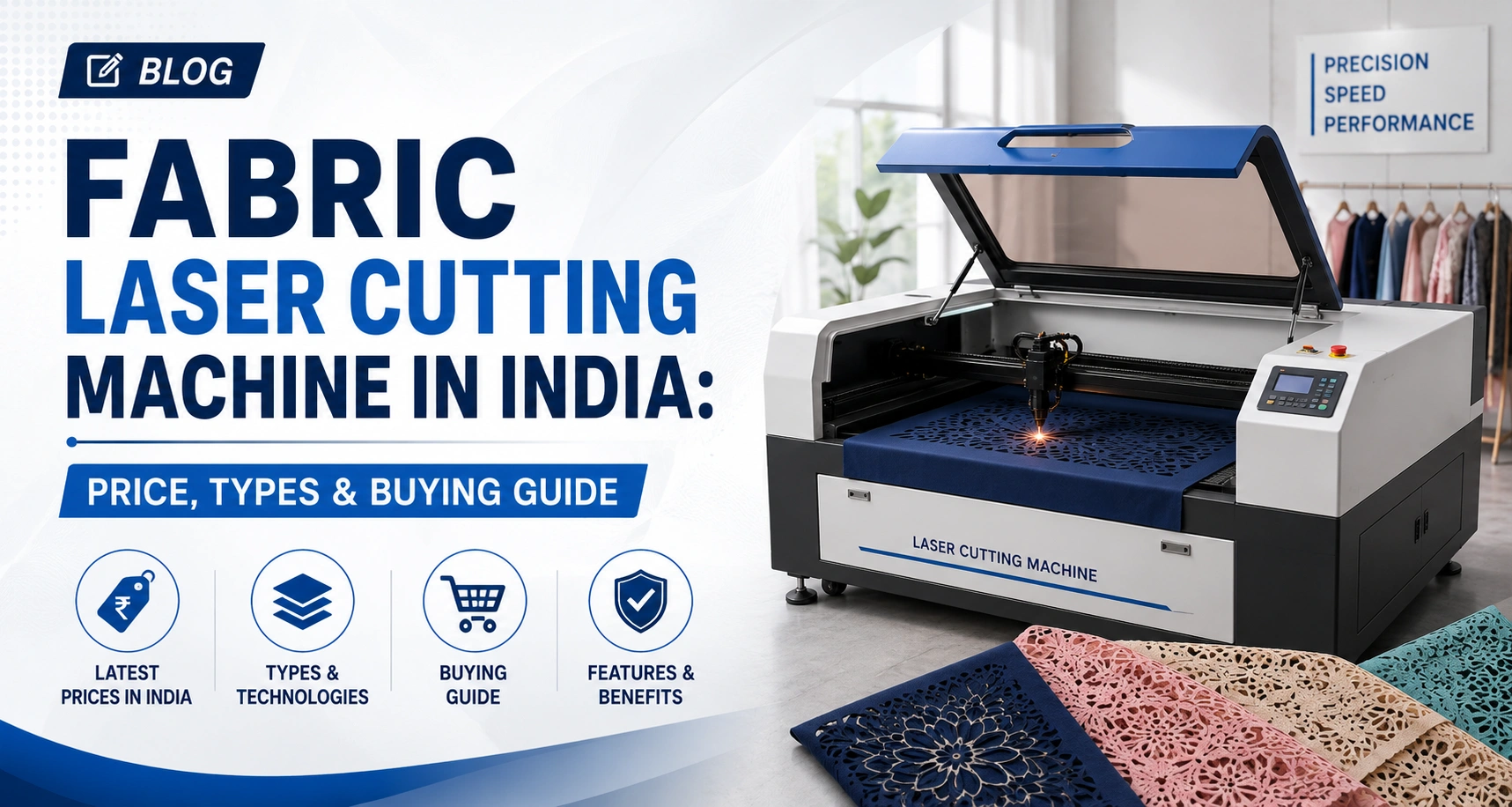
Garment and textile businesses switching from manual or die-based cutting to laser cutting usually do it for one of two reasons: they need cleaner, more consistent cuts at scale, or they’re tired of synthetic fabric edges fraying after the first wash. A fabric laser cutting machine solves both — but pricing in the Indian market varies enormously depending on power, automation level, and whether you actually need a fabric-specific machine or a general-purpose one.
Quick answer: Entry-level Fabric Laser Cutting Machine in India start around ₹1.9–2.65 lakh for basic single-head models suitable for small and mid-sized operations. Mid-range machines with higher power or additional features run ₹3.87–4.67 lakh, while auto-feeding and double-head industrial machines — built for high-volume, continuous production — range from ₹6.5 lakh up to ₹14.5 lakh or more. The critical technical point most buyers miss: fabric cutting requires a CO2 laser, not a fiber laser — fiber lasers are built for metal and aren’t suitable for cutting textiles.
What Is a Fabric Laser Cutting Machine (And Why CO2, Not Fiber)?
A fabric laser cutting machine uses a focused laser beam — specifically a non-metal laser cutting head — to cut fabric and similar materials accurately and quickly, without any physical blade contact. This is worth being precise about, because the broader “laser cutting machine” category in India includes fiber laser machines built for cutting metal, which are a completely different technology and unsuitable for fabric. If you’re specifically shopping for fabric cutting, make sure any machine you’re evaluating is explicitly marketed as a CO2 fabric/textile laser cutter, not a general or fiber laser system — this distinction affects both the machine you need and the price you should expect to pay.
Materials and Industries It’s Used For
CO2 fabric laser cutters handle a wide range of materials: cotton, wool, silk, polyester, nylon, denim, and leather. This versatility is why the technology has spread across several industries beyond garment manufacturing:
- Apparel and garment manufacturing — precision pattern cutting at production scale
- Leather goods — bags, belts, and accessories requiring clean, consistent edges
- Home textiles — curtains, upholstery fabric, and similar large-format cutting
- Automotive interiors — seat covers and interior fabric components
- Footwear — from cutting insoles and uppers to decorative heel work and loop holes, where laser cutting’s precision and repeatability suit both mass production and detailed customization
Advantages Over Traditional Cutting Methods
- Non-contact cutting — no pressure is applied to the material, which means no deformation and no physical damage from blade force, particularly valuable for delicate or high-value fabrics.
- Sealed edges on synthetic fabrics — the heat from the laser fuses the cut edge on materials like polyester and nylon, significantly reducing fraying compared to mechanical cutting.
- Speed — laser cutting typically runs 3–4 times faster than traditional cutting methods, which directly translates into shorter production cycles at scale.
- Automation — CNC-driven operation reduces manual labor dependency and improves cutting consistency across large production runs, where human-operated cutting naturally introduces more variation.
Fabric Laser Cutting Machine Price in India (2026)
| Machine Type | Typical Price Range | Best For |
|---|---|---|
| Entry-level, single-head, manual feed | ₹1.9 lakh – ₹2.65 lakh | Small workshops, boutique or low-volume operations |
| Mid-range, higher power/features | ₹3.87 lakh – ₹4.67 lakh | Growing operations needing more consistent output |
| Auto-feeder, double-head | ₹6.5 lakh | Higher-volume production wanting reduced manual loading |
| Industrial auto-feeding, high-power (90W+) | ₹14.5 lakh and above | Large-scale, continuous production operations |
These figures reflect starting prices listed by multiple suppliers on B2B platforms as of mid-2026 — actual pricing depends heavily on specific configuration (power, bed size, automation features) and negotiated terms, and should be confirmed directly with suppliers rather than treated as fixed quotes.
What Actually Affects the Price
- Laser power (wattage). Higher wattage cuts faster and handles thicker or denser materials more effectively, but costs more — a 90W dual-head machine sits at the premium end of the market for exactly this reason.
- Single-head vs. double-head. Double-head machines cut two identical patterns simultaneously, roughly doubling output for high-volume operations, at a meaningfully higher price than single-head equivalents.
- Auto-feeding capability. Machines that automatically feed fabric from a roll cost considerably more than manual sheet-loading models, but reduce labor dependency significantly for continuous production runs.
- Working area/bed size. Larger cutting beds accommodate bigger fabric pieces or higher-volume batch cutting, which affects both machine cost and factory floor space requirements.
- Cooling system. Higher-power machines typically require more robust cooling (air or water-based) to sustain continuous operation, adding to both upfront and running costs.
Where These Machines Are Manufactured and Sold in India
Fabric laser cutting machine manufacturing and supply in India is spread across several established industrial hubs, including Maharashtra (notably Pune and the Mumbai/Thane region), Gujarat (Ahmedabad), and Tamil Nadu (Coimbatore, a significant textile manufacturing center in its own right). Most established suppliers list current pricing and specifications on B2B platforms like IndiaMART and TradeIndia, where you can compare multiple manufacturers’ current offerings, request product brochures, and initiate direct quotes.
How to Choose the Right Machine for Your Business
- Match power to your material and volume needs, not the other way around. A small boutique operation cutting lighter fabrics in modest volume doesn’t need a 90W industrial machine — that capacity (and cost) only makes sense once your production volume genuinely requires it.
- Decide whether auto-feeding is worth the premium. If you’re running continuous, high-volume production, the labor savings from auto-feeding can offset its higher upfront cost fairly quickly. For smaller, more varied batch work, manual feeding may remain more practical.
- Confirm the machine is CO2-based and explicitly rated for fabric, not a general-purpose or fiber system — this is the single most important technical check before purchasing.
- Request a live demonstration or sample cutting on your actual fabric types before committing, since cutting quality can vary meaningfully by material even among machines with similar specifications.
- Compare multiple suppliers, not just the lowest listed price. Warranty terms, after-sales service availability, and spare parts access vary significantly between manufacturers and matter more over the machine’s working life than the initial purchase price alone.
Common Mistakes When Buying
- Confusing fiber laser machines with fabric-suitable CO2 machines. This is the most consequential mistake a first-time buyer can make — fiber lasers are built for metal and simply aren’t appropriate for textile cutting, regardless of how a listing is worded.
- Buying based on the lowest listed starting price alone, without confirming what’s actually included (bed size, software, installation, training, warranty) at that price point.
- Underestimating power needs for thicker or layered materials. A machine that handles single-layer cotton well may struggle with multi-layer denim or leather — match power rating to your actual heaviest use case, not your average one.
- Skipping after-sales service verification. Laser cutting machines require occasional maintenance and part replacement; a supplier without accessible local service support can mean costly downtime later.
- Not budgeting for installation, training, and ongoing consumables (like laser tubes, which have a finite lifespan) beyond the machine’s sticker price.
FAQs
Q.1 What is the price of a fabric laser cutting machine in India?
Entry-level single-head machines start around ₹1.9–2.65 lakh, mid-range machines run roughly ₹3.87–4.67 lakh, and industrial auto-feeding, high-power machines can run ₹6.5 lakh up to ₹14.5 lakh or more, depending on power, automation level, and bed size.
Q.2 Should I buy a CO2 laser or a fiber laser machine for cutting fabric?
CO2 laser, specifically. Fiber laser machines are built for cutting metal and are not suitable for fabric or textile materials — confirming this distinction before purchasing is one of the most important checks a first-time buyer needs to make.
Q.3 What materials can a fabric laser cutting machine handle?
Cotton, wool, silk, polyester, nylon, denim, and leather are all commonly cut with CO2 fabric laser machines, spanning use cases from apparel and leather goods to home textiles, automotive interiors, and footwear components.
Q.4 Is a double-head machine worth the extra cost?
For high-volume production, generally yes — double-head machines cut two identical patterns simultaneously, roughly doubling output, which can offset the higher upfront cost fairly quickly at sufficient production scale. For smaller or more varied operations, a single-head machine is often more cost-effective.
Q.5 Does laser cutting actually reduce fabric fraying?
Yes, particularly for synthetic materials like polyester and nylon — the laser’s heat fuses the cut edge as it cuts, meaningfully reducing fraying compared to traditional mechanical cutting methods.
Conclusion
Choosing a fabric laser cutting machine in India comes down to matching power, automation level, and bed size to your actual production needs — not simply picking the lowest advertised price. Confirm you’re evaluating a genuine CO2 fabric-rated machine, request a sample cut on your specific materials, and weigh supplier service support alongside the purchase price itself. If you’re setting up a new textile or garment business around this kind of equipment, our guide on How to Register a Sole Proprietorship in India covers the foundational business setup steps, or explore the full Business, Money & Career Guide.