

You’ve decided to get in shape. You open YouTube, and within minutes you’re buried in advice: six-day splits, fancy supplements, and workouts that would humble a professional athlete. No wonder so many people quit before they even begin.
Here’s the good news. The best workout program for beginners isn’t complicated. It’s simple, consistent, and built around a few key movements. This guide walks you through exactly what to do, how often to do it, and how to avoid the mistakes that sideline most newcomers.
What Makes the Best Workout Program for Beginners?
Not every routine suits someone just starting out. A good beginner workout plan shares a few traits:
- Full-body focus: You train every major muscle group several times a week, which speeds up learning and progress.
- Low complexity: Basic exercises beat trendy, complicated ones.
- Progressive overload: You gradually add weight, reps, or time so your body keeps adapting.
- Built-in recovery: Rest days let your muscles repair and grow.
- Sustainability: If you dread it, you won’t stick with it.
According to the U.S. Department of Health and Human Services, adults should aim for at least 150 minutes of moderate aerobic activity per week plus muscle-strengthening work on two or more days. The plan below fits comfortably inside those guidelines.
How Often Should Beginners Work Out?
For most people, three days per week is the sweet spot. Training on Monday, Wednesday, and Friday (or any non-consecutive days) gives your body a full day to recover between sessions.
Starting with more can backfire. Overly sore muscles, burnout, and injuries are common when beginners go from zero to six days a week. Think of your first month as building a habit, not chasing results at all costs.
Your 3-Day Full-Body Beginner Workout Plan
Each session should take about 40 to 50 minutes. Begin with a five-minute warm-up, such as brisk walking, arm circles, and bodyweight squats.
Day 1: Full-Body Strength A
- Goblet squat: 3 sets of 10 reps
- Push-ups (knees down if needed): 3 sets of 8 reps
- Dumbbell row: 3 sets of 10 reps per arm
- Glute bridge: 3 sets of 12 reps
- Plank: 3 holds of 20 to 30 seconds
Day 2: Full-Body Strength B
- Romanian deadlift (light dumbbells): 3 sets of 10 reps
- Dumbbell shoulder press: 3 sets of 8 to 10 reps
- Lat pulldown or assisted pull-up: 3 sets of 10 reps
- Reverse lunges: 3 sets of 8 reps per leg
- Dead bug: 3 sets of 10 reps
Day 3: Strength Plus Cardio
- Leg press or bodyweight squats: 3 sets of 12 reps
- Incline push-ups: 3 sets of 10 reps
- Seated cable row: 3 sets of 10 reps
- Farmer’s carry: 3 walks of 30 seconds
- Cardio finisher: 10 to 15 minutes of brisk walking, cycling, or light jogging
Rest 60 to 90 seconds between sets. Choose weights that make the last two reps challenging but still allow good form.
How to Progress Week by Week
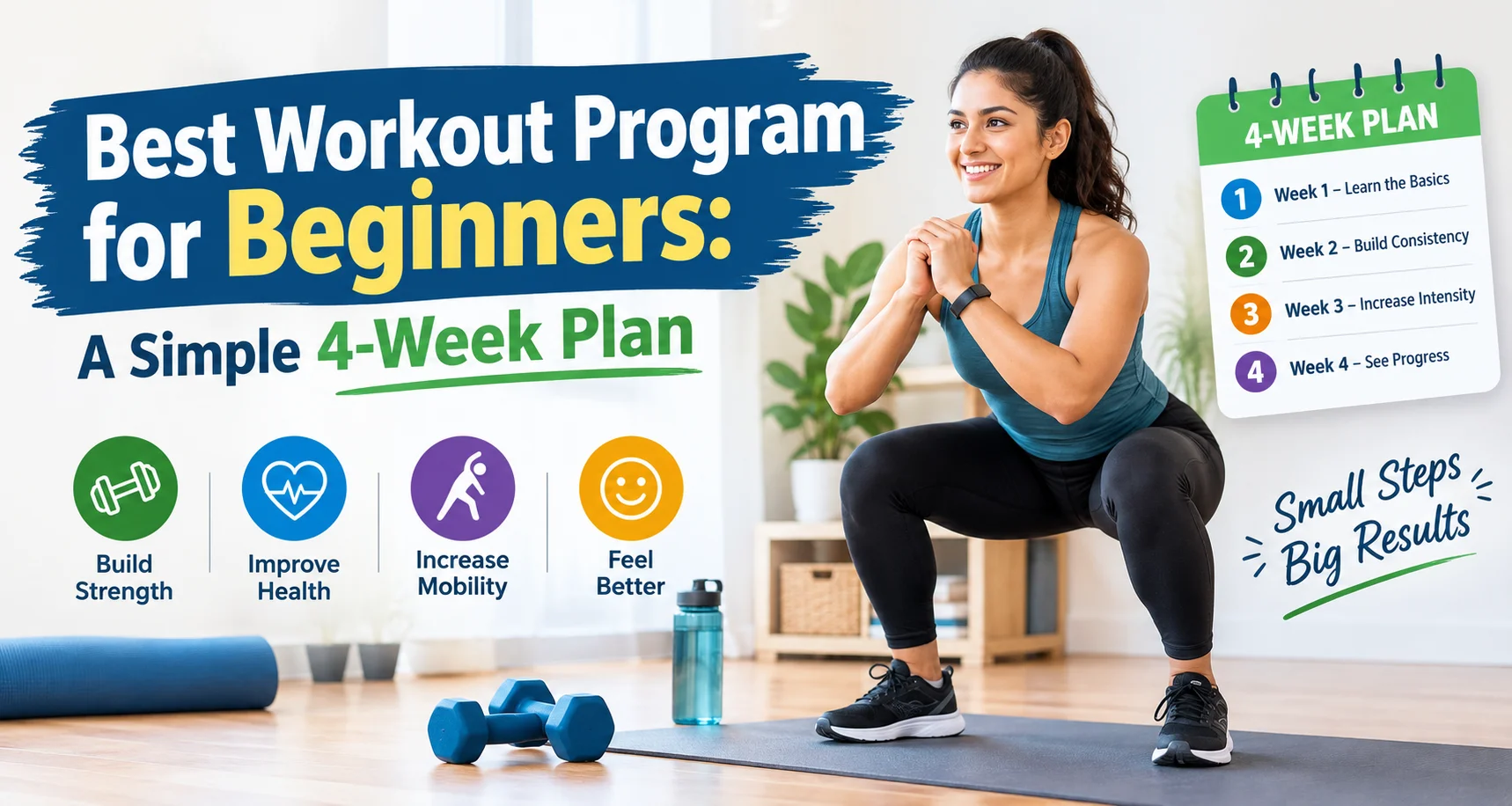
Progress doesn’t have to be dramatic. Here’s a simple four-week roadmap:
- Week 1: Learn the movements with light weights. Focus on form, not intensity.
- Week 2: Add a few pounds or one or two extra reps to each set.
- Week 3: Add a fourth set to your first two exercises each day.
- Week 4: Increase the weight again and extend your cardio finisher by five minutes.
Write your numbers down in a notebook or a free tracking app. Seeing your lifts creep upward is one of the best motivators there is.
Beginner Workout Mistakes to Avoid
Even the best workout program for beginners falls flat if these habits creep in.
- Skipping the warm-up. Cold muscles are more prone to strains. Five minutes is enough.
- Lifting too heavy, too soon. Ego lifting ruins form and invites injury. Master the movement first.
- Ignoring nutrition. You can’t out-train a poor diet. Prioritize protein, vegetables, whole grains, and plenty of water.
- Skipping sleep. Muscles recover while you rest. Aim for seven to nine hours a night.
- Comparing yourself to others. The person next to you may have trained for years. Your only competition is last week’s version of you.
Gym vs. Home: Where Should You Start?
Both work. A gym gives you access to machines, cables, and barbells, which is handy when you’re learning. A home setup, on the other hand, saves time and money.
If you’re training at home, a pair of adjustable dumbbells, a resistance band set, and a yoga mat cover most of the plan above. Swap the machine exercises for banded rows, step-ups, and push-up variations. The key principle, challenging your muscles a little more over time, works anywhere.
Simple Nutrition Tips to Support Your Results
You don’t need a strict meal plan to see progress. Start with these basics:
- Eat a source of protein, like eggs, chicken, Greek yogurt, beans, or tofu, at every meal.
- Fill half your plate with vegetables or fruit.
- Drink water throughout the day, especially around workouts.
- Limit sugary drinks and heavily processed snacks.
If you have a medical condition, are pregnant, or haven’t exercised in a long time, check with your doctor before starting any new fitness routine.
Final Thoughts: Start Small, Stay Consistent
The best workout program for beginners is the one you’ll actually follow. Three full-body sessions a week, a handful of foundational exercises, steady progress, and enough rest will take you much further than any extreme challenge ever could.
Give this plan four weeks. By the end, you’ll likely feel stronger, move better, and, most importantly, have a habit that sticks. Pick your start date, schedule your first session today, and take that first step.
Looking for more health, lifestyle, and fitness inspiration? Explore the latest articles at Magzilla Trends.
Frequently Asked Questions
1. What is the best workout program for beginners?
A three-day-per-week full-body routine is widely considered the best workout program for beginners. It covers every major muscle group, allows proper recovery, and is easy to follow.
2. How long should a beginner workout last?
Most beginners do well with 40 to 50 minutes per session, including a warm-up. Shorter, focused workouts are better than long ones that leave you exhausted.
3. Can beginners build muscle and lose fat at the same time?
Yes, especially in the first few months. Strength training combined with enough protein and a moderate calorie intake can support both goals, though progress varies from person to person.
4. Do I need a gym membership to start?
No. Bodyweight exercises, resistance bands, and a couple of dumbbells are enough to follow an effective beginner plan at home.
5. How soon will I see results?
Many people notice better energy and strength within two to four weeks. Visible changes in muscle tone typically take eight to twelve weeks of consistent training and good nutrition.