

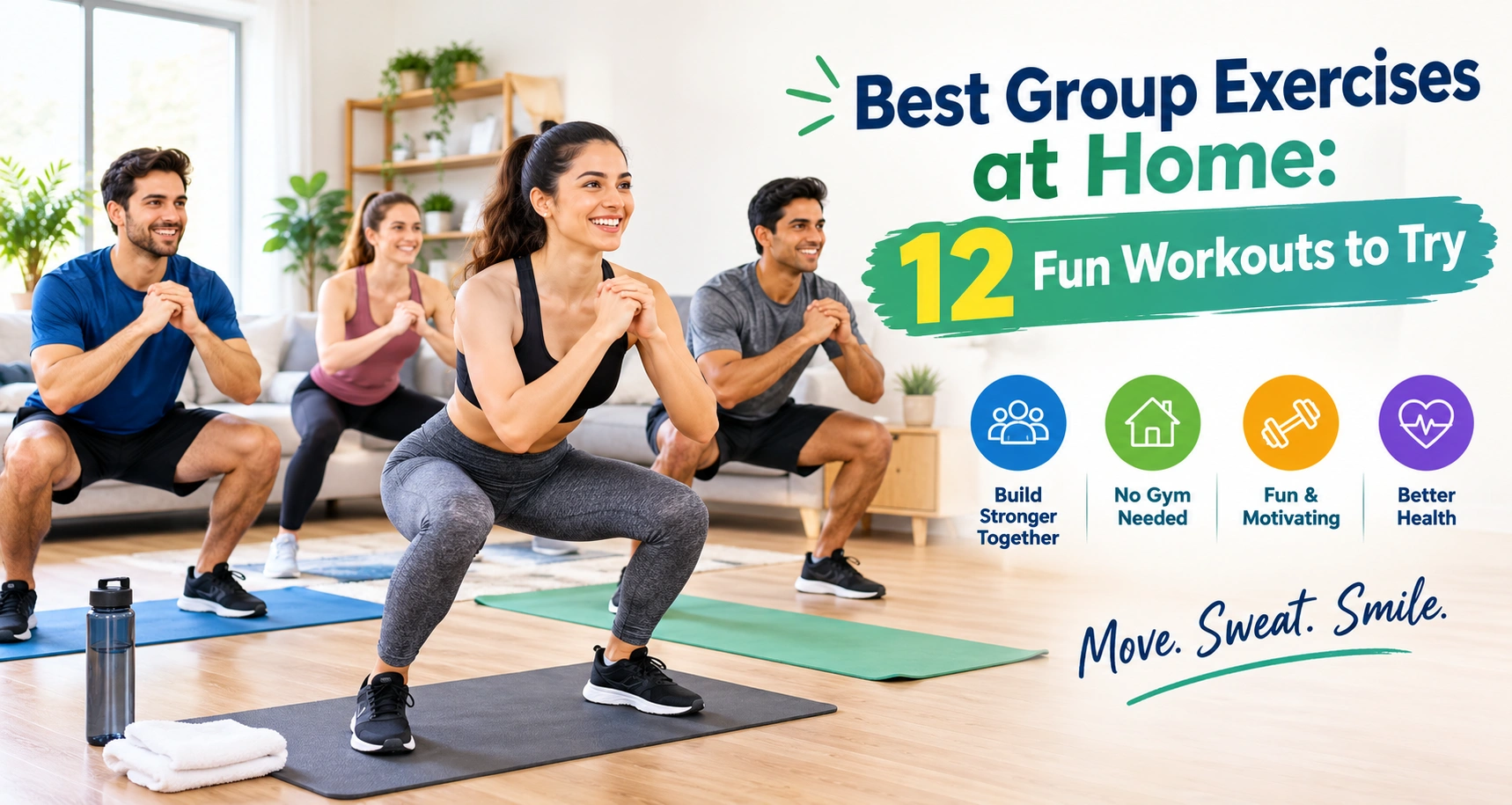
Working out alone is fine until it isn’t. You skip a Tuesday. Then a Thursday. Two weeks later the yoga mat is holding up a stack of laundry. But add one other person to the mix and something shifts. Suddenly there’s a reason to show up, because someone is waiting in the living room with the furniture already pushed against the wall.
That’s the quiet power behind the best group exercises at home. They turn fitness from a chore you owe yourself into something closer to a hangout. No gym membership, no commute, no waiting for a squat rack. Just a bit of floor space and a few people willing to sweat together.
Here’s how to make it work, whether your group is a family of four, two roommates, or a handful of neighbors who show up on Saturday mornings.
Why Group Workouts at Home Actually Work
Exercising with others isn’t just more pleasant. It changes behavior in measurable ways.
- Accountability is built in. Canceling on yourself costs nothing. Canceling on your sister costs something.
- You push harder. Most people work at a higher intensity in a group setting without even noticing the difference.
- Sessions last longer. Conversation makes 40 minutes feel like 20.
- It’s cheaper than everything else. No monthly fees, no fuel, no childcare scramble.
- The habit sticks. Shared routines survive bad weeks far better than solo ones.
For families in particular, home group exercise doubles as time together. Kids who see parents moving tend to move more themselves, and nobody has to drive anywhere.
Space and Equipment: Start Smaller Than You Think
You need less than you imagine. A 6×6 foot patch of clear floor per person is enough for most bodyweight training. Beyond that:
Nice to have, not required:
- Yoga or exercise mats
- A set of resistance bands (loop and long bands cover almost everything)
- One or two pairs of dumbbells or a kettlebell
- A sturdy chair or step
- A speaker, because music matters more than equipment
Free substitutes: water jugs for weights, a towel for sliders on hardwood, stairs for cardio, a backpack loaded with books for added resistance.
The Best Group Exercises at Home
1. Partner Circuit Training
Set up three to five stations around the room. Everyone rotates every 45 seconds with 15 seconds to switch. A simple circuit might be squats, push-ups, mountain climbers, glute bridges, and plank holds.
This format is the backbone of most home group workouts because it scales. A teenager and a 60-year-old can run the same circuit at different intensities and finish together.
2. Tabata and HIIT Rounds
Twenty seconds hard, ten seconds rest, eight rounds. Four minutes total per exercise. Call the moves out loud so everyone stays in sync.
Good Tabata picks: jumping jacks, high knees, squat jumps, skaters, burpees. Keep two or three low-impact swaps ready so anyone with knee issues can march instead of jump.
3. Follow-Along Dance Cardio
Put on a 30-minute dance workout video and let everyone flail. It’s the least intimidating entry point for people who describe themselves as “not really a workout person,” and it burns a genuine amount of energy.
4. Group Yoga or Stretch Flow
Perfect for evenings or recovery days. One person reads the sequence aloud while everyone moves through it. Sun salutations, seated forward folds, pigeon pose, and a long savasana at the end.
Bonus: it works across age gaps better than almost anything else on this list.
5. Partner Resistance Work
These require two people and nothing else:
- Partner-resisted rows: one holds a towel, the other pulls against resistance
- Wheelbarrow walks: one holds the other’s ankles while they walk on their hands
- Back-to-back wall sits: lean against each other, hold, suffer together
- Medicine ball passes: rotational throws build core strength fast
6. AMRAP Challenges
“As Many Rounds As Possible” in a fixed window. Pick three moves, set a 12-minute timer, and count rounds. Everyone works at their own pace but finishes at the same moment, which keeps the group together without forcing a shared fitness level.
7. Family Fitness Games
For households with kids, gamify it:
- Fitness dice (roll for exercise, roll for reps)
- Deck of cards, where each suit maps to a movement
- Animal walks: bear crawls, crab walks, frog jumps
- Obstacle courses built from couch cushions and painter’s tape
8. Strength Supersets with Shared Weights
If you own one set of dumbbells, pair up. One person does goblet squats while the other holds a plank, then swap. The rest period is built into the rotation and nobody stands around waiting.
Building a Weekly Schedule
A sample week that balances effort and recovery:
- Monday: Circuit training, 30 minutes
- Tuesday: Dance cardio or a brisk group walk
- Wednesday: Yoga flow, 25 minutes
- Thursday: Strength supersets
- Friday: HIIT or AMRAP
- Saturday: Family games or an outdoor session
- Sunday: Rest or gentle stretching
Three sessions a week is a genuinely good start. Consistency beats volume every time.
Keeping the Group Motivated
The first two weeks are easy. Week five is where groups fall apart. A few things that help:
- Lock in a fixed time. “After dinner Tuesdays and Thursdays” beats “sometime this week.”
- Rotate who leads. Shared ownership prevents one person from carrying the whole thing.
- Track something visible. A whiteboard with checkmarks works surprisingly well.
- Allow modifications openly. If people feel judged for scaling back, they stop coming.
- Keep it short when life is busy. A 15-minute session everyone attends beats a 45-minute one that gets skipped.
Safety Notes Worth Taking Seriously
Warm up for five minutes before anything intense. Clear the floor of cords, toys, and coffee table corners. Check ceiling height before anyone attempts jumping jacks. And if someone in the group is pregnant, recovering from injury, or managing a heart condition, they should talk to a doctor before starting a new routine.
Final Thoughts
The best group exercises at home aren’t the ones with the most complicated programming. They’re the ones your group will actually do on a Wednesday night when everyone is tired and the couch looks appealing. Start with a simple circuit, keep the sessions short, and let the social pull do the heavy lifting.
Six weeks from now, the hardest part won’t be the burpees. It’ll be remembering why you ever thought you needed a gym.
Frequently Asked Questions
Q.1 What are the best group exercises at home for beginners?
Beginners can start with simple bodyweight circuit exercises such as squats, wall push-ups, glute bridges, and marching in place. Try 30 seconds of activity followed by 30 seconds of rest. Aim for two or three 20-minute sessions each week and gradually increase the intensity over four to six weeks.
Q.2 How many people do you need for a group workout at home?
You can have an effective group workout with just two people. Partner exercises, such as wheelbarrow walks and resisted rows, are ideal for pairs, while circuit and AMRAP workouts can easily accommodate five or six participants. With larger groups, available space may become the main consideration.
Q.3 Can group exercises at home replace a gym membership?
For general fitness, weight management, and cardiovascular health, home group workouts can be an effective alternative to a gym membership. Bodyweight exercises and resistance bands can meet many fitness needs. However, those training for heavy powerlifting or sport-specific strength may eventually require equipment such as loaded barbells.
Q.4 What equipment do I need for home group workouts?
Very little equipment is required. A workout mat, resistance bands, and a pair of dumbbells can support a wide variety of home group exercises. Everyday items such as water jugs, towels, sturdy chairs, and stairs can also serve as practical alternatives.
Q.5 How long should a group workout at home last?
Most home group workouts can be completed in 20 to 40 minutes. Short, manageable sessions are often easier to maintain consistently. For example, a 25-minute workout three times a week can be more sustainable than an occasional one-hour session.