

Ever ordered shoes online, waited a week, and found they pinch your toes? Or maybe you’re shopping for a gift and have no idea what size to pick. In both cases, one question comes up: what is the average shoe size for height men can expect?
Height and foot length are linked, though not perfectly. A taller man usually has a longer foot, and a shorter man usually has a smaller one. In this guide, we’ll look at how the two connect, share a practical chart, and show you how to confirm your real size before you buy.
Why Height and Shoe Size Are Connected
Your body grows in proportion. As your bones lengthen during your teenage years, your feet grow along with your legs and torso. That is why basketball players often wear very large shoes while smaller-framed men tend to wear less.
Foot length typically makes up about 15% of a person’s height. So a man who is 6 feet tall (about 72 inches) often has a foot around 10.5 to 11 inches long. This is only a rough guide, but it explains why the average shoe size for height men rises steadily as height goes up.
What the Average Man’s Shoe Size Looks Like in the USA
The average adult American man is roughly 5 feet 9 inches tall and wears a shoe somewhere between size 9.5 and 10.5. Many footwear brands treat size 10 as the standard sample size, and retailers stock the most pairs in sizes 9 to 11.
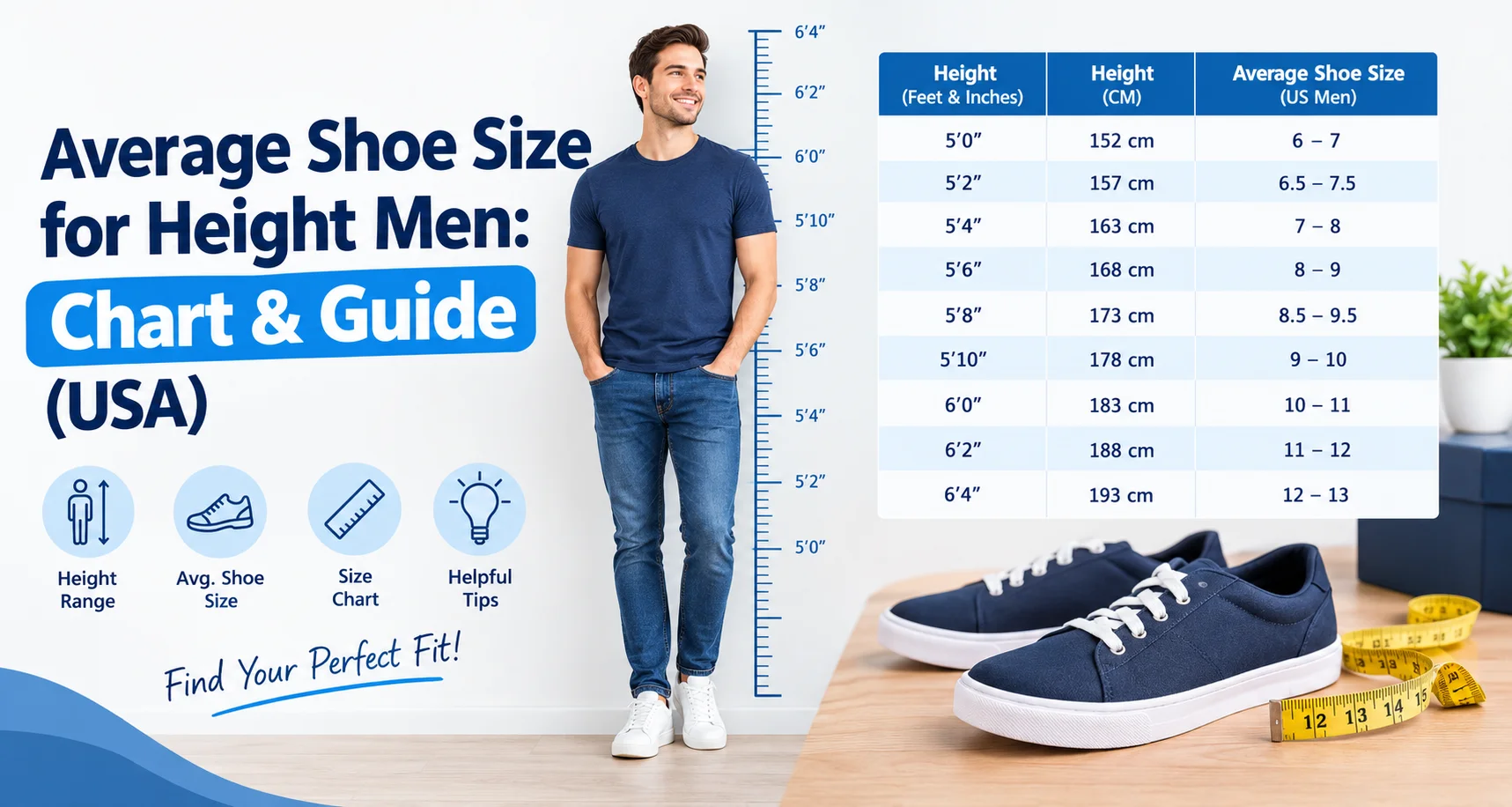
Average Shoe Size for Height Men: Quick Reference Chart
Use this table as a starting point. These are estimates based on common foot-length proportions and typical US men’s sizing.
| Height (ft/in) | Height (cm) | Average US Men’s Shoe Size |
| 5’0″ – 5’2″ | 152–157 | 6 – 7 |
| 5’3″ – 5’5″ | 160–165 | 7.5 – 8.5 |
| 5’6″ – 5’8″ | 168–173 | 9 – 9.5 |
| 5’9″ – 5’11” | 175–180 | 10 – 10.5 |
| 6’0″ – 6’2″ | 183–188 | 11 – 12 |
| 6’3″ – 6’5″ | 191–196 | 12.5 – 13.5 |
| 6’6″ and above | 198+ | 14 – 16 |
Keep in mind that this chart shows averages. Plenty of healthy men fall a size or two above or below these numbers.
Why the Chart Isn’t Always Accurate
Think of the chart as a helpful guess, not a rule. Several factors can push your real size away from the average.
Genetics and Family Traits
Some families simply have larger or smaller feet. If your father or grandfather had wide, long feet for their height, you may too.
Foot Width and Arch Type
Two men who are both 5’10” may need different shoes. One may have a narrow foot, while the other has a wide forefoot or a high arch. Width matters just as much as length for comfort.
Body Weight and Build
Heavier men often need a slightly bigger size or a wider fit, because the foot spreads under extra load.
Age and Foot Changes
Feet can lengthen and flatten with age, especially after years of standing or running. Many men find they go up half a size by their 40s or 50s without gaining any height.
How to Measure Your Foot Size at Home
Don’t rely only on a chart. A two-minute measurement gives you a far better result.
- Tape a sheet of paper to a hard floor, with the edge against a wall.
- Stand on the paper with your heel touching the wall.
- Mark the tip of your longest toe (it may not be the big toe).
- Measure from the wall to the mark in inches or centimeters.
- Repeat with the other foot and use the larger measurement.
Do this in the evening. Feet swell slightly during the day, so an evening measurement avoids shoes that feel tight later.
Quick US Men’s Size Conversion by Foot Length
- 9.6 inches (24.4 cm): size 7
- 9.9 inches (25.4 cm): size 8
- 10.2 inches (26 cm): size 9
- 10.6 inches (27 cm): size 10
- 10.9 inches (27.9 cm): size 11
- 11.3 inches (28.7 cm): size 12
Always check the specific brand’s size chart as well, since measurements can vary slightly.
Tips for Choosing the Right Shoe Size
Knowing the average shoe size for height men gives you a baseline. These habits help you finalize the fit:
- Leave the thumb-width room. Aim for roughly half an inch between your longest toe and the front of the shoe.
- Try shoes on later in the day. Your feet are at their largest then.
- Wear the socks you’ll actually use. Athletic socks and dress socks change the fit.
- Walk around the store. Check that your heel doesn’t slip and your toes can wiggle.
- Check each brand’s chart. A size 10 in one brand can fit like a 9.5 or 10.5 in another.
- Read return policies when buying online. Free returns make it easier to swap sizes.
Shoe Size Differences by Shoe Type
Not every shoe fits the same way, even in your usual size.
- Running shoes: Most runners go up half to a full size to allow for foot swelling.
- Dress shoes: These tend to run narrower, so you may need a wider cut.
- Boots: A thicker sock often means sizing up slightly.
- Sneakers: Fit varies widely, so rely on the brand’s size guide.
If you enjoy keeping up with fashion and footwear trends, you can find more style inspiration at Magzilla Trends.
Frequently Asked Questions
1. What is the average shoe size for a 6-foot man?
A man who is 6 feet tall typically wears a US size 11 to 12. Some will be slightly smaller or larger depending on foot width and genetics.
2. What is the average shoe size for a man in the USA?
The typical adult American man wears around a size 10, with most men falling between sizes 9 and 11.
3. Is shoe size really related to height?
Yes, in general. Taller men tend to have longer feet. However, the relationship isn’t exact, so a man’s actual size can differ from the average by a size or two.
4. Can a short man have big feet?
Absolutely. Genetics and body structure play a large role. Some men who are 5’6″ wear a size 10 or more, and some tall men have surprisingly small feet.
5. Should I trust a height-to-shoe-size chart when buying shoes?
Use it as a rough guide only. For the best fit, measure your foot at home and compare it with the brand’s own size chart.
Final Thoughts
The average shoe size for height men gives a useful starting point, whether you’re buying for yourself or someone else. A 5’9″ man usually wears around size 10, while someone who is 6’3″ often needs size 12.5 to 13.5. Still, your feet are unique. Genetics, width, arch type, and age all affect what fits best.
So use the chart for a quick estimate, then confirm with a proper foot measurement and a try-on. Do that, and you’ll avoid pinched toes, wasted returns, and uncomfortable days.