

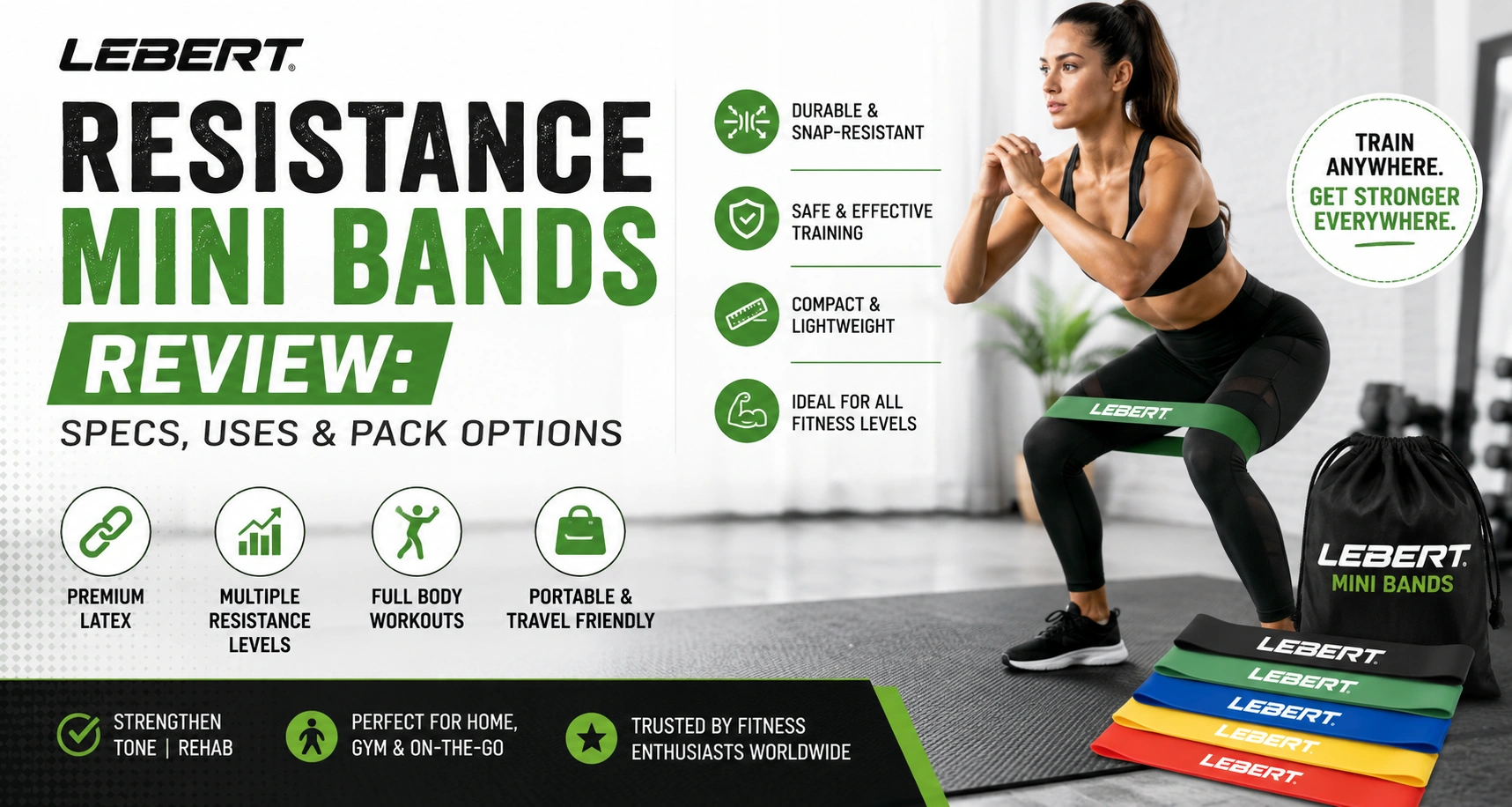
Mini loop bands are one of those pieces of equipment that seem interchangeable until you actually use a cheap one — rolling mid-set, losing tension unevenly, or simply wearing out after a few weeks. Lebert Fitness, the brand behind the well-known EQualizer bodyweight training bars, brings that same “built to actually last” positioning to its Mini Bands line.
Quick answer: Lebert Resistance Mini Bands are 12″ x 2″ natural latex loop bands sold in color-coded resistance levels, used for glute, hip, thigh, and shoulder activation, general strength and mobility work, and physical therapy rehab exercises. They’re available in a 3-pack (Light/Medium/Heavy) or an expanded 5-pack covering a wider resistance range — worth noting upfront that the two pack options use different color-to-resistance mappings, so it’s worth checking which pack you’re buying rather than assuming a color always means the same resistance level.
What Are Lebert Resistance Mini Bands?
According to Lebert Fitness’s own product listing, the Mini Bands are professional-grade, all-stretch loop bands measuring 12 inches by 2 inches, made from durable natural latex rubber engineered to hold its elasticity over years of regular use — a meaningful claim given how quickly cheaper bands tend to lose tension or develop weak points. They’re marketed as multi-functional, usable around the ankles, knees, legs, thighs, or wrists depending on the exercise, and are positioned for a genuinely wide range of applications: strengthening, toning, mobility and warm-up work, and physical therapy rehabilitation.
Pack Options: A Real Discrepancy Worth Knowing About
This is worth flagging clearly, since it isn’t obvious from browsing quickly: Lebert’s 3-pack and the newer 5-pack use different color-to-resistance mappings.
| Pack | Colors and Resistance |
|---|---|
| 3-Pack (Light/Medium/Heavy) | Red = Light, Yellow = Medium, Black = Heavy |
| 5-Pack (expanded range) | Yellow = Light (5–20 lbs), Green = Medium (20–35 lbs), Blue = Heavy (35–40 lbs), Black = Extra Heavy (40–45 lbs), Red = Extra Extra Heavy (45–50 lbs) |
Notice that red means “light” in the 3-pack but “extra extra heavy” in the 5-pack, and black means “heavy” in one and “extra heavy” in the other. If you’re combining bands from both packs, or replacing a single band, don’t assume a color you remember from one pack matches the same resistance level in the other — check the specific pack’s resistance labeling directly rather than relying on color memory alone.
Key Features Of Lebert Resistance Mini Bands
| Feature | Detail |
|---|---|
| Size | 12″ x 2″ (all bands, both pack options) |
| Material | Natural latex rubber, professional-grade |
| Durability | Engineered to maintain elasticity over years of use, per Lebert |
| Primary use areas | Glutes, thighs, hips, shoulders; also usable at ankles, knees, wrists |
| Application range | Strength training, toning, mobility/warm-up, physical therapy rehab |
| Portability | Lightweight and compact — fits easily in a gym bag |
What You Can Actually Do With Them
Lebert positions the Mini Bands around a genuinely broad set of use cases, spanning both general fitness and rehabilitation contexts:
General strength and mobility work:
- Lateral band walks and monster walks for glute and hip activation
- Goblet squats with added band tension
- Isometric holds for coordination and stability work
- Shoulder mobility and warm-up sequences using the band around the wrists
Physical therapy and rehab applications: Lebert specifically markets the Mini Bands for use in recovery from torn ACL and MCL injuries, knee replacement rehabilitation, and patella or meniscus rehab. This is a meaningful claim worth treating with the appropriate caveat — resistance bands are a genuinely common tool in real physical therapy programs, but any post-surgical or injury rehab exercise should be guided by a physical therapist or qualified clinician, not self-directed based on product marketing alone, given how much rehab programming depends on the specific injury, surgery type, and healing timeline.
Lebert Mini Bands vs. Lebert Hip Resistance Band
Since both products come from the same brand and cover overlapping use cases, it’s worth understanding how they differ:
| Factor | Mini Bands | Hip Resistance Band |
|---|---|---|
| Size | 12″ x 2″ | 14″ x 3.5″ |
| Material | Natural latex rubber | Cotton/polyester blend with latex interior |
| Pack options | 3-pack or 5-pack, multiple resistance levels | Sold as a single band |
| Best for | General strength, mobility, rehab, multiple body areas | Specifically glute/hip activation with anti-roll fabric construction |
| Washability | Not specifically marketed as machine washable | Fully machine washable |
In practice, these aren’t competing products so much as complementary ones — the Mini Bands offer more resistance-level variety and broader multi-area use (ankles, wrists, knees), while the Hip Resistance Band’s wider fabric construction is specifically built to resist rolling during lateral hip and glute work. Several Lebert bundle listings sell them together for exactly this reason.
Mini Bands vs. F.A.T. Bands: Don’t Confuse the Two
Lebert also sells a separate product line called F.A.T. (Functional Assisted Training) Bands, which are a different style entirely — longer, wider looped bands (ranging from ½” to 1⅗” wide) designed for assisted pull-ups, dips, and higher-resistance strength work (15–120 lbs depending on band size), rather than the smaller-scale glute and mobility work the Mini Bands are built for. If you’re specifically looking for assisted bodyweight training support, the F.A.T. Bands — not the Mini Bands — are the right product to search for.
Who These Are Actually Good For
- Anyone building a home mobility or activation routine who wants multiple resistance levels in one purchase rather than buying single bands individually.
- Trainers and coaches who need a versatile, portable tool that works across several body areas and client needs.
- People in a physical therapy program using bands as part of guided rehab exercises — with the understanding that program design should come from their clinician, not the product listing.
- Anyone who’s had cheaper mini bands snap, roll, or lose tension and wants a more durable alternative.
Probably not necessary for: someone who only wants light glute activation work and doesn’t need a range of resistance levels — a single band (like the Hip Resistance Band) may be simpler and sufficient for that narrower use case.
Pros and Cons
Pros:
- Genuinely versatile across multiple body areas (glutes, thighs, shoulders, ankles, wrists)
- Backed by a brand with a multi-decade track record in bodyweight and resistance equipment
- Available in a range of resistance levels for progressive training
- Compact and portable
Cons:
- The 3-pack and 5-pack use different color-to-resistance mappings — a genuine source of confusion if you’re not careful about which pack you’re referencing
- Not specifically marketed as machine washable, unlike Lebert’s fabric Hip Resistance Band
- Rehab-related marketing claims (ACL, MCL, knee replacement) shouldn’t be treated as a substitute for actual clinician-guided programming
FAQs
Q.1 What size are Lebert Resistance Mini Bands?
All Lebert Mini Bands measure 12 inches by 2 inches, regardless of resistance level or which pack (3-pack or 5-pack) you purchase.
Q.2 What’s the difference between the 3-pack and 5-pack color coding?
They use different mappings entirely — in the 3-pack, red is light and black is heavy; in the 5-pack, yellow is light and red is the heaviest option. Always check the specific resistance labeling on the pack you’re buying rather than assuming color consistency across Lebert’s product range.
Q.3 Can I use Lebert Mini Bands for physical therapy rehab?
Lebert markets them for use in recovery from injuries like torn ACL/MCL, knee replacement, and meniscus rehab, and resistance bands are a common tool in real PT programs. That said, any rehab exercise program should be designed and guided by a physical therapist or clinician familiar with your specific injury and recovery stage, not self-directed from product marketing alone.
Q.4 Are Lebert Mini Bands different from the Lebert Hip Resistance Band?
Yes — the Mini Bands are smaller (12″x2″), made of latex, and sold in multiple resistance levels for broader multi-area use. The Hip Resistance Band is a single, wider (14″x3.5″) fabric band specifically built to resist rolling during lateral hip and glute exercises. Many people use both together.
Q.5 What’s the difference between Mini Bands and F.A.T. Bands?
They’re different product lines — Mini Bands are small loop bands for activation and mobility work, while F.A.T. Bands are larger, higher-resistance looped bands designed for assisted pull-ups, dips, and heavier strength training.
Conclusion
Lebert Resistance Mini Bands are a versatile, durable option for anyone building a home mobility, activation, or light rehab routine, backed by a brand with a genuine track record in resistance training equipment. The one thing worth double-checking before you buy: confirm which pack (3-pack or 5-pack) you’re purchasing and its specific color-to-resistance mapping, since Lebert’s own listings aren’t consistent on this point. For a wider-band alternative built specifically for glute and hip work, see our review of the Lebert Fitness Hip Resistance Band, or explore the full Fitness & Workout Guide.