

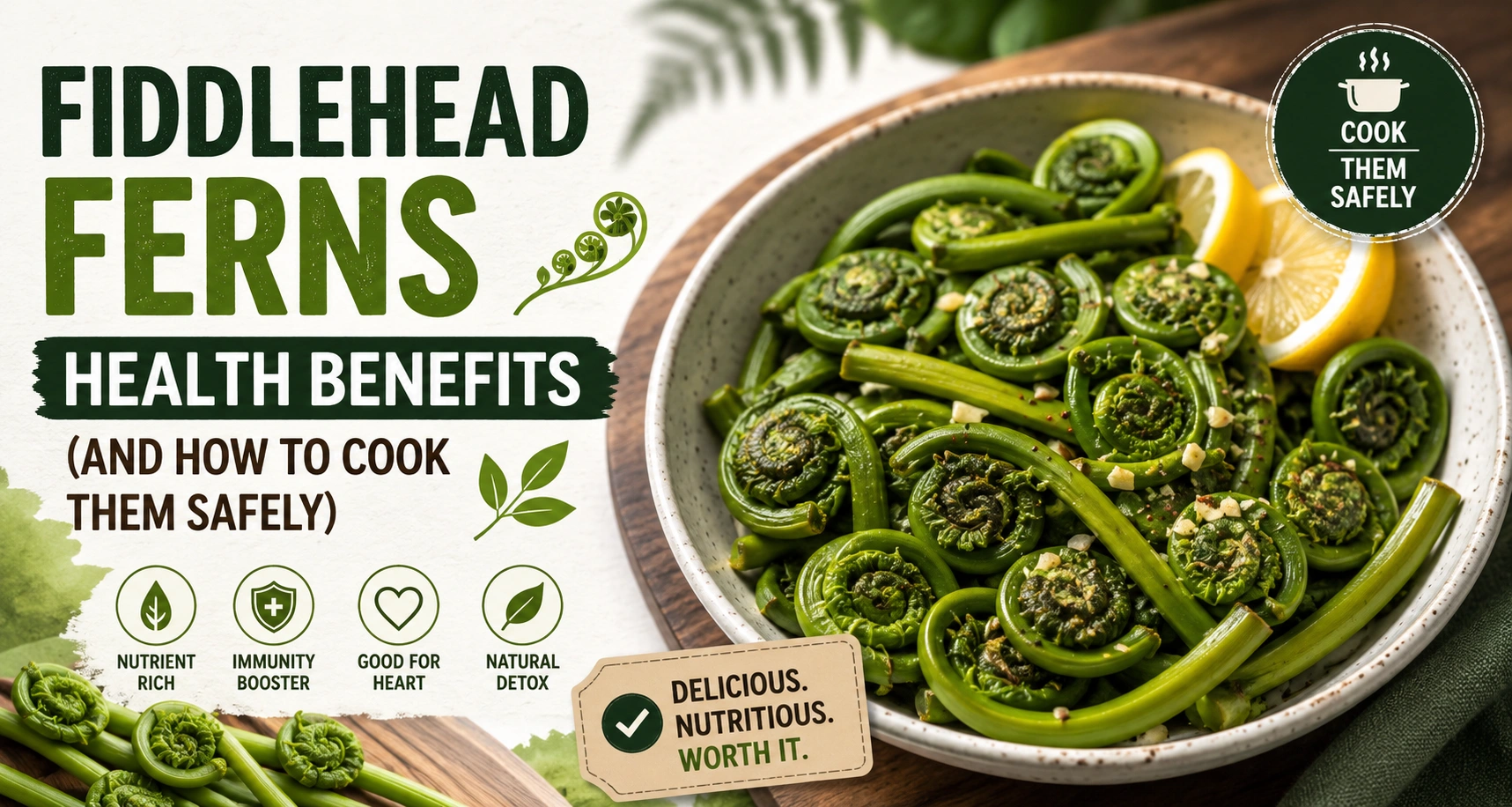
Fiddlehead Ferns Health Benefits show up for only a few weeks each spring, and that short window is part of why they’re treated as a delicacy rather than a pantry staple. They’re also one of the rare vegetables where the nutrition benefits and the safety warnings deserve genuinely equal attention — this is not a “wash and eat” green.
Quick answer: Fiddlehead ferns (the young, coiled fronds of the ostrich fern) are a good source of omega-3 fatty acids, antioxidants (including vitamins A and C), potassium, vitamin K, folate, and iron, with research suggesting antioxidant levels that rival spinach. But they must be thoroughly cooked before eating — the CDC and food safety authorities in both the US and Canada have documented real foodborne illness outbreaks tied to raw or undercooked fiddleheads, so this is one vegetable where correct preparation isn’t optional.
What Are Fiddlehead Ferns?
Fiddleheads are the young, tightly coiled fronds of the ostrich fern (Matteuccia struthiopteris), harvested in early spring before they unfurl into full fern leaves. Their name comes from their resemblance to the scroll-shaped head of a fiddle. They’re most commonly foraged and sold commercially in the northeastern United States, the upper Midwest, and coastal Canada, with a season that typically lasts only a few weeks. Outside their brief fresh season, they’re also available frozen or canned.
Taste-wise, they’re often described as a cross between asparagus, green beans, and spinach — slightly grassy, slightly bitter, with a texture that holds up well to sautéing, steaming, or boiling.
Nutrition Profile
| Nutrient | Notable Content |
|---|---|
| Omega-3 fatty acids | A genuinely good plant source, uncommon among vegetables |
| Vitamin A and C | High antioxidant content — early research has compared levels favorably to spinach |
| Vitamin K | Supports bone health and blood clotting function |
| Potassium | Supports fluid balance and normal muscle function |
| Folate | Important for cell division and particularly relevant during pregnancy |
| Iron, zinc, copper, manganese | A useful spread of trace minerals in a single vegetable |
Fiddlehead Ferns Health Benefits
Antioxidant content. Fiddleheads are rich in antioxidant compounds, including vitamins A and C — research has suggested their antioxidant levels can rival more familiar antioxidant-dense greens like spinach, which is a notable claim for a vegetable most people have never tried.
Omega-3 fatty acid content. This is one of the more distinctive things about fiddleheads nutritionally — omega-3s are more commonly associated with fish than vegetables. Adequate omega-3 intake is broadly associated with cardiovascular health, healthy neurological function, and is particularly emphasized during pregnancy for fetal neurological and eye development.
Bone and blood health support. The vitamin K content in fiddleheads contributes to normal blood clotting function and is broadly associated with bone health as part of an overall balanced diet.
Mineral variety in a single vegetable. Zinc, copper, manganese, and iron together support a range of basic bodily functions, from immune function to energy metabolism — having several of these in one seasonal vegetable is a genuine nutritional bonus, even in the modest quantities typical of a single serving.
As with most single-food health claims, fiddleheads are best understood as one nutritious component of a varied diet, not a standalone solution to any specific health concern — and given their brief season, they’re realistically an occasional addition rather than a dietary staple for most people.
The Most Important Section: Fiddlehead Food Safety
This is not a minor caveat — it’s the single most important thing to know before eating fiddleheads, and it deserves more attention than most nutrition-focused articles give it.
Fiddleheads must be thoroughly cooked. Never eat them raw or undercooked. The CDC has documented real, confirmed outbreaks of foodborne illness tied specifically to raw or undercooked fiddleheads — including a well-known 1994 investigation covering restaurant-linked illness in New York and western Canada, where a majority of surveyed patrons who ate undercooked fiddleheads developed symptoms. Food safety authorities in both the US and Canada continue to warn about this risk today, and outbreaks have been recorded going back to at least 1994.
What causes the illness: health authorities have identified this as being caused by a natural toxin in the raw fiddlehead that is broken down by thorough cooking. The exact toxin hasn’t been definitively pinpointed, but the fix is well established and consistent across every food safety authority that has studied it: cook them properly, and the risk drops dramatically.
Symptoms if undercooked fiddleheads are eaten: nausea, vomiting, diarrhea, abdominal cramps, and headaches, typically beginning 30 minutes to 12 hours after eating. Illness is generally self-limiting and resolves within 24 hours to a few days, but dehydration is a real concern for vulnerable groups — young children, older adults, and anyone with an existing health condition. Seek medical care if symptoms are severe or persist.
How to Cook Fiddleheads Safely
- Clean thoroughly. Peel away the papery brown husk with your fingers as much as you can, then run the fiddleheads under several rounds of cold water, swishing them around each time, until no grit or husk fragments remain.
- Cook them fully — this step has a wider margin for error than you’d expect if you skip it. Drop them into a pot of vigorously boiling water and let them cook for a full 15 minutes, or place them in a steamer basket over simmering water for 10–12 minutes, until they’ve softened and lost their raw, springy texture.
- Pour out the water you cooked them in and start fresh for anything else. The liquid they were cooked in isn’t safe to repurpose into a broth or sauce base, since it’s likely carrying whatever was cooked out of the fiddleheads themselves.
- Only then sauté, fry, bake, or add to another dish. Cooking methods like a quick sauté are fine as a finishing step, but they aren’t a substitute for the initial thorough boil or steam.
- If freezing for later, give them a quick two-minute dunk in boiling water first, pour that water away, shock them in a bowl of ice-cold water to stop the cooking, let them drain well, and then bag them up for the freezer — handled this way, they’ll hold their quality for up to twelve months.
Some culinary sources suggest shorter cooking times (6–10 minutes) for a firmer, more al dente texture. Given the documented illness risk, this article follows the more conservative guidance from food safety authorities (CDC, Health Canada, University of Maine Cooperative Extension) rather than culinary preference — when food safety guidance and taste preference conflict on a food with a real illness history, safety guidance should win.
Make Sure You Have the Right Fern
Not all ferns are edible, and some are genuinely toxic or carcinogenic — this matters most if you’re foraging rather than buying from a grocery store or reputable seller. The edible ostrich fern fiddlehead can be identified by:
- A brown, papery scale-like covering on the coiled frond
- A smooth stem (not fuzzy or hairy)
- A deep U-shaped groove running along the inside of the stem
Ferns to avoid entirely: bracken fern and foxglove fern are not safe to eat and may be toxic or carcinogenic. If you’re not confident distinguishing ostrich fern fiddleheads from other fern species, buying from a reputable grocer or farmers market vendor is a meaningfully safer choice than foraging without expert guidance.
Who Should Be Extra Cautious
- Children and older adults, who are more vulnerable to dehydration if foodborne illness does occur.
- Anyone foraging fiddleheads themselves without confirmed expertise in identifying the correct fern species.
- Pregnant women and anyone with a compromised immune system — general food safety caution around any undercooked food applies with extra weight here, alongside the standard “cook thoroughly” guidance that applies to everyone.
FAQs
Q.1 Are fiddlehead ferns safe to eat?
Yes, when thoroughly cooked — boiled for at least 15 minutes or steamed for 10–12 minutes. Eating them raw or undercooked carries a real, documented risk of foodborne illness, confirmed by CDC-investigated outbreaks and ongoing warnings from US and Canadian food safety authorities.
Q.2 What do fiddlehead ferns taste like?
Most people describe the flavor as a cross between asparagus, green beans, and spinach — slightly grassy and slightly bitter, with a texture similar to a firm green vegetable once properly cooked.
Q.3 Can you eat fiddleheads raw?
No. This is not a matter of preference — raw or undercooked fiddleheads have caused confirmed, documented outbreaks of foodborne illness, and every major food safety authority that has studied the issue recommends thorough cooking before eating.
Q.4 How long do you need to cook fiddleheads?
Food safety authorities recommend boiling for at least 15 minutes or steaming for 10–12 minutes, then discarding the cooking water before using the fiddleheads in another dish.
Q.5 What are the main Fiddlehead Ferns Health Benefits?
They’re a notable plant source of omega-3 fatty acids, rich in antioxidants (vitamins A and C), and contain vitamin K, potassium, folate, and a range of trace minerals — a nutritionally dense vegetable, best enjoyed as an occasional seasonal addition given their short availability window.
Q.6 How can I tell if I have the right (edible) fiddlehead fern?
Edible ostrich fern fiddleheads have a brown, papery covering, a smooth (not fuzzy) stem, and a deep U-shaped groove on the inside of the stem. If you’re not confident identifying this correctly, buying from a reputable seller is safer than foraging without expert guidance.
Conclusion
Fiddlehead Ferns Health Benefits genuinely earn their reputation as a nutritious seasonal delicacy — rich in antioxidants, a rare plant source of omega-3s, and packed with a useful spread of vitamins and minerals. But the health benefits only matter if they’re prepared safely: cook them thoroughly (boiled 15 minutes or steamed 10–12), discard the cooking water, and make sure you’re working with genuine ostrich fern fiddleheads if foraging yourself. Treat the cooking guidance in this article as non-negotiable, not optional — it’s the difference between a nutritious spring delicacy and a documented cause of foodborne illness.