

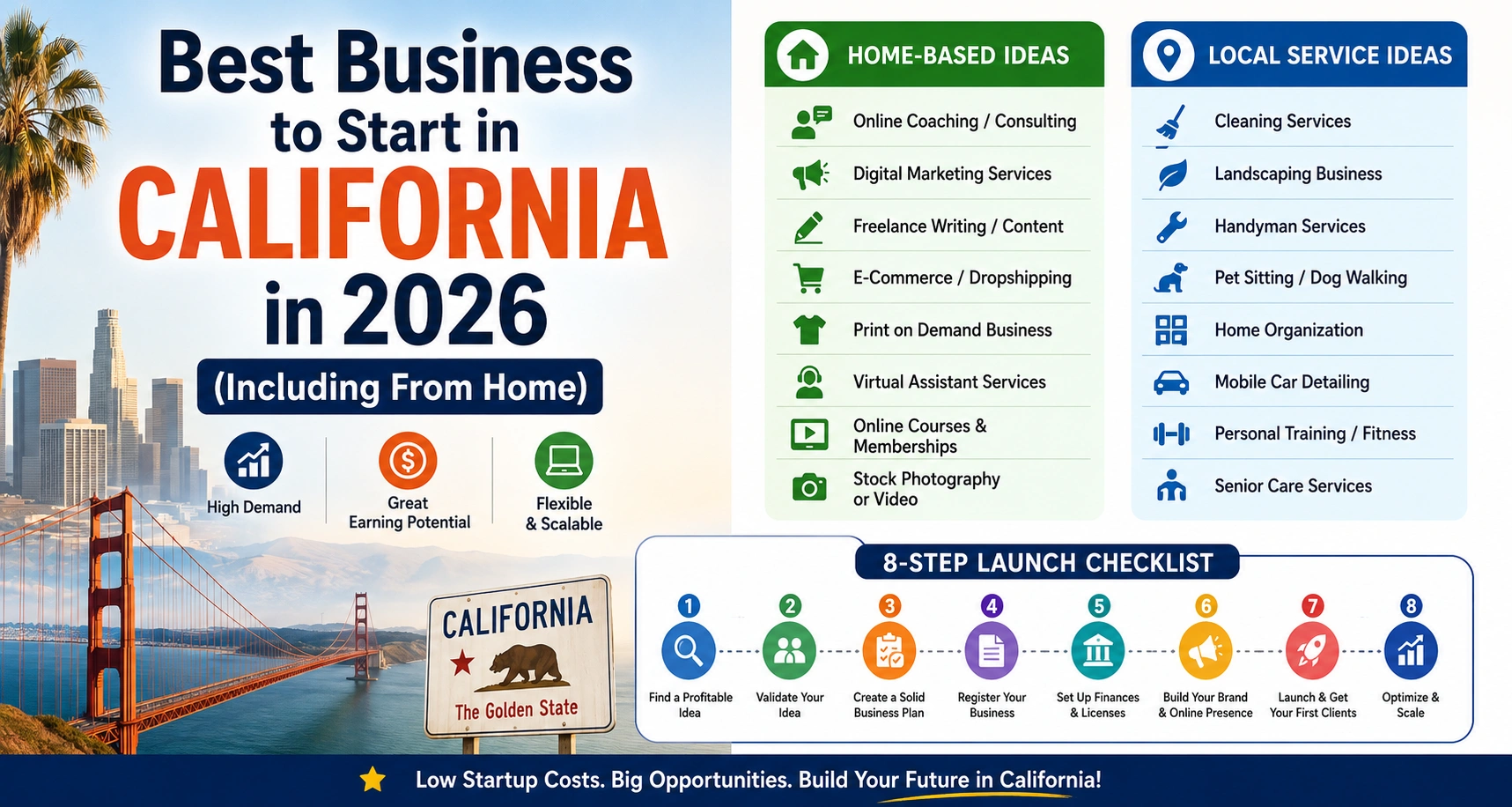
California is a genuine paradox for new business owners: a market of over 39 million people with more spending power and diversity than almost anywhere else in the country, wrapped in some of the strictest, most expensive regulatory conditions in the US. The businesses that do well here tend to be the ones built with that tension in mind from day one, not figured out after the fact.
Quick answer: The Best Business to Start in California in 2026 split into two categories. From home, e-commerce, consulting, freelance digital services, and online education have the lowest overhead and fewest location-specific regulatory hurdles. As a local service business, pressure washing, cleaning services, mobile pet grooming, and licensed trades like HVAC and plumbing tend to offer the strongest margins, with skilled trades reporting owner earnings that can exceed $200,000 annually after 3–5 years, though they require more upfront licensing and investment.
This article is for general informational purposes and isn’t legal, tax, or financial advice. Business licensing, zoning, and tax requirements vary by city and county in California — consult a licensed attorney or accountant before making formation decisions specific to your business.
Why California Is Both an Opportunity and a Challenge
Before picking an idea, it’s worth understanding the two forces pulling in opposite directions here:
The opportunity: California offers a market of roughly 39.24 million people, one of the most diverse economies in the world, and deep talent pools that make hiring and scaling genuinely easier than in smaller states.
The challenge: the state also carries a statewide minimum wage of $16/hour (higher in many cities), commercial real estate costs running roughly 2–3 times the national average, among the highest workers’ compensation insurance premiums nationally, and California’s AB5 law, which sets strict rules around classifying workers as independent contractors versus employees — a genuine compliance risk for businesses that lean heavily on freelance or gig labor.
The practical takeaway: businesses with low physical overhead and simple staffing structures tend to have an easier time in California’s regulatory environment than businesses that need significant commercial space or a large contractor workforce.
Best Business to Start in California From Home 2026
| Business Idea | Why It Works From Home in CA | Key Consideration |
|---|---|---|
| E-commerce store | No commercial lease needed; sells beyond California’s borders | Still requires a seller’s permit for taxable goods |
| Consulting services | Pure knowledge-based work, minimal overhead | Industry-specific credentials may still apply |
| Freelance digital services (writing, design, marketing) | Fully remote-capable, low startup cost | Watch AB5 rules if you plan to hire subcontractors |
| Online education/course creation | Scales without added physical costs | Content and platform fees are the main ongoing cost |
| Virtual assistant services | Very low barrier to entry | Time zone flexibility is a real advantage serving both coasts |
| Social media marketing agency | High local demand from small businesses | Portfolio and case studies matter more than formal credentials |
| Print-on-demand or dropshipping | No inventory to store at home | Margins are thinner; competition is significant |
| Home-based food business (cottage food) | Growing consumer interest in local, small-batch food | California’s Cottage Food Law has specific product and sales limits — check current rules before starting |
Best business to start in California from home generally still need to check local zoning rules, since even a fully remote consulting business may technically need a home occupation permit depending on the city — this is one of the most commonly overlooked compliance steps for home-based founders.
Best Local Service Businesses to Start in California
| Business Idea | Why California Specifically | Startup Investment |
|---|---|---|
| Pressure washing / cleaning services | Strong margins (reportedly 20–40%), low equipment cost, easy to start part-time | Low |
| Mobile pet grooming | High pet ownership rates in many CA metro areas; convenience-focused demand | Low-to-moderate |
| Pool cleaning and maintenance | California has more residential pools than any other state — over 1.3 million | Low-to-moderate |
| HVAC, plumbing, or electrical contracting | Among the highest profit margins (reportedly 15–25%) of any local trade | High — licensing and equipment costs are significant |
| Property management / home staging | Strong demand in high-rent, high-turnover rental markets | Moderate |
| Health and wellness coaching | Deep cultural demand for wellness services in much of California | Low-to-moderate, depending on certification needs |
Skilled trades carry the highest barrier to entry — licensing exams, apprenticeship requirements, and equipment costs — but also the strongest reported long-term earning potential, with established owners in trades like HVAC and plumbing reportedly earning over $200,000 annually after 3–5 years, compared to a more typical $75,000–$150,000 range across service businesses generally. Treat these as broad industry estimates, not guaranteed outcomes — actual earnings vary widely by location, competition, and execution.
Licensing and Legal Basics You’ll Need to Check
| Requirement | What It Covers |
|---|---|
| Local business license | Required by most California cities and counties, even for online-only businesses |
| Seller’s permit | Required if you sell physical, taxable products |
| Professional/trade licensing | Required for regulated professions (contractors, cosmetologists, healthcare-adjacent services, and others) |
| Zoning / home occupation permit | Applies even to home-based businesses in many California cities |
| Franchise tax | California requires an annual franchise tax for most registered business entities |
California requires business licensing even for businesses that operate entirely online — this is a common and costly mistake among new founders who assume a lack of a physical storefront exempts them from local licensing requirements.
How to Actually Start a Business in California
- Validate your idea against real local demand — check competitor density and pricing in your specific city or region before committing.
- Choose a business structure (sole proprietorship, LLC, or corporation) based on your liability tolerance and tax situation, ideally with an accountant’s input.
- Register your business name through the California Secretary of State, and confirm your chosen name is available and compliant with state naming rules.
- Get an EIN from the IRS for tax and banking purposes.
- Obtain the required licenses and permits — local business license, seller’s permit if applicable, and any professional or trade-specific licensing your business requires.
- Set up business banking and basic accounting separate from personal finances from day one.
- Get appropriate insurance, particularly important given California’s comparatively high liability exposure and cost environment.
- Launch and market, starting with a focused local or niche strategy before attempting to scale broadly.
Common Mistakes New California Business Owners Make
- Assuming an online-only business doesn’t need local licensing. California requires business licenses regardless of whether you have a physical storefront.
- Ignoring zoning rules for home-based businesses. Even fully remote consulting or freelance work can technically require a home occupation permit in some California cities.
- Underestimating California’s cost structure. Commercial real estate, insurance, and labor costs all run meaningfully higher than the national average — budget accordingly rather than using generic national estimates.
- Misclassifying contractors under AB5. California’s worker classification rules are notably strict; getting this wrong carries real financial and legal risk for businesses that rely on freelance labor.
- Picking an idea based on trend appeal rather than local demand data. A business that’s saturated in one California market may be genuinely underserved twenty miles away — local research matters more than broad state-level trend reports.
Frequently Asked Questions
Q.1 What’s the easiest business to start from home in California?
E-commerce, freelance digital services, and consulting are generally the easiest, since they require minimal physical overhead — though even home-based businesses should confirm local zoning and licensing requirements first.
Q.2 Do I need a business license to run an online-only business in California?
Yes, in most cases. California generally requires business licensing at the local level even for businesses operating entirely online, which is one of the most commonly overlooked requirements for new founders.
Q.3 What’s the most profitable business to start in California in 2026?
Skilled trades like HVAC, plumbing, and electrical contracting reportedly offer the highest profit margins, though they require significant licensing and startup investment. Among lower-investment options, pressure washing and cleaning services are commonly cited for strong margins with a faster, cheaper startup.
Q.4 Can I start a business in California part-time while working another job?
Yes — many service businesses like pressure washing, cleaning, and lawn care are commonly started part-time on evenings and weekends, transitioning to full-time once revenue covers the owner’s living expenses.
Q.5 What is AB5 and why does it matter for new California businesses?
AB5 is California’s law governing how workers must be classified as employees versus independent contractors. It matters significantly for any business planning to rely on freelance or gig labor, since misclassification carries real legal and financial risk.
Conclusion
California rewards businesses that plan around its specific regulatory and cost environment rather than applying a generic national playbook. From home, digital-first businesses with low overhead tend to navigate the state’s requirements most easily; as a local service business, the trades and in-demand convenience services (pool care, pet grooming, cleaning) offer some of the strongest reported margins if you’re prepared for the licensing investment. Either way, confirm your specific city’s licensing and zoning requirements early — it’s consistently the step new founders underestimate. For more on building a flexible, low-overhead business model, read our guide on How to Start Freelancing in 2026, or explore the full Business, Money & Career Guide.