

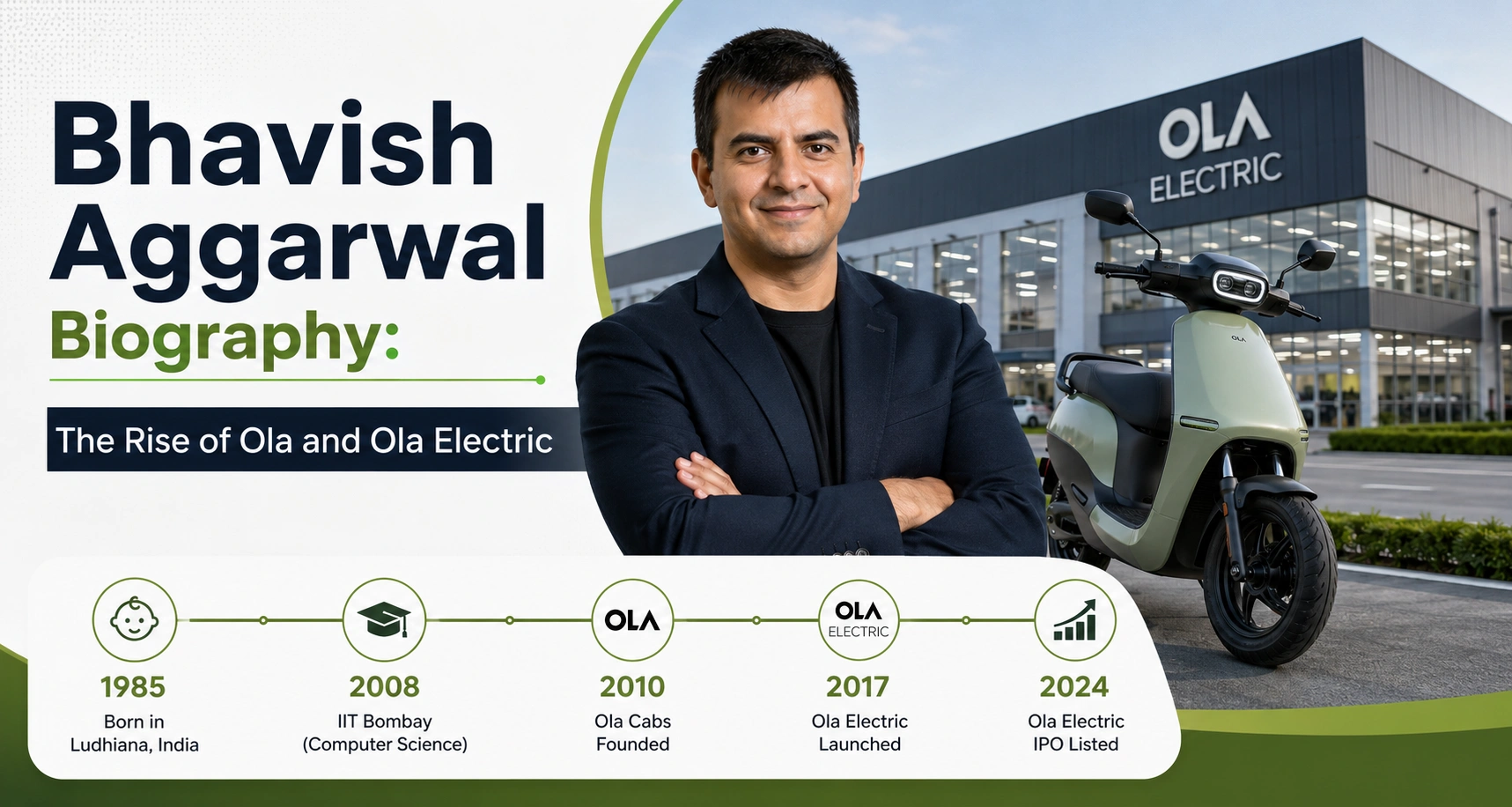
A frustrating taxi ride between two Indian cities doesn’t usually change an industry. For Bhavish Aggarwal, it did. A dispute with a driver mid-journey in 2010 became the spark for Ola Cabs — and fifteen years later, that same founder is running a homegrown electric vehicle manufacturer, an AI company, and a reputation as one of Indian tech’s most intense, most polarizing leaders.
Quick answer: Bhavish Aggarwal, born August 28, 1985, in Ludhiana, Punjab, co-founded Ola Cabs in 2010 after leaving a research role at Microsoft, later founded Ola Electric in 2017 to build India’s electric vehicle manufacturing capability, and founded the AI company Krutrim in 2023. Ola Electric’s 2024 IPO made him one of India’s youngest billionaires, with a net worth estimated at roughly $2.3 billion.
Early Life and Education
Aggarwal was born and raised in Ludhiana, Punjab. He went on to study Computer Science and Engineering at the Indian Institute of Technology Bombay, one of India’s most competitive engineering institutions, graduating in 2008. During his time there, he began showing more interest in building something of his own than in pursuing purely academic work — a trait that would define the next phase of his career.
After graduating, Aggarwal joined Microsoft Research India, first as an intern and later as a research associate, spending roughly two years there. During that period he filed two patents and published three papers in international journals — solid technical credentials, though ones that ultimately didn’t hold his attention as much as building a company did.
The Taxi Ride That Led to Ola
Aggarwal’s first venture wasn’t Ola — it was Olatrips.com, a travel platform that didn’t gain traction. Rather than treating that as a dead end, he used it as a starting point to rethink the problem he was actually trying to solve.
The real catalyst came in 2010, during a taxi journey from Bengaluru to Bandipur. According to accounts Aggarwal has given in interviews, the driver stopped partway through the trip and demanded more money than originally agreed; when Aggarwal refused, he was left stranded and had to find another cab. That experience became the seed for a more reliable, tech-enabled way to book rides.
Later that year, Aggarwal co-founded Ola Cabs (under the parent entity ANI Technologies) with his IIT Bombay classmate, Ankit Bhati. He invested roughly ₹5 lakh of his own savings, and the company’s first funding round raised about ₹34 lakh from early backers including Snapdeal co-founder Kunal Bahl, Rehan Yar Khan, and Anupam Mittal. Ola’s first office was a modest 1BHK space in a mall in Powai, Mumbai — a detail that stands in sharp contrast to the scale the company eventually reached.
Building Ola Into a National Ride-Hailing Giant
Ola’s early growth was steady rather than instant. By July 2014, the company hit a meaningful milestone — 10,000 rides booked in a single day — and it went on to become India’s largest ride-hailing platform, drawing more than $200 million in investment from SoftBank founder Masayoshi Son alone as it scaled to compete directly with Uber in the Indian market.
Aggarwal didn’t stop at ride-hailing. Over the following years, Ola expanded into a cluster of adjacent businesses: Ola Fleet (2015), a mobile payments service called OlaMoney (2015), a grocery delivery arm called Ola Dash (2015), and a food delivery service, Ola Cafe, later folded into an acquisition of Foodpanda’s Indian operations in 2017. Not every experiment succeeded — Ola Cafe and Ola Dash were both eventually shut down, along with a later venture into used-car sales, Ola Cars, which closed in 2022. The pattern that emerges is a founder willing to launch aggressively into adjacent markets and just as willing to cut losses when they didn’t work.
Founding Ola Electric
In 2017, Aggarwal registered Ola Electric as a subsidiary of ANI Technologies, initially piloting electric charging infrastructure and vehicles in Nagpur rather than launching straight into consumer scooters. In 2018, he personally acquired a 92.5% stake in Ola Electric from the parent company, with the remaining share staying with ANI Technologies for continued use of the Ola brand name — effectively establishing Ola Electric as its own distinct venture under his direct ownership.
The company later secured major backing from investors including SoftBank, Tiger Global, and Matrix Partners, and pivoted more decisively toward manufacturing electric scooters during the pandemic years. That bet culminated in the construction of the Ola Futurefactory, a roughly 500-acre manufacturing facility in Krishnagiri, Tamil Nadu, which the company has described as the largest two-wheeler EV factory in the world.
Ola Electric’s scooter launch was framed around a bigger idea than just a new vehicle — Aggarwal positioned it publicly as part of a larger shift away from India’s dependence on petrol-powered two-wheelers, aimed at the roughly 250 million Indians who rely on scooters and motorcycles as their primary transportation. Between 2022 and 2024, the company sold close to 800,000 electric scooters, accounting for roughly a third of all electric scooter sales in India during that period.
Stepping Back From Ola Cabs to Focus on EVs
In April 2022, Aggarwal stepped down from day-to-day operations at Ola Cabs to focus on Ola Electric and the company’s newer quick-commerce ambitions. Ola Cabs was later rebranded to Ola Consumer in August 2024 to reflect a broader range of consumer services beyond ride-hailing, with Aggarwal remaining co-founder and CEO of that business alongside his primary focus on Ola Electric.
The Ola Electric IPO and Krutrim
Ola Electric went public in August 2024, an event that made Aggarwal one of India’s youngest self-made billionaires, with net worth estimates around $2.3 billion. That same period, Aggarwal also founded Krutrim, a large language model AI company that became India’s first AI unicorn in 2024, reaching an estimated valuation of $1 billion — expanding his ventures well beyond mobility and into India’s emerging AI sector.
The period following the IPO hasn’t been entirely smooth. Ola Electric’s share price has fallen significantly from its post-listing high, driven by a combination of reported vehicle safety issues, customer service complaints, and intensifying competition from more established two-wheeler manufacturers entering the EV space.
Leadership Style and Recognition
Aggarwal has built a reputation as an intense, hands-on leader, and that intensity has drawn both admiration and criticism. He has publicly defended long working hours as a necessary condition for building category-defining companies from India, a stance that drew significant public debate, including pushback from doctors who raised health concerns about extended work weeks. Reports from former employees have also described a demanding, high-pressure internal culture, which several outlets have linked to a string of senior executive departures over the years.
Aggarwal has received recognition from Forbes India (2018) for its inclusion in the ‘30 Under 30′ list, time magazine (2018) for being one of the 100 Most Influential People and the Economic Times (entrepreneurship award). He is frequently mentioned in Indian and international media as one of the nation’s most ambitious (and controversial) startup founders, often likened to other high-intensity founder personalities around the world for both his vision and sense of combativeness.
What Founders Can Learn From Bhavish Aggarwal’s Journey
- A failed first venture doesn’t have to be the end. Olatrips.com’s failure directly informed the idea that became Ola.
- Vertical integration and ownership matter for capital-intensive industries. Personally acquiring a majority stake in Ola Electric gave Aggarwal direct control over a business he saw as strategically critical, rather than leaving it fully dependent on the parent company’s priorities.
- Willingness to shut down failed experiments is as important as launching new ones. Ola Cafe, Ola Dash, and Ola Cars were all discontinued once they didn’t work — a discipline that’s easy to underrate next to the more visible wins.
- Leadership style has real trade-offs. Aggarwal’s high-intensity approach has coincided with genuine scale and innovation, but also with real, documented internal turnover and public criticism — a reminder that founder intensity isn’t cost-free.
Frequently Asked Questions
Q.1 When did Bhavish Aggarwal found Ola Cabs?
He co-founded Ola Cabs in December 2010, along with his IIT Bombay classmate Ankit Bhati, after a frustrating taxi experience inspired the idea for a more reliable ride-booking service.
Q.2 Why did Bhavish Aggarwal start Ola Electric?
He founded Ola Electric in 2017 to build India’s domestic electric vehicle manufacturing capability, aiming to shift the country’s large base of scooter and motorcycle riders away from petrol-powered vehicles toward electric alternatives.
Q.3 Is Bhavish Aggarwal still involved with Ola Cabs?
He stepped back from day-to-day operations at Ola Cabs in April 2022 to focus on Ola Electric, though he remains co-founder and CEO of Ola Consumer (the rebranded Ola Cabs business) alongside that focus.
Q.4 What is Krutrim, and why did Aggarwal start it?
Krutrim is a large language model AI company Aggarwal founded in 2023, which became India’s first AI unicorn in 2024 — expanding his focus beyond mobility into India’s growing artificial intelligence sector.
Q.5 How much is Bhavish Aggarwal worth?
Estimates place his net worth at roughly $2.3 billion following Ola Electric’s 2024 IPO, though like most founder wealth tied to public company shares, this figure moves with Ola Electric’s stock price and should be checked against a current source for an up-to-date number.
Conclusion
Bhavish Aggarwal’s path from a Microsoft research role to founding three billion-dollar-plus ventures reflects a founder who moves fast, bets on capital-intensive, structurally difficult industries, and isn’t afraid to shut down what doesn’t work. His leadership style remains genuinely divisive, but the scale of what he’s built — India’s largest ride-hailing platform, its largest two-wheeler EV factory, and its first AI unicorn — is difficult to argue with. For another high-intensity founder profile, see our piece on Elon Musk’s Daily Routine, or explore the full Biography & Success Stories Guide.