

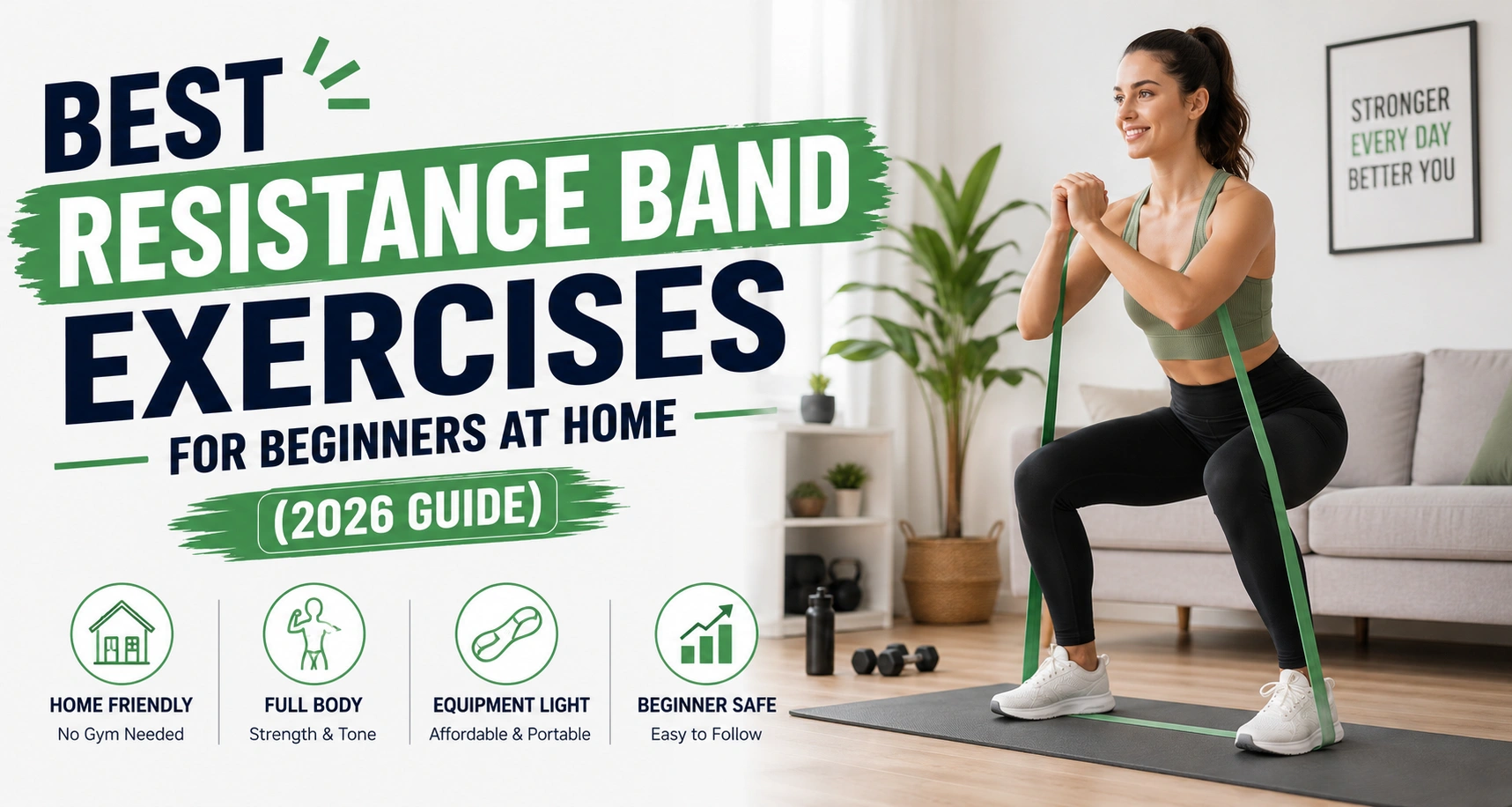
You don’t need a gym membership or a rack of dumbbells to start building real strength. A single resistance band — the kind that costs less than a takeaway dinner and fits in a drawer — can work your entire body: legs, glutes, back, chest, shoulders, arms, and core.
Quick answer: In a nutshell, if you’re a best resistance band exercises for beginners at home include the banded squat, standing row, band pull-aparts, bicep curls, glute bridges, and Pallof presses. These six basic movements are designed to work all of the major muscle groups and offer resistance without causing too much stress to the joints in the body and with little risk of injury. Work 2-3 times a week with 2-3 sets of 10-12 reps per set for each exercise, and progress to more difficult exercise by using a stronger band or making it tighter by using a shorter band.
Why Resistance Bands Are Ideal for Beginners
Unlike dumbbells, resistance bands provide variable resistance — the tension increases as the band stretches, so the hardest part of each rep lines up with the point where your muscle is naturally strongest. That makes bands more joint-friendly than free weights while still delivering a real training stimulus.
So resistance band training isn’t just a marketing ploy, but also a training method proven to be helpful. Research published in the British Journal of Sports Medicine reported in 2022 showed that elastic resistance training was able to yield strength gains similar to conventional resistance training in most of the studies that they reviewed. Recent studies with older, frail adults have demonstrated that banded exercise can enhance physical function and decrease frailty in these individuals, making resistance bands even more useful for all levels of physical fitness, from beginner to rehabilitative.
Three reasons bands work especially well if you’re just starting out:
- Low cost, zero space — one band replaces an entire rack of light-to-medium dumbbells.
- Joint-friendly — constant, controlled tension instead of the jarring load of free weights.
- Naturally self-limiting — it’s harder to use bad form with a band than to swing a dumbbell using momentum, which lowers injury risk while you’re learning technique.
What You’ll Need
- One long resistance band (flat or tube-style) for upper-body moves
- One looped mini-band for glutes and legs (optional but useful)
- A light-to-medium resistance level to start — you should be able to complete every rep with control, not strain
If you’re unsure which resistance to buy, start lighter than you think you need. You can always shorten the band or grip it closer to the anchor point to increase difficulty mid-workout.
10 best resistance band exercises for beginners at home
| Exercise | Target Area | Sets x Reps | Form Cue |
|---|---|---|---|
| Banded squat | Quads, glutes | 2–3 x 12–15 | Weight in heels, knees track over toes |
| Standing row | Back, biceps | 2–3 x 10–12 | Squeeze shoulder blades, don’t shrug |
| Band pull-apart | Upper back, shoulders | 2–3 x 12–15 | Keep arms straight, control the return |
| Bicep curl | Biceps | 2–3 x 10–12 | Elbows pinned to sides |
| Glute bridge with band | Glutes, hamstrings | 2–3 x 12–15 | Press knees out against the band |
| Standing chest press | Chest, shoulders | 2–3 x 10–12 | Exhale on the press, control the return |
| Lateral band walk | Glutes, hips | 2–3 x 10 steps/side | Stay low, avoid standing up between steps |
| Triceps extension | Triceps | 2–3 x 10–12/side | Keep elbow fixed near your ear |
| Pallof press | Core, obliques | 2–3 x 10/side | Resist rotation — that’s the whole point |
| Seated leg press | Quads, glutes | 2–3 x 12–16 | Slow, controlled push and return |
Rest 30–60 seconds between sets. As a beginner, one full round of all 10 moves is a complete workout — you don’t need to repeat the whole circuit multiple times when you’re starting out.
How to Do Each Move Correctly
Banded Squat: Feet shoulder-width apart, stand on resistance band with ends or handles at shoulder height. Tighten the stabilizers of the body, straighten your knees to get into a squat, then bend your knees until they are parallel to the floor. Step back to standing position, keeping the chest up, pressing through the heels the whole time.
Standing row: Secure the band at chest height (a door anchor is best) and hold the handles with arms straight, this is called standing row. Pull handles toward lower ribs, squeeze shoulder blades together while stepping back to create tension. Stop briefly at top and then extend slowly under control to starting position.
Band pull-apart: Hold the band in front of you at chest height, arms straight, hands shoulder-width apart. Pull your hands apart until the band touches your chest, then slowly return.
Bicep Curl: Stand on the middle of resistance band with one end or handle in each hand, palms facing forward. Elbows close to body and hands towards shoulders. Slowly take the band back down to the starting position without momentum or elbows moving forwards, pausing slightly at the top.
Glute Bridge with Band: Lay face up with your knees bent and feet flat on the ground with a mini resistance band above your knees. Firmly press knees apart with belt, and lift hips until body is straight from shoulders to knees. Squeeze glutes at the top before dropping hips back down slowly.
Pallof Press: Anchor the resistance band at chest height next to you, and stand facing sideways to the anchor. Keeping the band at your chest with both hands, step back so there is light tension and then push your hands straight out in front. Do not let the pull of the band cause twisting of the body, or instability of the torso. Hold for a few seconds before bringing hands back to chest. This is an anti-rotation core workout; the goal is to keep the position steady and controlled – not to create movement.
A Simple Weekly Routine for Beginners
- Days 1 and 2 (non-consecutive): All 10 exercises above, 2 sets each, resting 30–60 seconds between sets.
- 1 rest or light-activity day between sessions so muscles recover.
- After 3–4 weeks: progress by adding a third set, shortening the band for more tension, or moving up one resistance level — in that order.
This pairs well with a broader home training plan. If you want a complete structure that combines resistance bands with bodyweight work, our 30-Day No-Equipment Home Workout Plan is a good next step once these moves feel comfortable.
Common Beginner Mistakes to Avoid
- Using too much resistance too soon. If you can’t control the return phase of a rep, the band is too strong for you right now.
- Letting the band go slack at the top of a movement. Constant tension is the entire point of band training — a slack band trains nothing.
- Skipping the eccentric (return) phase. Snapping back to the start position wastes most of the benefit; control the band on the way back, not just the way out.
- Training the same 3–4 exercises every session. Bands can train your whole body — rotating through all major muscle groups prevents imbalances.
- Ignoring band condition. Bands lose elasticity and can snap over time — check for nicks or thinning before each session, especially if anchored to a door.
Frequently Asked Questions
Q.1 For beginners, how many times a week should they use resistance bands?
Two to three full-body resistance band exercises weekly should get most beginners on a comfortable program. Rest between sessions for at least 1 day to allow your muscles to recover & adapt. As the strength and endurance build, progression can be made by switching to a heavier band, increasing repetitions or sets per set, or adding a training day, as long as recovery is good.
Q.2 Can you build real muscle with resistance bands alone?
Yes. Research comparing elastic resistance training to traditional weight training has found comparable strength gains in the majority of studies, particularly for beginners and intermediate lifters.
Q.3 What resistance band strength should a beginner buy?
Start with a light-to-medium band — often color-coded yellow or light red — and progress to a stronger band once you can complete every set with a controlled return, not just the lift itself.
Q.4 Do resistance bands help with weight loss?
Resistance bands support fat loss indirectly: they build muscle, which raises resting metabolism, but weight loss ultimately depends on maintaining a calorie deficit through diet and overall activity.
Q.5 How long before I see results from band training?
Most beginners notice a strength improvement within 3–6 weeks of consistent, 2–3 times a week training.
Conclusion
You don’t need a home gym to start building strength — you need one band, ten movements, and consistency. Start with two full-body sessions a week, focus on control over speed, and progress gradually as the moves start to feel easy. Once you’ve got these fundamentals down, pair them with our 30-Day No-Equipment Home Workout Plan for a complete beginner training structure, or explore the full Fitness & Workout Guide for more home training resources.