

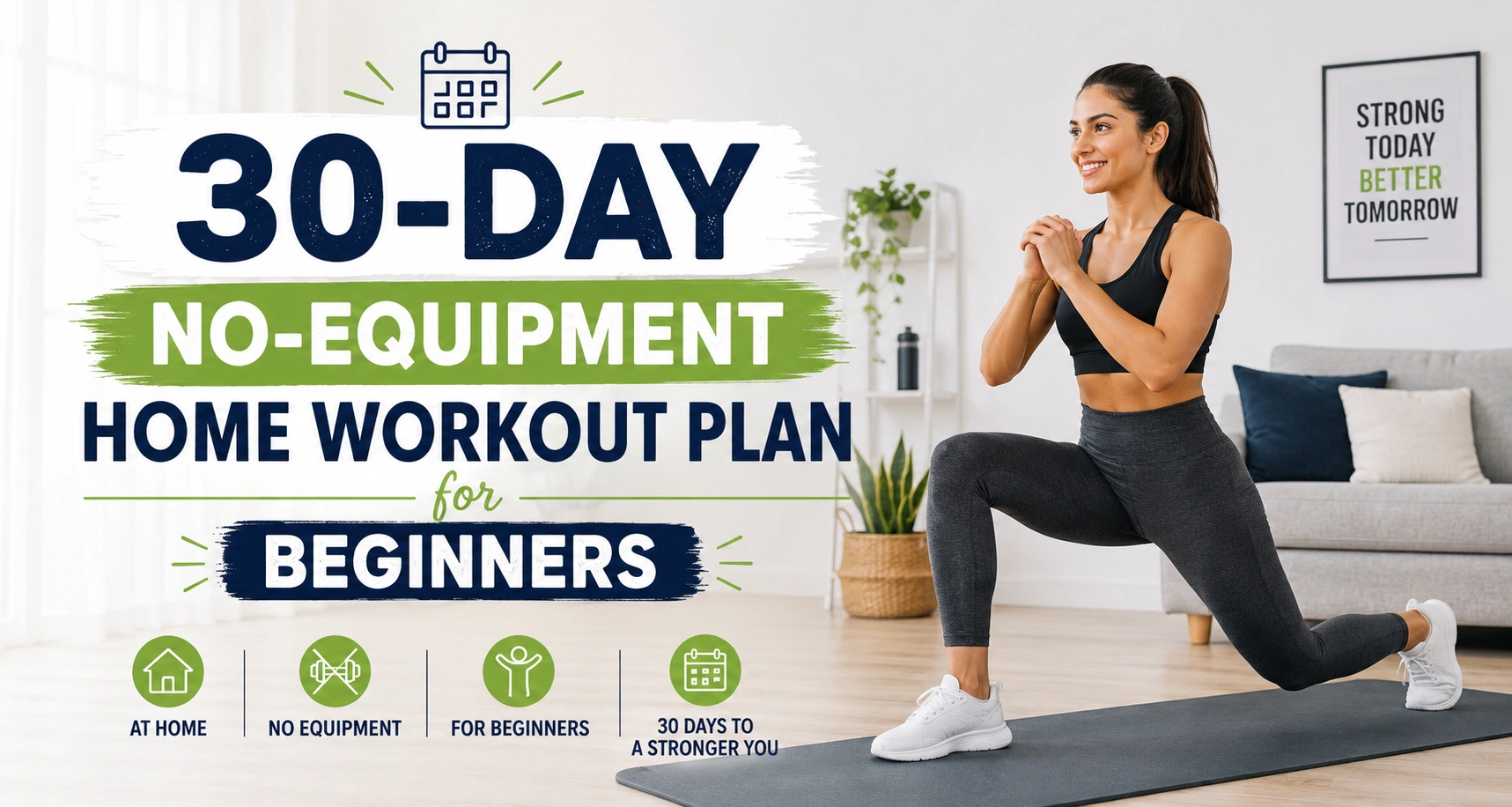
Let’s be honest — the hardest part of getting fit isn’t the workout itself. It’s getting started.
Maybe you’ve paid for a gym membership you never use. Maybe the idea of walking into a room full of people lifting heavy weights makes you want to stay under the blanket instead. Or maybe you simply don’t have the time, money, or energy to commute to a gym every day.
Here’s the good news: you don’t need any of that. A solid home workout plan for beginners can be just as effective as a gym routine, especially in the first 30 days, when your goal is to build the habit, not chase personal records. All you need is a bit of floor space, your body weight, and 20 to 30 minutes a day.
This guide walks you through a complete, no-equipment, 30-day fitness plan designed specifically for people who are just starting out — whether you’re in Mumbai, Manchester, or Manhattan. No fancy machines. No monthly fees. Just consistent, simple movement that adds up.
Why a No-Equipment Home Workout Actually Works
There’s a common myth that you need dumbbells, resistance bands, or a treadmill to see real results. That’s simply not true, especially for beginners.
A no equipment workout at home relies on bodyweight training — using your own body as resistance. Squats, push-ups, lunges, and planks might look basic, but they build strength, improve mobility, and burn calories just as effectively as many machine-based exercises, particularly when you’re new to fitness.
Here’s why this approach works so well for beginners:
- Lower injury risk — Bodyweight exercises for beginners let you learn proper movement patterns before adding external weight.
- No cost barrier — You skip gym fees, equipment purchases, and travel time.
- Flexibility — You can train in your bedroom, living room, or a hotel room while traveling.
- Builds consistency — Removing every excuse (time, money, access) makes it easier to actually show up every day.
- Scalable — As you get stronger, you can increase reps, slow down your tempo, or reduce rest time instead of buying new equipment.
Think of this first month as building your foundation. You’re not just training your muscles — you’re training the habit of showing up.
How This 30-Day Fitness Challenge Is Structured
This 30 day fitness challenge for beginners is built around four simple movement categories: lower body, upper body, core, and full-body/cardio. Each week slightly increases in intensity so your body has time to adapt without burning out.
A general weekly rhythm looks like this:
- 5 days of training, 2 rest days (adjust based on how your body feels)
- 20–30 minutes per session
- Rep-based, not equipment-based — everything is scaled by how many reps or seconds you complete
- Rest days still include light movement, like walking or stretching
You don’t need to follow the exact day-by-day order below word for word. What matters most is hitting each muscle group a few times a week and giving yourself proper recovery.
Week 1: Building the Foundation
The goal in week one is simple — learn the movements and get your body used to moving regularly again.
- Day 1: Bodyweight squats, wall push-ups, standing march, plank hold (20 sec)
- Day 2: Rest or light walk
- Day 3: Glute bridges, knee push-ups, standing side leg raises, dead bug
- Day 4: Rest or gentle stretching
- Day 5: Squats, incline push-ups (hands on a table/chair), lunges, plank hold (25 sec)
- Day 6: Light cardio — brisk walk or dancing for 15–20 minutes
- Day 7: Rest
Aim for 2–3 sets of 10–12 reps per exercise. If a full push-up feels too tough right now, that’s completely normal — modified versions still build real strength.
Week 2: Adding Volume
By week two, your muscles should feel less sore, and the movements should feel more familiar. Increase reps slightly and reduce rest between sets.
- Day 1: Squats, push-ups (knee or full), reverse lunges, plank hold (30 sec)
- Day 2: Active rest — stretching or yoga
- Day 3: Glute bridges, tricep dips (using a chair), mountain climbers, side plank
- Day 4: Rest
- Day 5: Jump squats (or regular squats if jumping is tough), push-ups, step-ups, bicycle crunches
- Day 6: 20-minute brisk walk or light jog
- Day 7: Rest
By this stage, many beginners notice better balance, easier stair-climbing, and less breathlessness during daily activities — small wins that matter.
Week 3: Increasing Intensity
This is where the home workout plan for beginners starts to feel like a real workout. You’ll introduce circuit-style training, where you move from one exercise to the next with minimal rest.
- Day 1: Circuit — squats, push-ups, lunges, plank (repeat 3 rounds)
- Day 2: Rest or stretching
- Day 3: Circuit — glute bridges, mountain climbers, tricep dips, bicycle crunches (3 rounds)
- Day 4: Rest
- Day 5: Circuit — jump squats, push-ups, reverse lunges, side plank (3 rounds)
- Day 6: 25-minute cardio (walk, dance, or light jog)
- Day 7: Rest
Try 30–45 seconds of work per exercise with 15 seconds of rest between movements. This keeps your heart rate up while still teaching correct form.
Week 4: Full-Body Challenge
The final week combines everything you’ve learned. It’s tougher, but by now your body has adapted significantly compared to Day 1.
- Day 1: Full-body circuit — squats, push-ups, lunges, plank, glute bridges (4 rounds)
- Day 2: Active rest
- Day 3: Cardio-focused — jumping jacks, mountain climbers, high knees, bodyweight squats (4 rounds)
- Day 4: Rest
- Day 5: Strength-focused — push-ups, tricep dips, lunges, side plank, dead bug (4 rounds)
- Day 6: 30-minute walk, jog, or dance session
- Day 7: Rest and reflect on your progress
By Day 30, don’t be surprised if exercises that felt impossible on Day 1 now feel manageable. That shift is the real win — not just physical change, but proof that consistency works.
Tips to Stay Consistent for 30 Days
Sticking to any new routine is harder than starting it. These simple strategies make a real difference:
- Schedule it like an appointment. Pick a specific time each day, even if it’s just 20 minutes.
- Track your workouts. A simple notebook or phone note showing your daily progress builds motivation.
- Focus on form, not speed. Slow, controlled movement builds more strength than rushing through reps.
- Listen to your body. Muscle soreness is normal; sharp pain is not. Rest when needed.
- Pair it with better sleep and hydration. Recovery matters just as much as the workout itself.
- Celebrate small wins. Completing Week 1 is worth celebrating just as much as finishing Day 30.
Common Mistakes Beginners Should Avoid
- Skipping the warm-up. Even 5 minutes of light movement prevents injury.
- Doing too much too soon. Overtraining in week one often leads to burnout by week two.
- Ignoring nutrition. Exercise alone won’t offset a poor diet — balanced meals support your results.
- Comparing yourself to others. Everyone’s starting point is different; progress is personal.
- Quitting after missing a day. One missed session doesn’t undo your progress — just pick back up the next day.
Final Thoughts
Getting fit doesn’t require an expensive gym membership or a garage full of equipment. This home workout plan for beginners proves that consistency, not complexity, is what actually drives results. By committing to just 20–30 minutes a day using nothing but your body weight, you’ll build strength, improve your energy levels, and create a habit that can carry you well beyond these first 30 days.
The best time to start was yesterday. The second-best time is today. Roll out a mat, clear a small space, and begin Day 1 — your future self will thank you.
Read More: Best 5 Day Gym Workout Plan for Women at Home (Beginner to Intermediate)
Frequently Asked Questions
Q.1 Can beginners really get fit with no equipment at all?
Yes. Bodyweight exercises for beginners — like squats, push-ups, and lunges — build genuine strength and endurance. Equipment becomes more useful later, once your body has adapted to basic movement patterns.
Q.2 How long should a beginner workout at home each day?
20 to 30 minutes is enough for most beginners. Focus on consistency over duration; a short daily session beats an occasional long one.
Q.3 Will I lose weight with this 30-day fitness challenge for beginners?
Weight loss depends on overall calorie balance, but regular workouts combined with a balanced diet can support steady, healthy weight loss over the 30 days and beyond.
Q.4 What if I can’t do a full push-up or squat correctly?
That’s completely normal when starting out. Use modified versions, like knee push-ups or wall-assisted squats, and gradually build up strength before progressing to the full movement.
Q.5 Do I need rest days in a no equipment workout at home routine?
Yes. Rest days allow your muscles to recover and actually grow stronger. Aim for 2 rest or active-recovery days each week throughout the plan.