

Traditional SaaS startups follow a familiar script. Raise a seed round. Hire a team. Built for 18 months. Hope the market is still there when you launch. That path works for some people. Most people don’t want it.
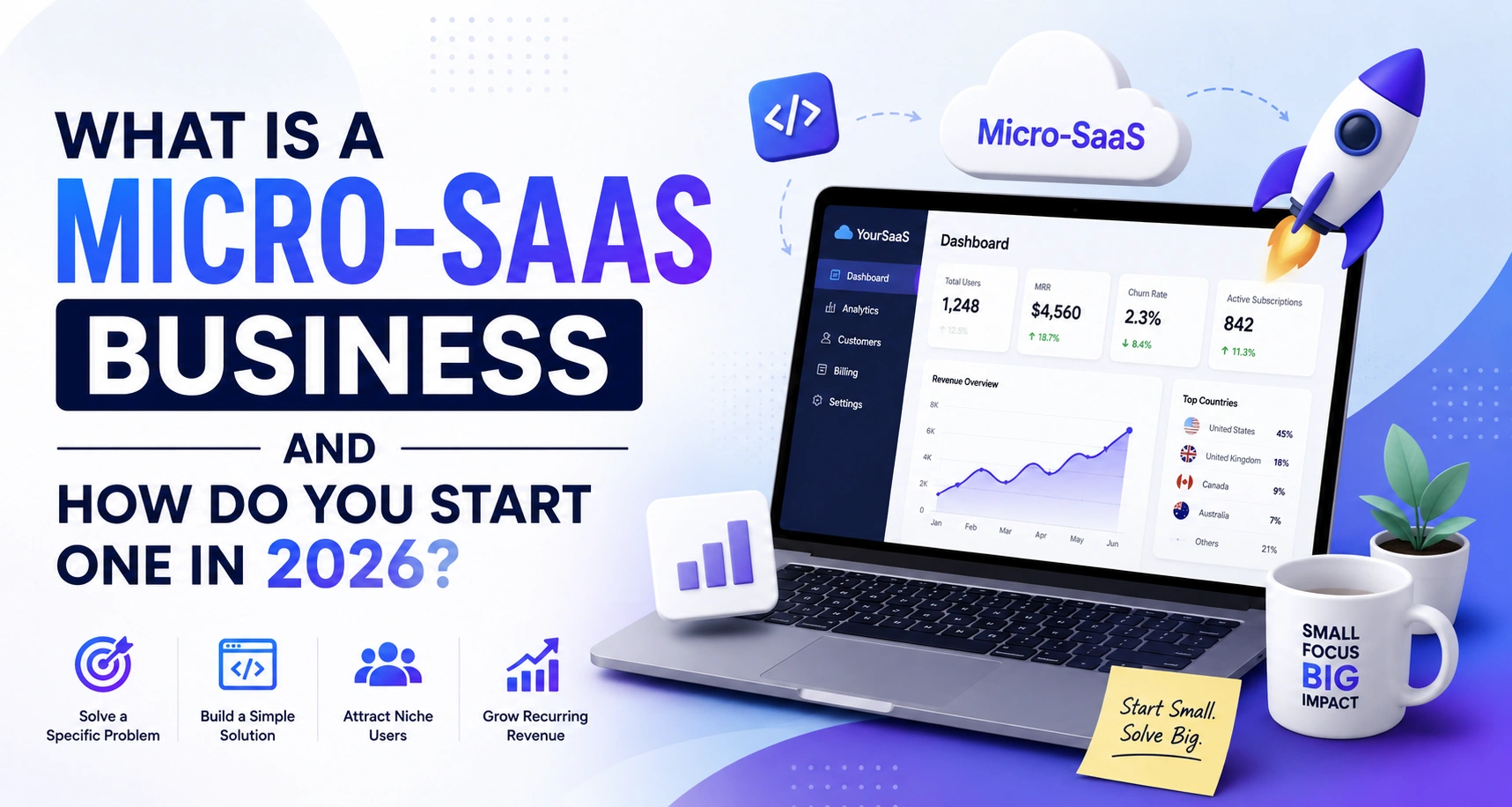
Micro SaaS business 2026 is a different model entirely. One person — or occasionally two — identifies a narrow, specific problem, builds a focused software solution, and starts charging a recurring monthly fee for it. No investors. No office. No 40-person Slack workspace. Just a product, a niche, and a subscription.
The micro-SaaS market is expanding rapidly, with annual growth of around 30% and projections placing it at $59.6 billion by 2030, according to Lovable. This surge is being fueled by three major trends: AI-powered development tools that enable solo founders to build products that once required entire engineering teams, no-code platforms that make software creation accessible to non-developers, and a growing number of industry experts turning their specialized knowledge into profitable digital products. In this guide, you’ll learn what micro-SaaS is, how much you can realistically earn, and the step-by-step process for building your own successful micro-SaaS business.
What Is a Micro-SaaS Business?
The simple definition
A micro-SaaS is a small, subscription-based software product built and run by one person or a tiny team, designed to solve a very specific problem for a well-defined niche audience.
That definition has three parts that all matter equally. It’s small — you’re not trying to be Salesforce. It’s subscription-based — recurring monthly revenue is the whole point. And it’s niche — the narrower the problem you solve, the less competition you face and the easier it is to reach the right customers.
Micro-SaaS vs. traditional SaaS: what’s actually different
Traditional SaaS companies are built to scale broadly. They raise venture capital, hire large teams, target large markets, and measure success in Annual Recurring Revenue that runs into the millions. The pressure to grow fast is baked into the funding structure.
Micro-SaaS flips the model. You’re optimising for profitability, not growth at all costs. You’re targeting a small audience that has a specific pain, charging them a fair price to solve it, and keeping overhead low enough that even modest revenue is genuinely life-changing.
Here’s what that looks like in real numbers. According to Freemius’s 2026 State of Micro-SaaS report, 70% of micro-SaaS businesses earn under $1,000 MRR — that early stage is where you validate and iterate. But once a product crosses into consistent profitability, the median is around $4,200 MRR, which translates to roughly $50K ARR. For a one-person business with near-zero overhead, that’s a meaningful income. The top 1% of micro-SaaS products exceed $50,000 MRR, run by teams of one to three people — without a single investor involved.
Profit margins can reach as high as 80%, according to Hostinger, because there are no office costs, minimal payroll, and virtually no physical infrastructure.
What micro-SaaS is NOT
It’s not a Chrome extension you build over a weekend and forget about. It’s not a free tool with a vague plan to monetize later. And it’s not an MVP in search of a pivot. A micro-SaaS is a real business — just a deliberately small one. You’re solving a real problem, charging real money, and building something with recurring revenue at its core.
Real Micro-SaaS Examples and How Much They Make
The model isn’t theoretical. There are hundreds of small software businesses generating consistent revenue right now, built by people who had domain knowledge and a specific frustration to solve.
Storemapper is one of the earliest and most-cited examples. It’s a store locator widget for e-commerce shops — one specific feature that Shopify didn’t handle well natively. Built as a complement to an existing platform, it found its audience and ran profitably for years as a tiny team product.
HypeFury solves a specific problem for Twitter/X creators: scheduling posts, auto-retweeting top-performing content, and turning long posts into threads. It found a niche audience with a clear willingness to pay and built a subscriber base around it.
Famewall — a testimonial collection and display tool — reached $1,000 MRR within 12 months of launch, according to Greensighter. It solves one specific conversion problem (collecting and displaying social proof) that took five separate tools to handle before.
The pattern across successful examples is consistent. They all target B2B buyers who have a recurring operational frustration. They all do one thing well rather than ten things adequately. And they all found their early customers in the specific communities where those buyers already spend time.
How to Find a Micro-SaaS Idea Worth Building
This is where most aspiring founders get stuck. They wait for a “big idea” that never comes. The better approach is systematic problem hunting, not creative inspiration.
Start with problems you already know
The fastest path to a viable micro-SaaS idea is your own domain expertise. If you’ve spent five years in legal operations, you know exactly which workflows are painful, which tools are inadequate, and which workarounds people rely on because nothing better exists. That knowledge is your unfair advantage. A developer who knows nothing about legal ops cannot build what you could build in the same time.
38% of SaaS founders launched their first product while still employed full-time, according to TechRT. That’s not a coincidence — those founders had access to daily, first-hand exposure to real problems in their industry.
Where to mine ideas
Beyond your own experience, the richest sources of validated problems are:
- 1-star reviews on G2 and Capterra for tools in your target niche. Angry paying customers are explicit about what’s missing.
- Reddit threads in niche professional subreddits. People vent about workflow pain in real-time, in specific terms.
- “How do you handle X?” posts on LinkedIn in any professional community — the thread replies are essentially a free market research session.
- Job postings — when companies post for a role that involves a repetitive manual task, that task is a product waiting to be built.
The AI-proof test
This is the step that almost no guide for this keyword currently covers — and it’s now the most important pre-validation question you can ask.
Before you commit to an idea, open ChatGPT or Claude and describe what your product would do. Try to get the AI to do it for you. If it does a passable job in 30 seconds and a single prompt, your product is in what some founders now call the “kill zone” — the space where a free AI update makes your software irrelevant overnight.
Micro SaaS business 2026 have one of three defences against this: a data moat (the product gets smarter as more people use it), a community moat (users stay because of who else is there), or deep workflow integration (it’s embedded in daily operations in a way that’s painful to replace). If your idea has none of these, sharpen it until it does.
B2B almost always wins
Business buyers pay for value without hesitation. A tool that saves a consultant three hours a week is worth $49 a month to them — easily justified and rarely cancelled. Consumer tools are far harder to monetise because individual users expect free software and churn the moment they lose the habit.
If you’re choosing between a B2B idea and a B2C idea at similar levels of interest, take the B2B one.
How to Validate Your Idea Before Building Anything
The single most common micro-SaaS mistake is building first and validating later. A month of development is an expensive way to find out nobody wants what you built.
Build a landing page first
Before you write a line of code, describe your product on a landing page. Use Carrd, Framer, or a simple Webflow template. Write a clear headline that names the problem and the solution. Add a “Join the waitlist” or “Pre-order at a launch price” button rather than a generic sign-up.
The goal is to see whether people who encounter this page in the wild take action. If you can drive 200 relevant visitors to the page and get 20 to give you their email, that’s meaningful signal. If you get 2, the positioning or the problem needs work.
Talk to 10 potential users before anything else
Contact 10 individuals who fit your ideal customer profile: via LinkedIn, Reddit, Slack groups, or your network. Don’t ask them the solution, ask them the problem. How do they do it now? How many times does it occur? What would make their day better?
Listen more than you pitch. The words they use to describe the problem are often the exact words you should use in your marketing copy.
Charge before you ship
This is the most reliable validation signal available. If someone gives you money for a product that doesn’t exist yet, the problem is real and the willingness to pay is proven.
Offer a founding-member price ($49 or $99 one-time, redeemable for the first year of access) to anyone on your waitlist. Even 5 pre-sales tells you more than 500 sign-ups with a free tier.
What “validated” actually means
You’re validated when you have paying customers — not signups, not “love the idea” emails, not positive feedback from friends. Cash from strangers who found you without personal connection is the signal. Everything else is noise.
How to Build Your First Micro-SaaS in 2026
Once you have validation, the build phase should be fast and deliberately limited in scope.
No-code vs. low-code vs. writing code
Your choice here depends on what you already know and how complex the product needs to be.
No-code tools like Bubble, Glide, and Softr let you build functional web apps without writing a single line of code. They’re the right starting point if you want to test a workflow quickly, build a lightweight MVP, or you have no coding background. You can get to first revenue with no-code and add custom development later once you’ve proven demand.
Low-code tools give you more control — useful when you need deeper customisation, stronger integrations, or the product is starting to grow beyond what a no-code platform handles well.
If you can code, or have access to a co-founder who can, build lean. AI coding assistants like GitHub Copilot dramatically compress development time. Founders who used to need 3 months for an MVP can now ship in 3 to 4 weeks.
The essential tool stack
You don’t need much to run a micro-SaaS. The core stack for most solo founders looks like this:
- Product: Bubble, Framer, or a custom build
- Payments: Stripe or Lemon Squeezy (Lemon Squeezy handles VAT and international tax automatically, which matters as soon as you have customers outside your home country)
- Automation: Zapier or Make for connecting tools without custom API work
- Customer support: A simple shared inbox or a lightweight helpdesk tool
That’s it to start. Add complexity only when a specific customer problem demands it.
Where to launch
Your first customers will almost certainly not come from Product Hunt or Google. They’ll come from the communities where your target users already spend time.
Post in the specific subreddits your customers use. Share in relevant Slack or Discord communities. Post on Indie Hackers — the audience there actively roots for solo founders and provides early feedback. LinkedIn works well for B2B tools when you can speak directly to the professional pain you’re solving.
A Product Hunt launch can amplify after you already have users and testimonials. It’s a poor fit for a Day 1 launch with no track record.
Pricing Your Micro-SaaS: What Actually Works
Subscription vs. one-time payment
Subscriptions are the goal. Recurring monthly revenue is what makes micro-SaaS a business rather than a freelance engagement. Monthly predictability lets you plan, improve the product, and eventually step back from active selling.
One-time payments have a role in early validation — charging $49–$99 once to prove people will pay before you’ve built the recurring infrastructure is smart. But as soon as the product is stable, move to a monthly or annual plan.
Avoid free plans early
A free tier feels like a growth strategy. In practice, free users rarely convert, rarely give useful feedback, and add significant support load. If you’re in the first 6–12 months of a micro-SaaS, skip the free plan entirely. Offer a 14-day free trial instead — it creates urgency, filters for serious users, and keeps your conversion math clean.
Starting price point guidance
For B2B tools, $19–$49 per month is the sweet spot for individual users and small teams. $49–$99 per month works well for tools with clear ROI — time saved, revenue generated, or compliance risk reduced. Anything below $15 per month is difficult to sustain with a small customer base and low churn tolerance.
Price higher than feels comfortable. You can always offer discounts. You cannot easily raise prices on existing customers without friction.
Read More:- Passive Income Ideas That Work in 2026 (Tested by Real People)
Frequently Asked Questions
Q.1 What is the difference between SaaS and micro-SaaS?
Traditional SaaS companies are built to scale to large markets, typically with venture funding, growing teams, and broad feature sets. Micro-SaaS is deliberately small — one person or a tiny team, a niche audience, a focused product, and a goal of sustainable profitability rather than rapid growth. Micro-SaaS doesn’t require funding and doesn’t aim to compete with enterprise software.
Q.2 How much money can a micro-SaaS make?
Revenue varies widely. According to Freemius’s 2026 data, 70% of micro-SaaS products earn under $1,000 MRR during the validation and early-growth phase. The median for businesses that reach consistent profitability is around $4,200 MRR — roughly $50K ARR. The top 1% exceed $50,000 MRR. Profit margins can reach 80% due to minimal overhead.
Q.3 Do I need to know how to code to build a micro-SaaS?
No. No-code tools like Bubble, Glide, and Softr let you build functional web apps and charge for them without writing code. Many successful micro-SaaS founders started with no-code platforms and added custom development later as the product grew. Domain expertise in the niche you’re serving matters far more than coding ability.
Q.4 How long does it take to build a micro-SaaS?
With a validated idea and a focused MVP scope, most founders can reach a launchable product in 2 to 6 weeks using no-code or AI-assisted development tools. The build phase should be intentionally short — spending months building before you have paying customers is one of the most common and costly mistakes in this space.
Q.5 So is micro-SaaS profitable in 2026?
Yes – and more than ever in past years. The time and cost of software development have been dramatically reduced with the help of AI, enhancing margins and accelerating revenue. The segment has a growth rate of about 30 % a year. The biggest danger for 2026 is the product that can be replaced by a free AI prompt — the founders who will make it in 2026 are going to have data moats, community moats or going to have deep workflow integrations that the AI can’t easily beat.
Read More:- What Is an AI Agent? Here’s What It Actually Means
The Bottom Line
Micro-SaaS is not a shortcut and it’s not passive income from day one. It’s a real business model — just one that’s sized for one person, optimised for profitability over growth, and built around a specific problem that a specific group of people genuinely need solved.
The advantages are real. You keep all the equity. You don’t answer to investors. You can run it from anywhere. And once it’s working, the recurring revenue creates a kind of financial stability that freelancing and consulting never quite deliver.
The path is straightforward even if it isn’t easy. Find a problem you understand from direct experience. Validate it with real money before you build. Build the minimum version that delivers the core value. Launch in the communities where your customers already spend time. Price for sustainability from day one.
The barrier has never been lower. The tools are better, the AI assistance is real, and the market for niche software keeps growing. What’s left is picking the right problem and starting.
Sources: Freemius 2026 State of Micro-SaaS; Lovable Micro-SaaS Guides 2026; TechRT Micro-SaaS Growth Statistics 2026; Hostinger SaaS Statistics 2026; Greensighter Micro-SaaS Ideas 2026; official product pages for all tools referenced.