

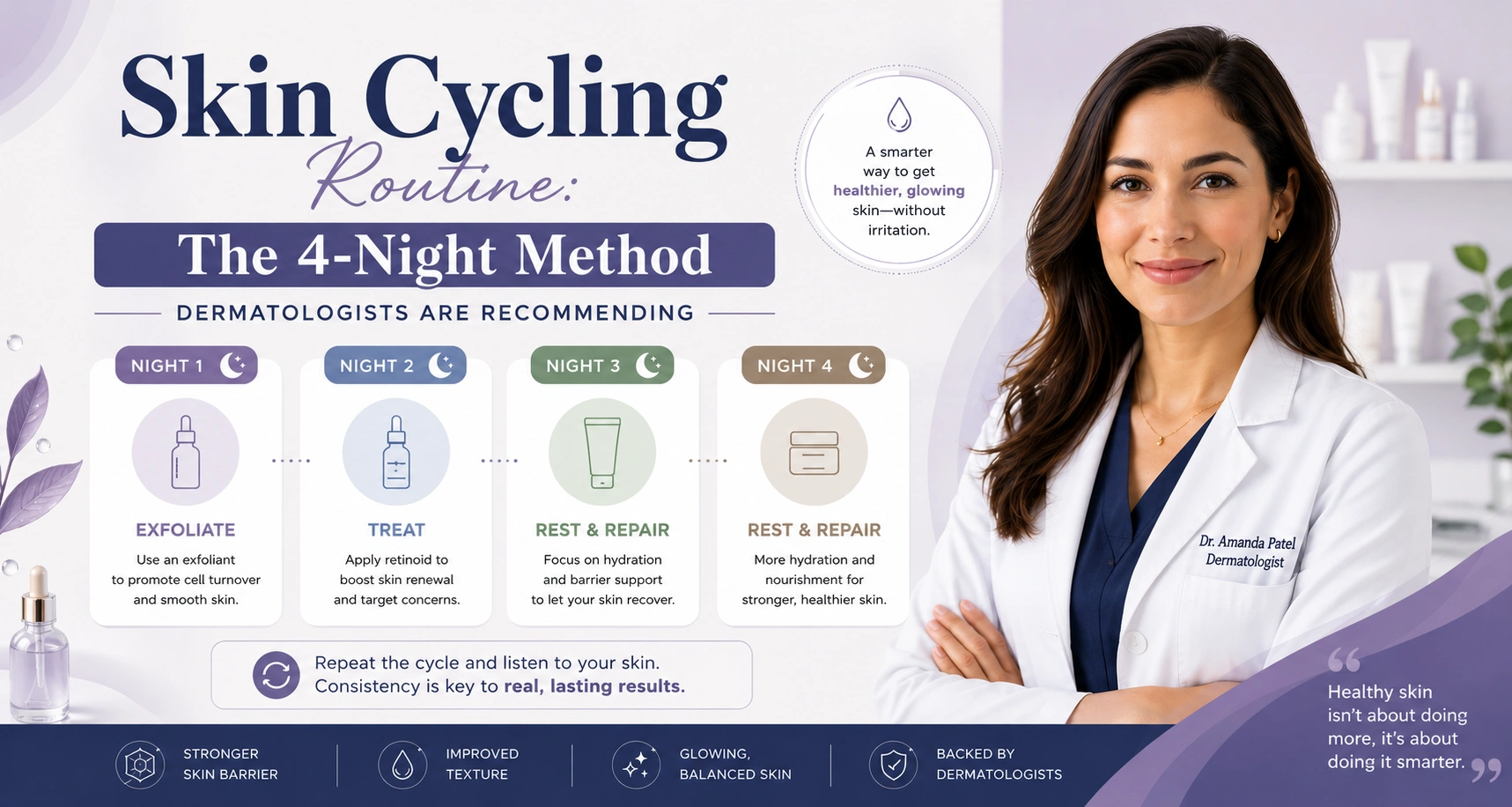
When you get stuck in the thick of skincare — putting down retinol, acids, and serums every night and thinking, “What am I doing wrong? — my face has redness and peels! —” you may be overdoing it. That is why the skin cycling routine was created.
Skin cycling, as coined by board-certified dermatologist Dr. Whitney Bowe in New York, is a 4-night cycle of different active ingredients that give you a clear idea of which to apply on which night (and, importantly, when to let your skin rest). For a reason, it has gone viral on TikTok – it works without the irritation associated with loading up with actives every night.
This is a guide to everything you need to know, what is skin cycling, the full 4 nights of skin cycling, how to adjust for skin type, and the pitfalls of not using it.
📌 FEATURED SNIPPET TARGET Skin cycling is a dermatologist-developed skincare routine that follows a 4-night rotation: Night 1 – Exfoliation, Night 2 – Retinol, Night 3 – Recovery, and Night 4 – Recovery. Created by Dr. Whitney Bowe, this approach helps maximize the benefits of active ingredients while reducing the risk of irritation, over-exfoliation, and damage to the skin barrier.
What Is Skin Cycling? The Dermatologist-Approved Method Explained
The core idea behind a skin cycling routine is deceptively simple: instead of using every active ingredient in your routine every single night, you cycle through them in a specific order and build in dedicated recovery nights where your skin gets nothing but gentle hydration and barrier repair.
Before skin cycling became mainstream, many people were layering retinol, glycolic acid, vitamin C, and niacinamide in their nightly routines — either all at once or on consecutive nights — and experiencing the predictable consequences: compromised skin barriers, persistent irritation, increased sensitivity, and breakouts caused not by their skin type but by their skincare choices.
Skin cycling fixes this by treating your skin’s capacity for active ingredients as a limited resource that needs replenishment. You draw on it (exfoliation night, retinol night), then you restore it (recovery nights), then repeat. The rotation is what gives the method its name.
👩⚕️ DERMATOLOGIST NOTE: Dr. Whitney Bowe, the board-certified dermatologist who developed skin cycling, explains the logic this way: “When you give your skin time to recover, you actually get better results from your actives — because the skin barrier is intact enough to respond to them properly, rather than spending its resources trying to repair damage.”
The Complete Skin Cycling Schedule: What to Do Each Night
Here is the full skin cycling routine broken down by night. This is the standard protocol for beginners and the foundation that dermatologists recommend before any modifications are made for specific skin types:
| Night | Focus | What to Apply | What to Skip |
|---|---|---|---|
| Night 1 | Exfoliation | Gentle cleanser → AHA or BHA exfoliant (e.g. glycolic acid, salicylic acid) → lightweight moisturiser → SPF if AM routine follows | Retinol, vitamin C, niacinamide (high %), benzoyl peroxide |
| Night 2 | Retinol | Gentle cleanser → retinol or retinoid (pea-sized amount) → rich moisturiser (buffering method) → facial oil if needed | Exfoliants (AHA/BHA), vitamin C, strong actives of any kind |
| Night 3 | Recovery | Gentle cleanser → hydrating toner or essence → barrier repair moisturiser (ceramides, peptides, hyaluronic acid) → occlusive if dry | All actives — no retinol, no acids, no vitamin C |
| Night 4 | Recovery | Repeat Night 3. Double down on hydration. Let your skin barrier fully rebuild before the next exfoliation night. | All actives. This is a rest night, not a treatment night. |
Night 1: Exfoliation Night
Exfoliation Night: This is the time that you are going to apply your chemical exfoliant, such as an AHA (alpha hydroxy acid) such as glycolic or lactic acid or a BHA (beta hydroxy acid) such as salicylic acid. These acids break down the link between those lost skin cells, unclogging congestion, smoothing texture and prepping the skin for next.
The key on exfoliation night is not to overdo it. One well-formulated exfoliant applied after cleansing, followed by a simple moisturiser — that’s it. No retinol on top, no vitamin C, no more acids. More is not better here; the exfoliant’s job is simply to resurface the skin, not to compete with three other actives for absorption.
💡 PRO TIP: Beginners: start with lactic acid rather than glycolic. Lactic acid is gentler, has a larger molecular size that penetrates more gradually, and is better tolerated by sensitive or dry skin types. Reserve glycolic acid for when your skin has been tolerating the cycle for at least 4–6 weeks.
Night 2: Retinol Night
Retinol night is the most powerful night in the skin cycling routine — and the one that requires the most care. Retinol (vitamin A) is the most studied anti-ageing ingredient in skincare, with decades of clinical evidence showing it increases cell turnover, stimulates collagen, reduces fine lines, and clears acne. It is also the ingredient most commonly misused.
In a skin cycling context, retinol is applied the night after exfoliation — when the skin surface is cleared of dead cells and primed for absorption — but before recovery nights give the skin time to handle any retinol-related sensitivity without additional stress from other actives.
👩⚕️ DERMATOLOGIST NOTE: The buffering method is highly recommended for skin cycling beginners. Use a light moisturiser first, then, apply the retinol on top. This will slow down absorption a little so as to decrease the likelihood of initial irritation as your skin develops tolerance. After 4–8 weeks, as your skin adapts, you can begin to apply retinol directly to the skin, as needed.
Use a pea-sized amount of retinol for your entire face. More than this doesn’t increase the benefit — it only increases the chance of irritation.
Nights 3 & 4: Recovery Nights
Recovery nights are the part of skin cycling most people underestimate. These are not passive nights — they are active barrier repair nights, and the quality of your recovery directly determines how well your skin responds on the next active cycle.
On recovery nights, the goal is to rebuild your skin’s moisture barrier using:
- Hydrating toners or essences — glycerin, hyaluronic acid, aloe vera
- Ceramide-rich moisturisers — ceramides are the structural lipids that form your skin barrier; depleted ceramides are the main reason active ingredients cause irritation
- Peptide serums — support collagen synthesis and barrier recovery without any active ingredient stress
- Occlusive layers (optional) — a thin layer of Vaseline, Aquaphor, or a dedicated overnight mask seals in moisture for dry skin types
The critical rule on recovery nights: no actives of any kind. No vitamin C, no niacinamide in high concentrations, no acids, no retinol. Just hydration, ceramides, and rest.
Skin Cycling Benefits: What to Expect and When
The skin cycling routine produces results differently from an every-night active routine — not necessarily slower, but more sustainably. Here’s a realistic timeline:
- Week 1–2: Most people notice a reduction in irritation if they previously used actives nightly. Some experience a minor adjustment period (mild dryness or purging) as the skin adapts to the new routine.
- Week 3–4: Skin texture typically begins to improve — smoother feel, reduced congestion, more even tone. These are the exfoliation benefits becoming visible as cell turnover accelerates.
- Week 6–8 (skin cycling before and after): The retinol effects begin showing — fine lines appearing softer, skin tone more even, pores appearing tighter. Skin cycling before and after comparisons at this stage are where most people see the results that make the method compelling.
- Month 3+: The sustained combination of exfoliation, retinol, and barrier recovery becomes cumulative. Skin is typically more resilient, better hydrated, and more responsive to actives because the barrier has been consistently repaired rather than chronically compromised.
👩⚕️ DERMATOLOGIST NOTE: Board-certified dermatologists who recommend skin cycling often note that patients on the 4-night rotation show better long-term tolerance to retinol than those who use it nightly — because the recovery nights allow the skin to maintain barrier function even as retinol strength is increased over time.
How to Adapt Skin Cycling for Your Skin Type
The standard 4-night rotation works well for most people, but some skin types need modifications:
| Skin Type | Recommended Adjustment | Key Watch-Out |
|---|---|---|
| Sensitive / Reactive | Extend recovery nights to 3 nights. Use lactic acid instead of glycolic. Start with retinol every 2 weeks. | Redness and flaking are signs to slow down, not push through |
| Dry / Dehydrated | Always buffer retinol between two layers of moisturiser. Add facial oil on recovery nights. | Tight, flaky skin after exfoliation means your barrier is compromised |
| Oily / Acne-Prone | Use BHA (salicylic acid) on exfoliation nights. Gel-based moisturiser on recovery nights. | Over-exfoliating triggers excess oil production — stick to the schedule |
| Combination | Target exfoliant to T-zone; use lactic acid on cheeks. Keep recovery nights gentle. | Avoid applying retinol to dry patches — it over-concentrates there |
| Normal / Resilient | Can follow the standard 4-night cycle from the start. May tolerate stronger AHAs sooner. | Introduce one active at a time regardless — even resilient skin can revolt |
Common Mistakes to Avoid With Skin Cycling
- Using retinol on exfoliation night (or vice versa). This is the most common mistake — and it defeats the entire purpose. AHAs and BHAs already remove the outer layer of dead skin, leaving it primed and sensitised. Adding retinol on the same night significantly increases the risk of irritation, redness, and barrier damage. One active per active night, always.
- Starting with a high-strength retinol as a beginner. If you’re new to retinol, begin with 0.025% or 0.05% retinol (not retinaldehyde or tretinoin, which are significantly stronger). The skin cycling method already delivers retinol more efficiently because it follows exfoliation — so you don’t need a high concentration to see results.
- Skipping sunscreen during the skin cycling retinol schedule. Retinol increases photosensitivity — your skin is more vulnerable to UV damage in the days following a retinol application. SPF 30 minimum every single morning is non-negotiable when cycling retinol. This applies year-round in the US, UK, Australia, and Canada.
- Treating recovery nights as optional. Many people skip straight to exfoliation night again after Night 2, thinking two recovery nights is excessive. It isn’t. The recovery nights are what make the active nights work — cutting them short means your skin never fully repairs its barrier, and your retinol and exfoliants start working against a compromised surface.
- Using too many products on recovery nights. Recovery nights should be simple: cleanser, hydrating toner, ceramide moisturiser, and maybe a facial oil. Layering five or six recovery products doesn’t multiply the benefit — it just adds ingredients your skin doesn’t need while it’s trying to repair.
- Not adjusting for seasons. In winter, skin barriers are more easily compromised by cold air and central heating. Consider adding a third recovery night in winter months, or switching to a gentler exfoliant during the colder period.
⚠️ CAUTION: If you are pregnant or breastfeeding, retinol and retinoids are not recommended. You can still follow a modified skin cycling routine using a gentle AHA exfoliation night followed by three recovery nights, or consult a dermatologist about pregnancy-safe alternatives.
Expert Tips and Best Practices for Skin Cycling
- Always patch test a new exfoliant or retinol before incorporating it into your cycle. Apply a small amount behind the ear or on the inner arm the night before your first use. Wait 24 hours. Proceeding without a patch test when introducing potent actives is how people end up with contact reactions that take weeks to resolve.
- Keep your cleanser consistent and gentle across all four nights. The cleanser is the only product that appears in every step of the skin cycling routine. A stripping or fragrance-heavy cleanser will undermine every other step — particularly recovery nights. Look for a fragrance-free, pH-balanced cream or gel cleanser.
- Introduce skin cycling gradually if you’re a complete skincare beginner. Start with just the two recovery nights for the first week — get your barrier strong before you start introducing exfoliants and retinol. A strong barrier tolerates active ingredients far better than a depleted one.
- Track your skin’s response in the first four weeks. Take a photo in consistent lighting at the same time of day on Day 1 and Day 28. The skin cycling before and after comparison is most meaningful at the 4-week mark when you can see both the exfoliation and early retinol effects together.
- Use a special eye cream during recovery days. The skin under the eyes is thinner and more sensitive to retinol irritation than any other part of the face and is more likely to be irritated by retinol. On recovery nights a ceramide eye cream offers a targeted barrier support to this vulnerable area.
🔗 READ MORE: What Is Cortisol Belly? The Science Behind Stress Weight Gain
🔗 READ MORE: Best Sleep Supplements in 2026: Magnesium, Ashwagandha & What Actually Works
Final Thoughts
The skin cycling routine works because it respects something most skincare routines ignore: your skin has a finite capacity to handle active ingredients, and exceeding that capacity doesn’t accelerate results — it delays them. By structuring your exfoliation and retinol nights around dedicated recovery time, skin cycling lets you use stronger actives more consistently over the long term than a nightly everything-at-once approach ever could.
For beginners in the US, UK, Australia, and Canada starting a retinol or exfoliation routine for the first time, skin cycling is simply the most sensible framework available. Start with the standard 4-night schedule, give it eight weeks, and take a before-and-after photo. The method speaks for itself.
Frequently Asked Questions (FAQs)
Q1. What is skin cycling and who is it for?
Skin cycling is a 4-night regimen of skincare products created by dermatologist Dr. Whitney Bowe. Nights 1 and 2 are devoted to exfoliation and retinol, while Nights 3 and 4 are recovery. It’s formulated for all users of active ingredients, especially beginners, sensitive skin and those who have tried using retinol and acids back to back and found that their skin became irritated.
Q2. How long does it take to see skin cycling results?
Most people notice improvements in skin texture and reduced irritation within the first two to four weeks. Visible retinol benefits — reduced fine lines, more even tone, tighter pores — typically appear at the six-to-eight-week mark. Skin cycling before and after comparisons are most meaningful at eight weeks, when both exfoliation and retinol effects have accumulated. Collagen-building results become more pronounced at the three-to-six-month mark with consistent cycling.
Q3. What retinol strength should I start with for skin cycling?
Beginners should start with 0.025% to 0.05% retinol for the first one to two months of skin cycling. Because retinol follows exfoliation night (when dead skin cells have been cleared), it absorbs more efficiently than it would in a non-cycling routine — so you don’t need a high concentration to see results. Increase strength gradually only when your skin shows no irritation at the current level for at least four consecutive cycles.
Q4. Can I do skin cycling with sensitive skin?
Yes — skin cycling for beginners with sensitive skin simply requires some modifications. Use lactic acid (gentler than glycolic) on exfoliation night, start with the lowest available retinol concentration, and extend recovery to three nights instead of two if irritation occurs. Some sensitive skin types do best starting with just recovery nights for the first week to strengthen their barrier before introducing any actives.
Q5. Can I use vitamin C in a skin cycling routine?
Yes, but vitamin C belongs in your morning routine, not your evening cycling schedule. It’s a potent antioxidant that works best in the morning to protect against UV-induced free radical damage — and it interacts poorly with both AHAs and retinol when layered on the same occasion. Use vitamin C serum every morning under SPF, and keep your skin cycling routine focused on exfoliation, retinol, and recovery at night.