

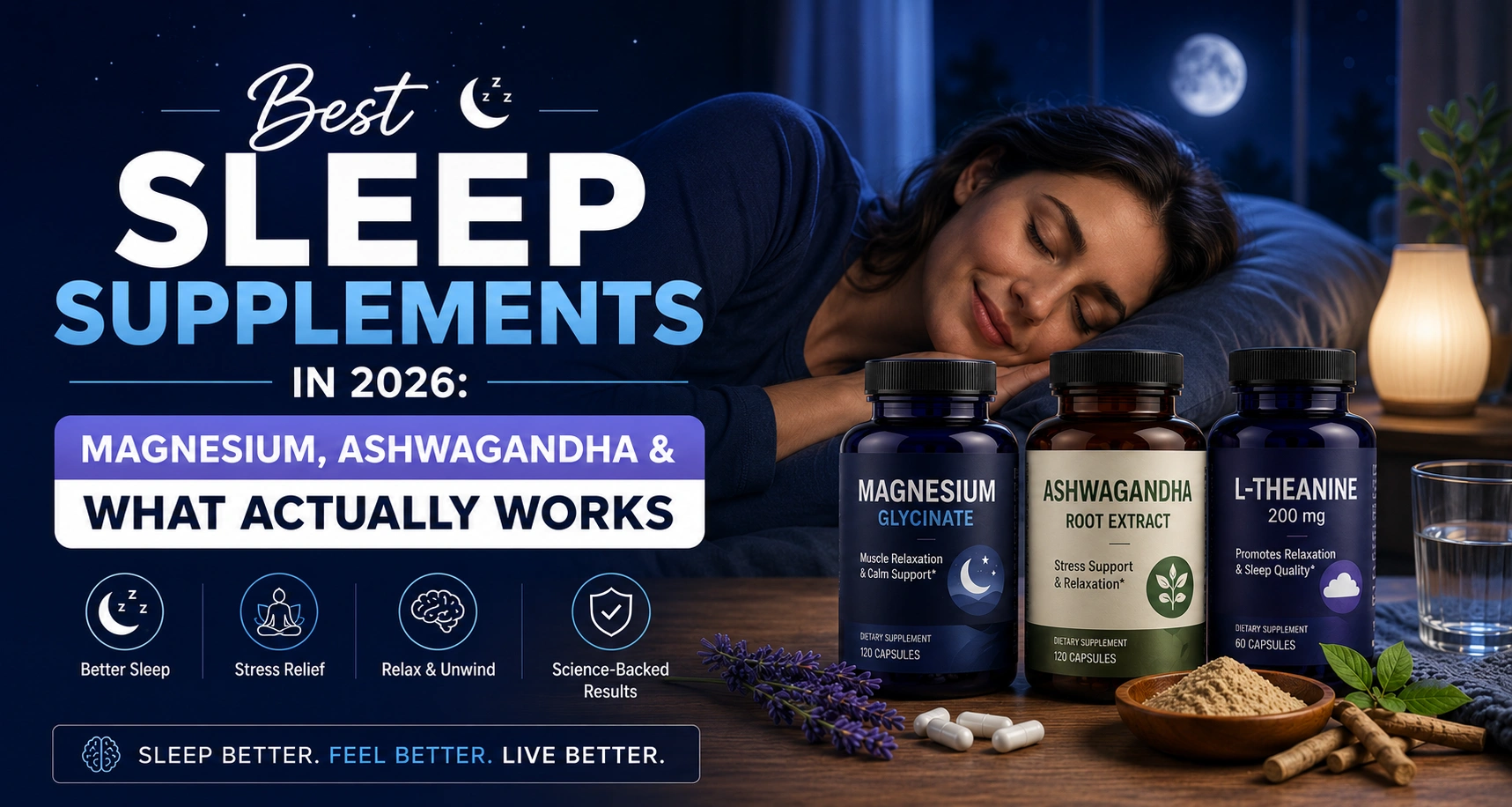
Anyone who has spent a few hours staring at the ceiling at 1am with the sense that they have to get up at 6am has thought to themselves, “What is there in a pill that might be of use? Supplements for sale are promising lots of things. The majority of these are limited in their scope. Some of them really do work!
The top sleep aids for 2026 don’t come from a magic ingredient list or a list of proprietary blends generated by celebrity endorsements, they are just a few clinically proven compounds that have proven their efficacy.
📌 FEATURED SNIPPET TARGET The best sleep supplements 2026 include magnesium glycinate (200–400 mg), ashwagandha KSM-66 (300–600 mg), and L-theanine (100–200 mg). These work through distinct biological pathways — regulating GABA, lowering cortisol, and supporting melatonin synthesis — and are supported by randomised controlled trial data across multiple studies.
What Are Sleep Supplements and How Do They Actually Work?
Sleep supplements are not sleeping pills. They don’t knock you out or override your nervous system the way pharmaceutical sedatives do. What the best natural sleep aids do is work with your body’s existing sleep architecture — reducing the physiological barriers to sleep rather than forcing it.
Those barriers are usually one of three things: elevated cortisol (the stress hormone that signals your body to stay alert), insufficient GABA activity (the calming neurotransmitter that slows brain activity for sleep onset), or poor melatonin timing (your body’s internal clock running out of sync).
The supplements with the strongest evidence address at least one of these pathways directly. Here’s the full comparison:
| Supplement | How It Helps Sleep | Recommended Dose | Time to See Effects | Evidence Level |
|---|---|---|---|---|
| Magnesium Glycinate | Activates GABA receptors; supports melatonin synthesis; lowers core body temp | 200–400 mg elemental | 2–4 weeks | 🟢 Strong RCT data |
| Ashwagandha (KSM-66) | Lowers cortisol via HPA axis; GABAergic effects; extends total sleep time | 300–600 mg | 4–8 weeks | 🟢 Strong RCT data |
| L-Theanine | Promotes alpha brain waves; calms without sedation; reduces sleep onset time | 100–200 mg | Same night | 🟡 Moderate evidence |
| Phosphatidylserine | Blunts cortisol response; supports cognitive wind-down before bed | 100–400 mg | 2–4 weeks | 🟡 Moderate evidence |
| Valerian Root | Increases GABA availability; mild sedative effect | 300–600 mg | 1–2 weeks | 🟡 Mixed evidence |
| Melatonin (low dose) | Regulates sleep-wake cycle; best for jet lag / shift work | 0.5–1 mg | Same night | 🟢 Strong — but narrow use case |
| Magnesium L-Threonate | Crosses blood-brain barrier; may enhance sleep architecture | 1,500–2,000 mg | 2–4 weeks | 🟡 Emerging evidence |
Why These Supplements Work: Key Benefits Backed by Research
Magnesium Glycinate for Sleep — The Most Underrated Pick
In the body, magnesium helps with more than 300 different enzyme reactions and one of its most clinically relevant is in the regulation of sleep. Since glycine is a sleep-promoting amino acid, magnesium glycinate, in which Magnesium is chelated with glycine, is the preferred form for sleep as it is more bioavailable, non-irritating to the stomach, and is gentler on the stomach than other magnesium supplements.
🔬 RESEARCH NOTE: A 2025 double-blind, placebo-controlled randomised trial (Schuster et al., Nature and Science of Sleep) found that 250 mg elemental magnesium bisglycinate significantly reduced insomnia severity scores in adults within just 4 weeks of supplementation.
Magnesium supports sleep through multiple mechanisms:
- Activates GABA receptors — the same receptors targeted by prescription sleep medications, but through a gentler, non-habit-forming pathway
- Supports melatonin synthesis — magnesium is a cofactor in the enzymatic process that converts serotonin into melatonin
- Lowers core body temperature — via glycine’s vasodilatory effect, which is one of the physical signals your body uses to initiate sleep
- Reduces cortisol — chronic magnesium deficiency is associated with elevated cortisol levels, and supplementation helps correct this imbalance
💡 PRO TIP: Magnesium glycinate is better absorbed than magnesium oxide (the cheapest and most common form in supplements). If a supplement doesn’t specify the form, it’s likely oxide — which has poor bioavailability and causes digestive issues. Always check the label for glycinate, bisglycinate, or threonate.
Ashwagandha Sleep Benefits — The Cortisol Solution
Ashwagandha (Withania somnifera) is an adaptogenic herb that has been used in Ayurvedic medicine for centuries. Its modern scientific profile is now well established: it’s one of the most reliably cortisol-lowering natural compounds available, and that’s precisely why it helps with sleep.
When cortisol stays elevated into the evening — which is increasingly common for people under chronic work, financial, or emotional stress — it directly suppresses melatonin production and delays sleep onset. Ashwagandha works by modulating the hypothalamic-pituitary-adrenal (HPA) axis, the hormonal system that regulates cortisol release.
🔬 RESEARCH NOTE: A review of 23 clinical studies (Quality in Sport, 2024) found that ashwagandha supplementation at 250–600 mg daily for 4–12 weeks consistently improved sleep quality, reduced sleep latency, and extended total sleep time across both insomniacs and healthy adults. A 2012 randomised trial found a 27.9% reduction in cortisol in the ashwagandha group versus placebo.
Look for standardised extracts: KSM-66 and Sensoril are the two most clinically studied forms. Generic ashwagandha powders vary wildly in withanolide content — the active compounds — and may not produce the results seen in trials.
Melatonin Alternatives: Why More Isn’t Always Better
Melatonin gets the most attention of any sleep supplement, but it’s probably the most commonly misused. It’s a signalling hormone, not a sedative — its job is to tell your brain it’s time to sleep, not to put you to sleep. Doses of 5–10 mg (which are standard in most US supplements) are vastly higher than what your brain naturally produces, and high-dose melatonin used nightly can suppress your body’s own production over time.
Magnesium glycinate and ashwagandha are preferable for long-term use for those who experience sleep problems in general. However, melatonin is a true standout in certain situations:
- Exercising the time change as soon as possible — jet lag
- Shift work, which involves a disruption of the sleep-wake cycle.
- Delayed sleep phase — those who naturally fall sleep very late in the day and have trouble waking up earlier
How to Use Sleep Supplements: A Step-by-Step Guide
Even the best supplement won’t perform if you take it at the wrong time, in the wrong dose, or without the right context. Follow this approach for best results:
- Identify your primary sleep problem first. Are you struggling to fall asleep (sleep onset), waking in the night (sleep maintenance), or not feeling rested despite sleeping? This determines which supplement to prioritise: L-theanine for onset, magnesium glycinate for maintenance, ashwagandha for stress-driven early waking.
- Start with one supplement, not a stack. Combining multiple sleep supplements before knowing how your body responds to each individually makes it impossible to know what’s working. Begin with magnesium glycinate — it’s the most broadly effective and well tolerated.
- Take magnesium glycinate 30–60 minutes before bed. A dose of 200–400 mg elemental magnesium (check the label — the elemental dose is usually lower than the total capsule weight) taken at this window allows enough time for the GABA-activating and temperature-lowering effects to begin.
- Take ashwagandha in the evening for sleep, or split morning and evening for all-day stress. 300–600 mg of KSM-66 or Sensoril extract. It works cumulatively, so don’t expect results after night one — the evidence shows meaningful effects at 4–8 weeks.
- If adding L-theanine, use it on high-stress nights rather than nightly. 100–200 mg taken 45–60 minutes before bed promotes calm alpha brain wave activity without drowsiness. It pairs well with magnesium glycinate.
- Run each supplement for at least four weeks before evaluating. Sleep supplements are not acute sedatives — they address the physiological conditions for sleep, which takes time to shift. Stopping after one week because you “didn’t feel anything” is the most common reason people abandon supplements that would have worked.
- Reassess at the 8-week mark. Track your sleep quality honestly — not just duration. If it’s meaningfully better, you’ve found your protocol. If not, consider adding ashwagandha, adjusting your dose, or looking at other lifestyle factors that supplements can’t fix on their own.
Common Mistakes to Avoid With Sleep Supplements
- Taking high-dose melatonin every night. Doses above 1 mg are significantly higher than physiological need for most adults. Start with 0.5 mg if you use melatonin at all. Higher doses don’t produce better sleep — they often cause next-morning grogginess and suppress natural melatonin production over time.
- Choosing magnesium oxide because it’s cheaper. This form has poor bioavailability and frequently causes diarrhoea. You’re spending money on a supplement your body can’t use effectively. Always opt for glycinate, bisglycinate, or threonate forms.
- Buying generic ashwagandha without checking the extract. Not all ashwagandha products are equivalent. Unless the label specifies KSM-66, Sensoril, or another standardised extract with a verified withanolide percentage, you can’t know whether you’re getting the dose used in clinical studies.
- Expecting supplements to fix a broken sleep environment. No supplement compensates for a bedroom that’s too warm, a phone on your bedside table with notifications on, or inconsistent sleep timing. Supplements work on top of good sleep habits — they don’t replace them.
- Taking ashwagandha if you’re on thyroid medication without checking first. Ashwagandha affects thyroid hormone levels and may interact with synthetic thyroid medications (levothyroxine). Always consult a GP or pharmacist before combining.
- Stopping too soon. This is the single most common reason people report that “supplements don’t work.” The cortisol-modulating effects of ashwagandha and the GABA-supporting effects of magnesium are cumulative. Give them the four-to-eight-week window the research uses.
⚠️ IMPORTANT: Always consult a GP or pharmacist before starting sleep supplements if you are pregnant, breastfeeding, on prescription medication (particularly sedatives, blood thinners, thyroid medication, or antidepressants), or managing a diagnosed sleep disorder. These supplements are safe for most healthy adults but not universally appropriate.
Expert Tips and Best Practices for Better Sleep in 2026
- Pair supplements with a consistent sleep schedule. Supplements work best when your circadian rhythm is already fairly regular. Going to bed and waking at the same time daily — even on weekends — is the single highest-impact sleep intervention, supplements included.
- Consider magnesium glycinate and ashwagandha as a combined protocol for stress-driven sleep issues. The two work through complementary, independent pathways (nervous system vs endocrine system) and the evidence supports their combined use. A 2025 2026 integrative medicine review at Mayo Clinic notes that magnesium glycinate is the gentler, better-absorbed choice versus other magnesium forms for this purpose.
- Use blue-light blocking glasses or activate night mode on devices two hours before bed. No supplement overcomes the melatonin-suppressing effect of bright screen light in the hour before sleep. This is the environmental fix that amplifies everything else.
- Track sleep quality, not just duration. The goal of sleep supplements is not simply to sleep longer — it’s to sleep better. Many people using magnesium glycinate report the same sleep duration but noticeably better quality and more rested mornings. A simple 1–10 sleep quality journal entry each morning takes 30 seconds and will tell you far more than a generic review of hours slept.
- If you live in the UK or Canada, check third-party tested products. Supplement regulation varies. Look for products tested by NSF International, Informed Sport, or USP verification marks. These certify that what’s on the label matches what’s actually in the capsule — an important standard that far too few brands meet.
🔗 READ MORE: What Is Cortisol Belly? The Science Behind Stress Weight Gain
🔗 READ MORE: Zone 2 Training: Why Every Fitness Influencer Is Obsessed With ‘Slow’ Cardio
Final Thoughts
Finding the best sleep supplements 2026 doesn’t require a complicated stack or expensive proprietary blends. The evidence consistently points to the same small group of well-studied compounds: magnesium glycinate for its GABA-activating and body temperature-lowering effects, ashwagandha KSM-66 for cortisol regulation and deep sleep extension, and L-theanine for high-stress nights when your brain simply won’t quiet down.
The key is using these correctly — right dose, right form, right timing — and giving them the four-to-eight weeks the clinical research consistently uses. Sleep is foundational. When it’s right, everything else functions better. If you found this useful, explore the related articles above for the full picture on stress, cortisol, and the lifestyle habits that make the biggest difference.
Frequently Asked Questions (FAQs)
Q1. What is the best sleep supplement 2026 for people who can’t fall asleep?
For difficulty falling asleep (slow sleep onset), the best combination is magnesium glycinate (200–400 mg) taken 30–60 minutes before bed, paired with L-theanine (100–200 mg) on high-stress nights. Magnesium activates GABA receptors and lowers core body temperature to trigger sleep onset, while L-theanine promotes calming alpha brain waves without daytime grogginess.
Q2. How long does ashwagandha take to work for sleep?
Most clinical trials show meaningful improvements in sleep quality at the 4–8 week mark with consistent daily use of 300–600 mg of a standardised extract like KSM-66 or Sensoril. Ashwagandha works cumulatively by modulating the HPA axis and reducing cortisol — effects that build over weeks rather than providing an immediate sedative response. Stopping after a few days is the most common reason people conclude it doesn’t work.
Q3. What are the best melatonin alternatives for chronic sleep problems?
The best melatonin alternatives for chronic insomnia or ongoing sleep difficulty are magnesium glycinate (200–400 mg nightly) and ashwagandha KSM-66 (300–600 mg daily). Both address root causes — GABA activity and cortisol regulation — rather than just signalling your body that it’s nighttime. Other options with moderate evidence include phosphatidylserine, L-theanine, and valerian root, depending on your specific sleep pattern.
Q4. Is it safe to mix magnesium glycinate with ashwagandha?
Yes – No known interactions between magnesium glycinate and ashwagandha. They operate through completely different processes (nervous vs endocrine) and so don’t overlap. The dosage of both taken 30–60 minutes before bed is an effective treatment for stress-related sleep problems, and has a solid evidence base and is recommended by integrated medicine practitioners.