

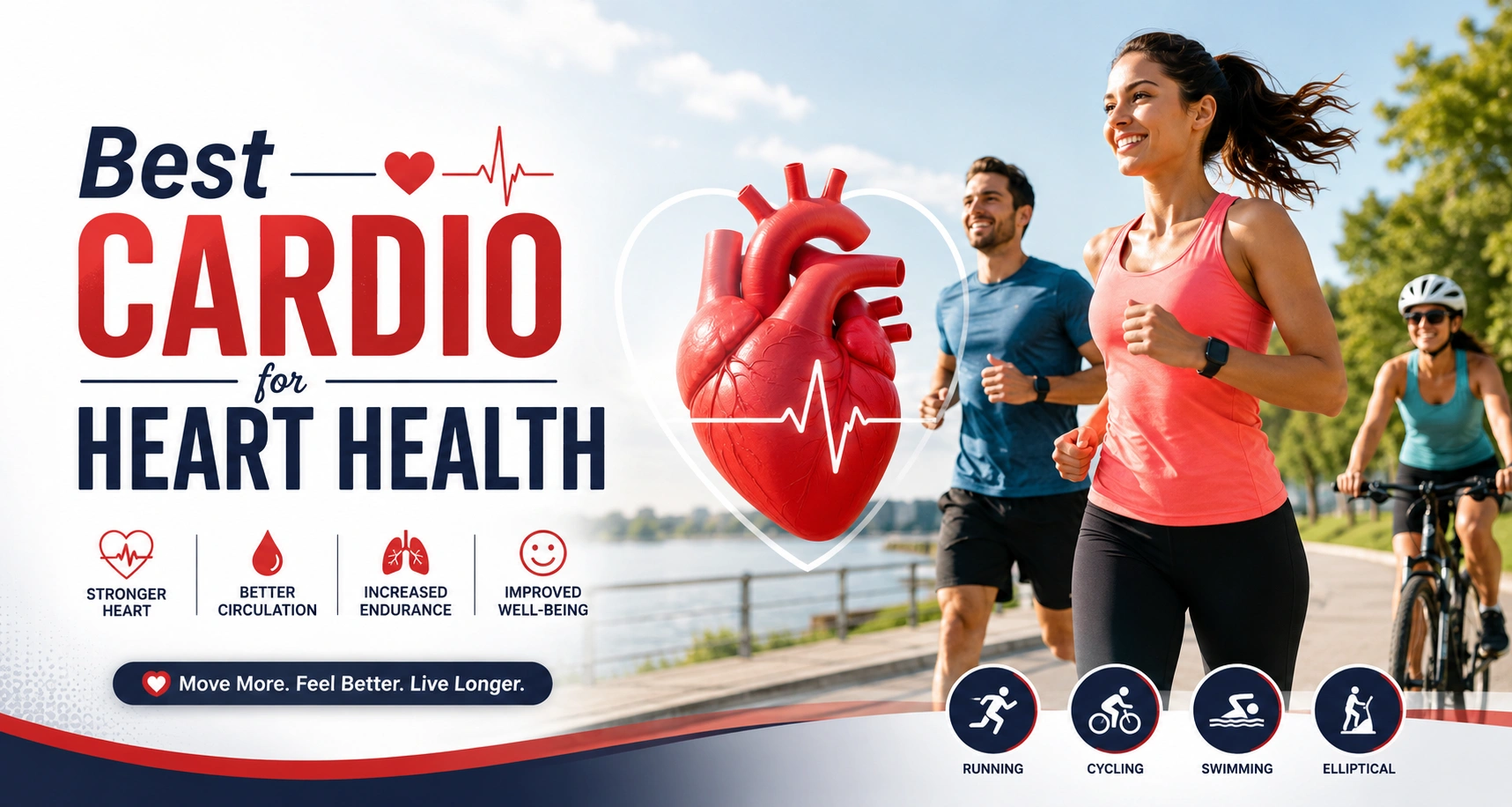
Your heart beats roughly 100,000 times every single day. It’s the hardest-working muscle in your body — and like every muscle, it gets stronger when you train it. But with so many workout options out there, it can be hard to know exactly which cardio is best for heart health.
Cardiovascular disease remains the leading cause of death worldwide. The good news? Research consistently shows that regular cardio exercise is one of the most powerful tools you have to protect your heart, lower your blood pressure, reduce cholesterol, and add years to your life.
In this guide, we break down the Best Cardio for Heart Health, backed by science — and help you find the right fit for your fitness level, lifestyle, and goals.
Why Cardio Is So Crucial for Your Heart
Before we jump into the exercises, let’s talk about why cardio matters so much for your cardiovascular system.
Cardio workouts improve cardiovascular health by continuously activating major muscle groups, which encourages the heart to circulate oxygen-rich blood more effectively throughout the body. Over time, regular aerobic activity enhances the heart’s performance, allowing it to deliver a larger volume of blood with each contraction — a measure referred to as stroke volume. This increased efficiency often leads to a lower resting pulse rate, a key sign of improved heart fitness and overall cardiovascular strength.
In addition, consistent cardiovascular exercise offers a wide range of health benefits. It enhances the strength and flexibility of the heart and circulatory system, boosts oxygen delivery to muscles and organs, and helps regulate blood pressure and unhealthy LDL cholesterol levels. Regular aerobic activity also lowers the likelihood of developing conditions such as cardiovascular disease, stroke, type 2 diabetes, and some forms of cancer. At the same time, it supports healthy weight management, easing pressure on the heart and improving overall physical well-being.
The American Heart Association recommends that adults engage in at least 150 minutes of moderate aerobic exercise or 75 minutes of high-intensity cardio each week to help reduce the risk of heart-related illnesses. Reinforcing these guidelines, a major 15-year research study tracking over 55,000 participants found that individuals who ran regularly experienced nearly a 45% lower risk of dying from cardiovascular disease compared to those who did not run.
The bottom line: the best cardio for your heart is the kind you’ll actually do consistently. But some types have edges over others depending on your goals. Let’s get into it.
7 Best Cardio Exercises for Heart Health
1. Brisk Walking — The Underrated Heart Hero
Best for: Beginners, older adults, those recovering from illness or injury
Although it may seem basic, brisk walking is among the easiest and most beneficial forms of cardiovascular exercise for maintaining heart health. Regular fast-paced walks help enhance blood circulation, support healthier blood pressure levels, and improve the strength and efficiency of the heart. Plus, because it places very little stress on the joints, it’s a safe and sustainable workout option for people of nearly all fitness levels.
The key is brisk: aim for a pace where you can still hold a conversation but feel your breathing increase. A pace of 3.5 to 4.5 mph is typically ideal.
How to start:
- 20–30 minutes, 5 days a week
- Gradually increase duration and pace over several weeks
- Use hilly terrain or a treadmill incline for more challenge
Pro tip: Walking after meals — even a 10-minute stroll — has been shown to lower blood sugar spikes, which further protects heart health.
2. Running and Jogging — The Classic Heart Strengthener
Best for: Moderate to intermediate fitness levels
Running is one of the most researched forms of cardio for cardiovascular health, and the results are consistently impressive. It boosts heart function, reduces cholesterol, strengthens the heart muscle, and burns significant calories.
Even light jogging — as little as 5–10 minutes per day at a slow pace — has been linked to meaningfully reduced cardiovascular risk. You don’t need to run marathons for your heart to benefit.
How to structure it:
- Beginners: Start with a run/walk interval approach (run 1 min, walk 2 min, repeat)
- Intermediate: 20–40 minute steady jogs at a conversational pace
- Advanced: Longer runs with occasional tempo efforts
Joint health note: If running bothers your knees or hips, swimming or cycling offer similar cardiovascular benefits with far less impact.
3. Cycling (Indoor & Outdoor) — Low Impact, High Reward
Best for: All fitness levels, especially those with joint issues
Cycling is a phenomenal heart workout that keeps impact low while still challenging your cardiovascular system intensely. Whether you’re on a road bike, a stationary bike, or a spin class, cycling steadily elevates your heart rate into the aerobic zone and keeps it there.
Indoor cycling (like Peloton or spin classes) is particularly effective because you can easily control intensity, making it great for structured cardio sessions.
Heart health benefits of cycling:
- Strengthens the heart and lungs
- Lowers resting heart rate over time
- Reduces blood pressure and LDL cholesterol
- Improves metabolic health
Target: 30–60 minutes at moderate intensity (65–75% of max heart rate), 3–5 times per week.
4. Swimming — The Full-Body Heart Workout
Best for: People with arthritis, joint pain, or physical limitations; all ages
Swimming is uniquely effective for heart health because it engages virtually every major muscle group simultaneously — meaning your heart has to work hard to pump blood across your entire body. It’s also extraordinarily joint-friendly.
Consistent swimming can significantly improve heart health by helping to reduce blood pressure, enhance circulation, and decrease stiffness in the arteries. It also boosts overall cardiovascular endurance while placing minimal stress on the joints and muscles. For individuals who find high-impact workouts difficult or uncomfortable, swimming often becomes an effective and sustainable alternative for staying active and fit.
- For the complete picture, see our fitness guide.
Getting started:
- 20–45 minutes per session, 3–4 times per week
- Mix strokes (freestyle, backstroke, breaststroke) to engage different muscles
- Even water aerobics offers meaningful heart health benefits for beginners
5. Zone 2 Cardio — The Sweet Spot for Long-Term Heart Health
Best for: Anyone serious about sustainable cardiovascular fitness
Zone 2 cardio has emerged as one of the most talked-about approaches to heart health in recent years — and the science behind it is compelling.
Zone 2 refers to exercising at 60–70% of your maximum heart rate — a pace where you can still hold a conversation but you’re clearly working. It feels moderate, almost too easy. But done consistently, it delivers remarkable benefits.
At Zone 2 intensity, your body is primarily burning fat for fuel and your heart is building aerobic efficiency without accumulating the fatigue that comes from harder efforts. Research shows this zone improves mitochondrial efficiency, fat oxidation, and long-term cardiovascular endurance.
As one fitness expert at Houston Methodist put it: “You’re still getting all of the health benefits of physical activity without the fatigue and soreness that comes with long bouts of high-intensity” training — making it highly sustainable for the long term.
Zone 2 activities include:
- Brisk walking or hiking
- Easy to moderate cycling
- Light jogging
- Rowing at a steady pace
- Swimming at a comfortable pace
Recommended: 3–4 sessions per week, 45–60 minutes each. This is the backbone of heart health training for many cardiologists and elite endurance athletes alike.
6. HIIT (High-Intensity Interval Training) — Maximum Gains in Minimum Time
Best for: Time-pressed individuals, intermediate to advanced fitness levels
HIIT — alternating between short bursts of near-maximal effort and active recovery — is one of the most time-efficient forms of cardio for heart health. A typical HIIT session lasts just 15–25 minutes, yet delivers cardiovascular benefits comparable to much longer steady-state workouts.
Research shows HIIT can improve aerobic capacity and insulin sensitivity as effectively as traditional endurance training, but in roughly half the time. In clinical settings, HIIT has even been found to be more effective than moderate-intensity steady-state cardio at improving cardiorespiratory fitness in people with coronary artery disease — and it was found to be safe and well-tolerated.
Key physiological benefits of HIIT:
- Significant increases in VO2max (a key measure of cardiovascular fitness)
- Improved stroke volume (blood pumped per heartbeat)
- Post-exercise calorie burn (EPOC effect)
- Better blood pressure and cholesterol levels
Sample beginner HIIT structure:
- 30 seconds hard effort (sprint, fast cycling, burpees)
- 90 seconds easy recovery
- Repeat 6–8 rounds
- 2–3 times per week maximum (recovery matters!)
Important: HIIT is demanding. Start slowly, listen to your body, and consult a doctor before beginning if you have any existing heart conditions.
7. Rowing — The Underdog of Cardio
Best for: Full-body conditioning seekers, gym-goers
Rowing might be the most underutilized cardio machine in any gym. A rowing machine (ergometer) combines lower body drive, core engagement, and upper body pulling — creating a full-body aerobic challenge that taxes the heart significantly more than many other machines.
Studies show that rowing builds cardiovascular endurance rapidly, improves oxygen utilization, and burns a high number of calories per session. It’s also surprisingly low-impact despite the intensity.
Rowing tips:
- Master the technique first (many people row with poor form)
- Start with 15–20 minute sessions and build up
- Mix steady-state rows (Zone 2) with short interval bursts for variety
HIIT vs. Steady-State Cardio: Which Is Better for Heart Health?
This is one of the most common questions in the fitness world. The honest answer: both are excellent, and the best choice depends on you.
| Factor | HIIT | Steady-State (Zone 2) |
| Time required | Short (15–25 min) | Longer (40–60 min) |
| Calorie burn during session | Moderate–High | Moderate |
| Post-workout calorie burn | High (EPOC) | Low |
| VO2max improvement | Very high | Moderate |
| Recovery needed | High | Low |
| Sustainability long-term | Moderate | Very high |
| Good for beginners | Not ideal | Yes |
| Heart health benefits | Excellent | Excellent |
The ideal approach? Combine both. Research and real-world practice point to a training model where 80% of your cardio is done at easy to moderate intensity (Zone 2) and 20% at high intensity (HIIT). This is how elite endurance athletes train — and it’s increasingly what cardiologists recommend for the general population too.
- You may also want to check out Best Aerobic Exercise For Heart Health.
How Much Cardio Do You Actually Need for Heart Health?
Here’s a practical weekly framework based on current guidelines:
Minimum (good for your heart):
- 150 minutes of moderate-intensity cardio per week
- E.g., five 30-minute brisk walks
Optimal (excellent for heart health):
- 150–300 minutes of moderate cardio, OR
- 75–150 minutes of vigorous cardio, OR
- A combination of both
Advanced (performance + heart health):
- 4–5 cardio sessions per week
- Mix of Zone 2 sessions (3–4x) and HIIT sessions (1–2x)
- Plus 2 days of strength training (also beneficial for the heart)
Remember: something is always better than nothing. Even 10 minutes of brisk walking per day is a meaningful step toward better heart health.
- For more on this, our guide on 10 Best Fitness Apps In India 2026 goes deeper.
Heart Rate Zones: A Quick Reference Guide
| Zone | % of Max HR | Feel | Benefits |
| Zone 1 | 50–60% | Very easy | Recovery, gentle conditioning |
| Zone 2 | 60–70% | Easy, conversational | Fat burning, aerobic base, mitochondrial health |
| Zone 3 | 70–80% | Moderate, harder to talk | Aerobic capacity |
| Zone 4 | 80–90% | Hard, difficult to speak | Lactate threshold, performance |
| Zone 5 | 90–100% | All-out effort | Max cardiovascular output (HIIT territory) |
Tips to Get the Most Out of Your Cardio for Heart Health
- Consistency beats intensity. A moderate 30-minute walk every day does more for your heart than an intense 90-minute session once a week. Build the habit first.
- Warm up and cool down. Always take 5 minutes to ease into and out of your sessions. This protects your heart from sudden workload changes.
- Monitor your heart rate. A fitness tracker or heart rate monitor takes the guesswork out and ensures you’re training in the right zone.
- Add strength training. Two sessions of resistance training per week complement cardio beautifully, improving metabolic health and reducing cardiovascular risk.
- Stay hydrated. Even mild dehydration increases the strain on your heart during exercise.
- Pay attention to your body’s warning signs. Symptoms such as chest discomfort, unexpected breathlessness, lightheadedness, or an irregular heartbeat during physical activity should never be ignored. Stop exercising immediately and consult a healthcare professional if these signs occur.
- Talk to your doctor. If you have an existing heart condition, are over 45, or are just starting exercise after a long break, get cleared by a physician before beginning a new program
Final Thoughts: The Best Cardio for Heart Health Is the One You’ll Do
The research is unambiguous: regular cardio exercise is one of the single most important things you can do for your heart and your overall longevity. The “perfect” workout matters far less than showing up consistently over weeks, months, and years.
Whether you prefer morning walks, weekend cycling, swimming laps, or crushing HIIT intervals, your heart will benefit. Start where you are, build gradually, and make it enjoyable — because sustainability is the real secret to a healthy heart.
Your heart has worked hard for you every single day of your life. It’s time to return the favor.
Disclaimer: This article is for informational purposes only and does not constitute medical advice. Always consult with a qualified healthcare provider before starting any new exercise program, especially if you have a pre-existing heart condition or other health concerns.