

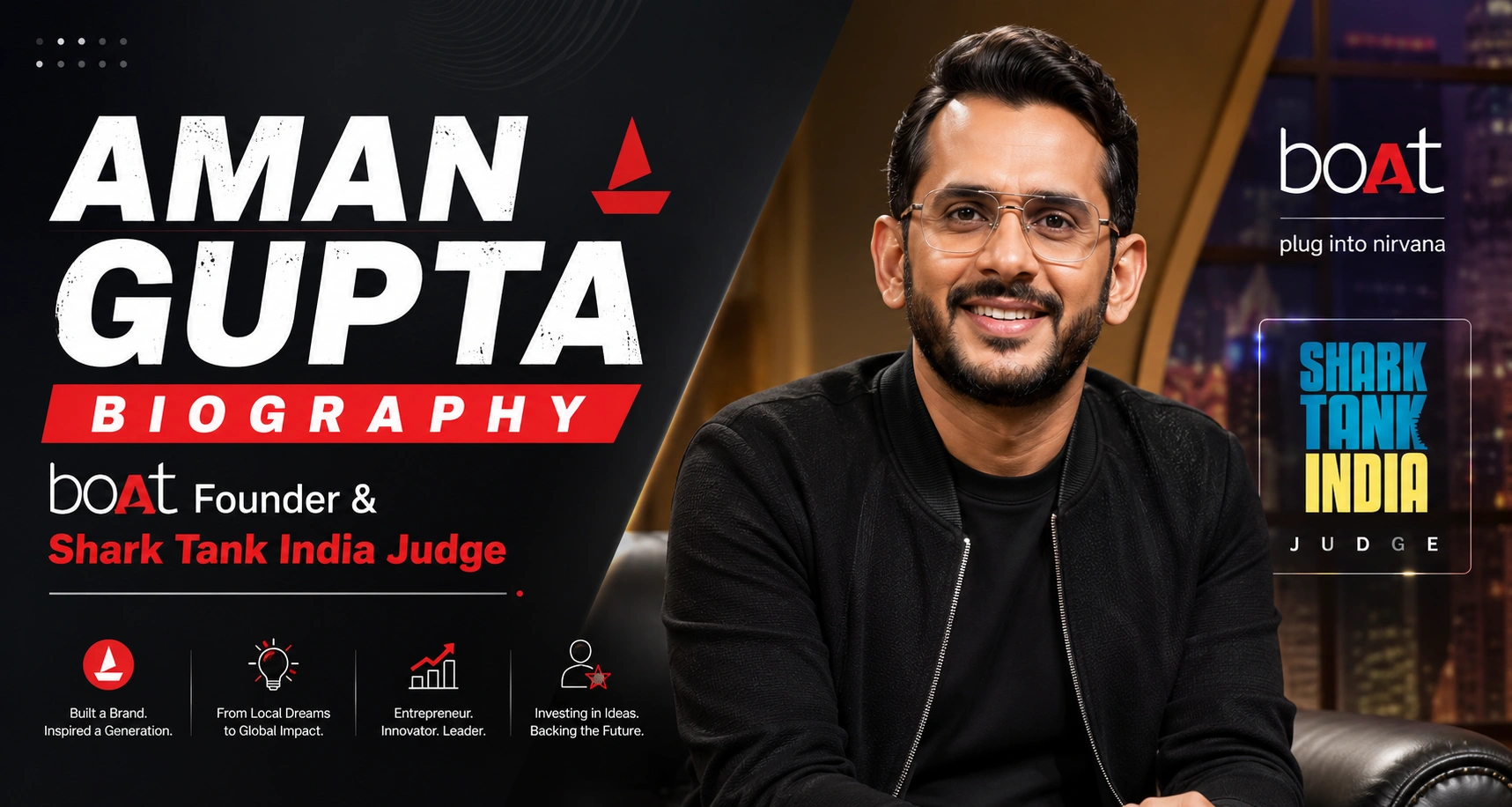
There is a moment in the early days of boAt that Aman Gupta often talks about.
He and his co-founder Sameer Mehta were trying to sell their first product — a charging cable that would not break after three months, unlike every other cable Indians were buying at the time. They had no venture capital, no celebrity endorsements, no marketing budget. They were knocking on doors, making cold calls, and wondering if anyone would ever take them seriously.
Today, boAt is valued at over ₹10,800 crore, has sold more than 20 million products, consistently ranks among the top 5 global headphone brands by volume, and is worn by millions of Indians from college campuses to gym floors to corporate offices.
And Aman Gupta — the CA-turned-CMO-turned-Shark — has a personal net worth of approximately ₹720 crore.
This is his story.
Quick Facts
| Detail | Information |
| Full Name | Aman Gupta |
| Date of Birth | March 4, 1982 |
| Age (2026) | 43 years |
| Birthplace | Delhi, India |
| Education | B.Com (Hons), Delhi University; CA; MBA from ISB & Kellogg School of Management |
| Profession | Entrepreneur, Investor, TV Personality |
| Company | boAt Lifestyle (Co-founder & CMO) |
| Net Worth (2026) | ~₹720 crore ($87–90 million) |
| Company Valuation | ~₹10,800 crore |
| Known For | boAt, Shark Tank India |
| Wife | Priya Dagar |
| Children | Two daughters — Adaa and Miraya |
Early Life — Delhi Boy with Big Dreams
Born on 4th March 1982 in Delhi, India, into a middle-class family, Aman was a child of discipline, education and hard work. He was grounded and ambitious by his father Neeraj Gupta and Mother Jyoti Kochar Gupta. He also has a sister named Neha Gupta.
He completed his schooling at Delhi Public School (DPS), R.K. Puram — one of Delhi’s most respected schools — where he was academically strong and already showed the sharp, competitive mindset that would define his entrepreneurial journey later.
From an early age, Aman had what can only be described as an entrepreneurial restlessness. He did not just want a stable job. He wanted to build something. But for the son of a middle-class Delhi family in the early 2000s, the most respected path was a professional degree — and so he followed it.
Education — The CA Who Wanted More
Following school, Aman studied a Bachelor of Commerce (Honours) from Delhi University and went on to qualify as a Chartered Accountant (CA) one of the most sought-after and rigorous professional qualifications in India.
However, he did not end there. He was thirsty for knowledge about the business world that went beyond just numbers and balance sheets and earned an MBA in Finance and Strategy from India’s premier business school, the Indian School of Business (ISB), Hyderabad. Then he earned an MBA from the Kellogg School of Management at Northwestern University, USA, completing his education with a truly international business education.
This will later form the crux of how he built boAt: emotionally aware of Indian consumers and run with world-class financial and marketing discipline.
Career Before boAt — The Road Less Talked About
Before Aman Gupta became a household name, he had a career that most people do not know about.
After completing his CA, he worked at Citibank as a manager. He then moved to KPMG as a senior associate. These roles gave him deep exposure to how large organizations work — their systems, their financial logic, and importantly, their limitations.
He then joined JBL (the global audio brand) as the India sales head — and this is where everything changed. Working at JBL taught him the audio industry from the inside. He understood what made a good product, what Indian consumers actually wanted from audio devices, what they were willing to pay, and — crucially — what was missing in the market.
The insight was simple but powerful: Indian consumers, especially young people, wanted great-quality audio products at affordable prices. Premium global brands like Sony and Bose were too expensive. Cheap Chinese knockoffs were too poor in quality. There was a massive gap right in the middle — and nobody was filling it for India specifically.
That gap became boAt.
The Birth of boAt — 2016
In January 2016, Aman Gupta and his close friend Sameer Mehta co-founded boAt Lifestyle. Sameer brought operational and supply chain expertise; Aman brought brand strategy, marketing vision, and his audio industry knowledge.
Their first product was humble: a durable Apple MFi-certified charging cable. Not headphones. Not smartwatches. A cable. But it solved a real problem — Indian consumers were tired of cables that frayed and stopped working within weeks.
The cable sold. Then came earphones. Then headphones. Then speakers. Then smartwatches. Then fitness bands.
boAt’s positioning was always clear: affordable, stylish, durable — made for young India. The brand spoke the language of college students, gym-goers, music lovers, and working professionals who wanted good products without paying ₹15,000 for a pair of earphones.
The brand strategy was genius. Instead of competing with Sony and Bose on specs, boAt competed on identity. It partnered with cricketers, musicians, and celebrities. It used bold colors and youthful designs. It marketed aggressively on Instagram, YouTube, and Amazon. It made buying a ₹1,500 earphone feel cool — not like a compromise.
boAt’s Rise — From Startup to ₹10,800 Crore Giant
boAt’s growth has been one of the most impressive stories in Indian consumer electronics:
- 2016: Founded with charging cables and basic earphones
- 2018: Crossed ₹100 crore in revenue — the first major milestone
- 2019: Became the #1 earwear brand in India by volume (IDC data)
- 2020–2021: Pandemic accelerated growth as Indians invested heavily in home audio and fitness tech
- 2021: Ranked among the top 5 global wearables brands by IDC — alongside Apple, Samsung, Xiaomi, and Imagine Marketing
- 2022–2023: Expanded into smartwatches, fitness bands, and premium audio
- 2026: Company valuation estimated at ₹10,800 crore ($1.3 billion)
boAt has consistently ranked among the top 5 global headphone brands by volume. It is one of India’s greatest direct-to-consumer success stories — built on the back of smart branding, relentless marketing, and an obsessive understanding of what young India wants.
Shark Tank India — The Moment India Fell in Love
If boAt made Aman Gupta rich, Shark Tank India made him famous.
When the Indian version of the global hit reality show launched in December 2021, Aman Gupta was one of the judges (called “Sharks”). He invested ₹9 crore in Season 1, ₹17.84 crore in Season 2, and has continued investing through subsequent seasons.
But more than the investments, it was Aman’s personality on screen that captured India. He was sharp, funny, relatable, and direct — a Shark who spoke in terms young entrepreneurs could understand. His feedback was honest without being cruel. His excitement when he found a great founder was genuine.
He became one of India’s most beloved business personalities overnight.
Some of his notable Shark Tank investments include:
- Shiprocket (logistics platform)
- 10 Club (consumer brands)
- Freecultr (fashion)
- Bummer (innerwear)
- Skippi Ice Pops (frozen treats)
In 2026, his investment portfolio continues to grow. Recent investments include ZOFF Foods (₹17 crore round), Orbit Wallet (fintech), and Edinora (lifestyle brand).
Personal Life — The Man Behind the Brand
Aman Gupta married Priya Dagar in April 2008 — a love story he describes as genuinely filmy. Priya is a senior policy advisor at the Embassy of the Kingdom of the Netherlands and has previously worked with the World Business Council for Sustainable Development and The Energy and Resources Institute (TERI). She is accomplished, independent, and deeply respected in her own right.
Together they have two daughters, Adaa and Miraya, who are growing up watching their father build one of India’s most exciting companies.
Aman has also spoken openly about personal tragedy — the loss of his brother Anmol Gupta, who passed away in a tragic accident on his own birthday. It is a grief that Aman carries quietly, and one that has given him a deep perspective on what truly matters in life.
What Makes Aman Gupta Different
In a startup ecosystem full of founders with billion-dollar valuations and polished LinkedIn profiles, what makes Aman Gupta genuinely stand out?
- He understood India before it was cool to.
When global brands were ignoring the ₹1,000–₹3,000 price segment, Aman bet everything on it. He understood that India’s middle class wanted quality AND affordability — not one or the other. - He is a marketer first.
Most tech founders are product-obsessed. Aman is obsessive about brand. boAt’s success is as much a marketing victory as a product one. The company turned a commodity product (earphones) into a cultural statement. - He is brutally honest.
On Shark Tank India, Aman is known for telling founders the hard truth with kindness. He values hustle above everything — and can spot the difference between genuine drive and rehearsed confidence within minutes. - He kept it Indian.
In an era when Indian brands were trying to sound American, boAt proudly embraced its Indian identity. The brand name itself — a reference to “anchoring” and “setting sail” — and its youthful Indian aesthetic resonated deeply with a generation that was proud to be Indian.
Aman Gupta’s 5 Business Lessons for Young Indians
From his interviews, Shark Tank appearances, and business journey, here are the five lessons Aman Gupta consistently shares:
- “Find the gap — and fill it for India specifically.”
Do not copy a Western business model and paste it on India. Understand what India needs, what India can pay, and what India aspires to. Then build for that. - “Hustle is non-negotiable.”
Aman grew up seeing his father work hard and never complain. He carries that work ethic everywhere. On Shark Tank, the first thing he looks for in a founder is energy and drive — not just a good idea. - “Brand is everything.”
A great product with poor branding will fail. A good product with exceptional branding can become iconic. Aman believes deeply that how you make people feel about your brand is more important than any feature on your spec sheet. - “Be honest — with yourself and with others.”
Aman has been publicly honest about his failures, his early rejections, and the difficulties of building boAt. He believes honesty builds trust — with investors, customers, and employees. - “Never stop learning.”
Even after building a ₹10,800 crore company, Aman continues to learn, invest, and expand. He is a Chartered Accountant who got an MBA. A CMO who became a CEO. An entrepreneur who became an investor. The growth never stops.
What’s Next for Aman Gupta in 2026?
The biggest news in Aman Gupta’s world right now is boAt’s long-anticipated IPO. The company has been moving closer to going public, which would be one of the most significant consumer electronics IPOs in Indian market history.
Beyond boAt, Aman is building out his investment portfolio aggressively, backing startups across fintech, consumer brands, and lifestyle sectors. He is also becoming an increasingly important voice in India’s entrepreneurship ecosystem — mentoring young founders, speaking at major events, and using his Shark Tank platform to inspire millions of aspiring entrepreneurs.
At 43, Aman Gupta is not just an entrepreneur. He is a symbol of what a new generation of Indian business leadership looks like — ambitious, creative, grounded, and deeply proud of being Indian.
Net Worth Breakdown (2026)
| Source | Estimated Value |
| boAt stake | Primary asset — largest contributor |
| Shark Tank India investments | ₹30+ crore invested across 50+ startups |
| Brand partnerships & engagements | Significant annual income |
| Real estate holdings | Delhi & Mumbai properties |
| Total estimated net worth | ~₹720 crore ($87–90 million USD) |
The Bottom Line
Aman Gupta’s story is not about a prodigy or a genius who had everything figured out from day one. It is about a Delhi boy who got the best education he could, worked hard in jobs he learned from, spotted a gap that everyone else ignored, and had the courage — and the hustle — to bet everything on filling it.
He did not just build a company. He built a brand that millions of young Indians wear on their ears and their wrists every single day.
That is not just success. That is the impact.
Also read on Magzilla Trends: