

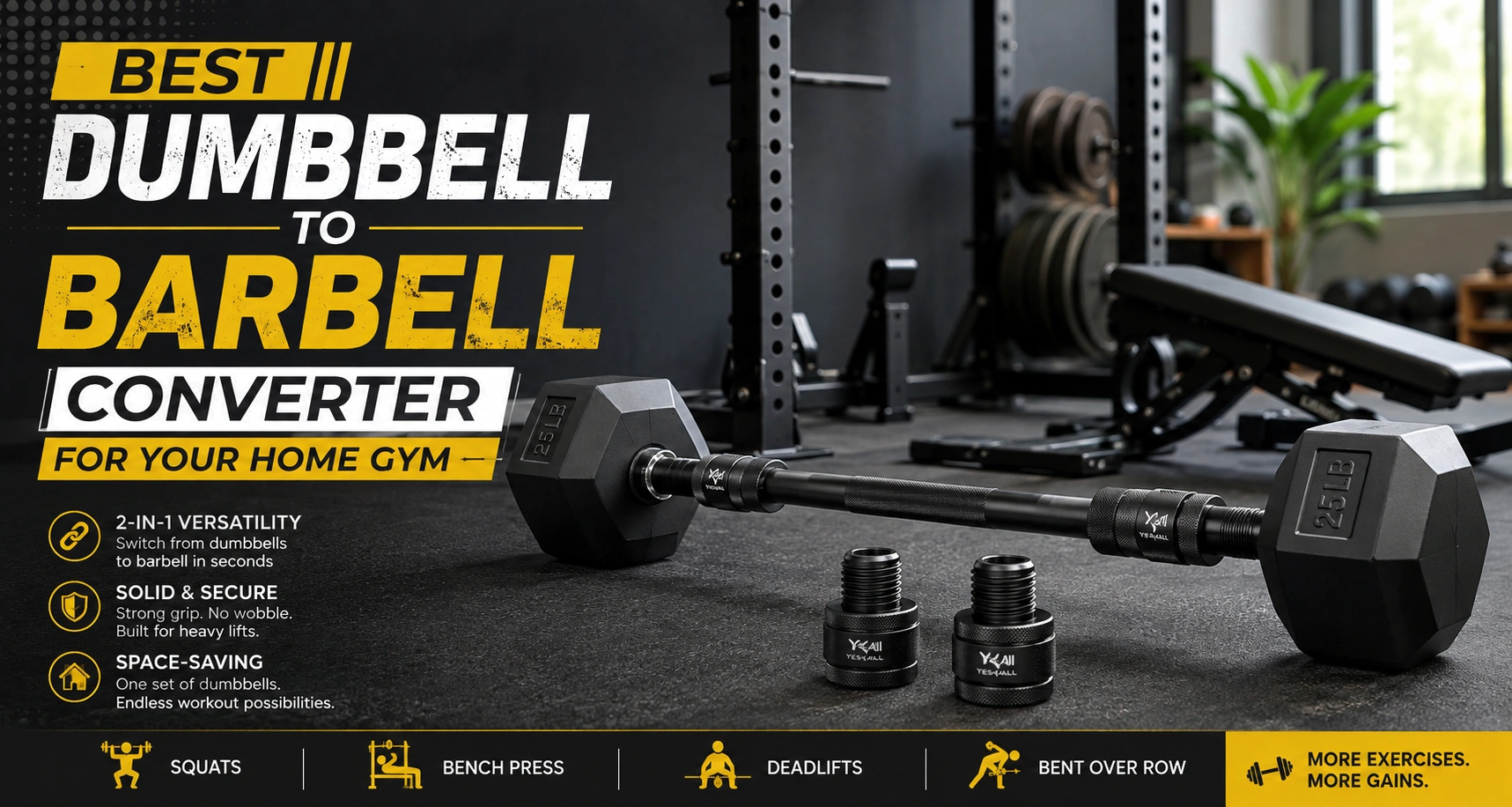
If you’ve ever stared at your pair of dumbbells and wished you could turn them into a full barbell for squats, bench presses, or deadlifts, you’re not alone. It’s one of the most common frustrations for home gym owners: dumbbells are great for isolation work, but there’s something about a barbell that just hits differently for compound lifts.
The good news is you don’t necessarily need to buy an entire barbell and plate set to get that experience. A dumbbell to barbell converter lets you clamp your existing dumbbells onto a connecting bar, instantly transforming them into a functional barbell. It’s compact, affordable, and one of the smartest space-saving upgrades you can make to a home gym.
In this guide, we’ll break down how these converters work, what to look for before buying one, and how to pick the best dumbbell to barbell converter for your specific setup.
What Is a Dumbbell to Barbell Converter?
A dumbbell to barbell converter is a piece of equipment — usually a steel or reinforced nylon bar with clamps on either end — that attaches to your dumbbells and holds them securely in place at both ends of the bar. Once locked in, your two dumbbells function as the “plates” of a makeshift barbell, letting you perform traditional barbell movements.
Most converters fall into one of two general designs:
- Clamp-style converters — These use a clamshell or collar mechanism that closes around the dumbbell handle and locks it in place.
- Slide-and-lock converters — These slide over a standard bar and are secured with locking collars, similar to how plates are secured on a normal barbell.
Either way, the goal is the same: give you barbell-style training without buying a second set of equipment.
Why Use a Dumbbell to Barbell Converter?
There are a few clear reasons this type of equipment has become so popular among home gym owners.
1. Space Savings
Not everyone has room for a full barbell, a rack of Olympic plates, and a squat rack. A converter lets you keep your equipment footprint small while still accessing compound barbell lifts.
2. Budget-Friendly Strength Training
Buying a full barbell and plate set can cost hundreds of dollars. A converter, on the other hand, is a fraction of that price and works with weights you likely already own.
3. More Exercise Variety
With a converter, you can move beyond dumbbell presses and curls into barbell-style squats, deadlifts, rows, overhead presses, and landmine exercises — all using the same pair of dumbbells.
4. Great for Small Apartments and Garage Gyms
If you’re training in a garage, spare room, or apartment, a converter takes up minimal storage space compared to a dedicated barbell and plate rack.
Key Features to Look for in the Best Dumbbell to Barbell Converter
Not all converters are created equal. Here’s what actually matters when comparing options.
Weight Capacity
This is one of the most important specs. Converters typically range from around 100 lbs to over 250 lbs of total capacity. If you’re a beginner or intermediate lifter, a lower-capacity model may be enough. If you’re working toward heavier compound lifts, look for a converter rated for higher loads so you have room to progress.
Compatibility With Your Dumbbells
Not every converter fits every dumbbell. Before buying, check:
- Handle length — Most converters require a minimum handle length (often around 4 to 4.5 inches) to clamp securely.
- Handle diameter — Standard handles are usually under 1.5 inches in diameter, but adjustable dumbbells can vary.
- Dumbbell type — Some converters are built specifically for adjustable dumbbell systems, while others work with fixed cast iron or rubber hex dumbbells.
Build Material
Look for converters made from:
- Heavy-duty steel — Offers excellent durability and a stable, gym-like feel.
- Reinforced nylon or polymer composites — Lightweight yet surprisingly strong, often used in modern clamp-style designs.
Locking Mechanism
A secure lock is non-negotiable for safety. The best dumbbell to barbell converter should have a locking system that doesn’t loosen mid-lift, whether that’s a twist-lock collar, a clamshell clamp, or a traditional spring collar.
Ease of Setup
Some converters require tools to install, while others use a tool-free clamp-and-lock design that takes just seconds. If you plan on switching between dumbbell and barbell exercises frequently during a workout, a fast, tool-free setup will save a lot of time.
Best Exercises You Can Do With a Dumbbell to Barbell Converter
Once your converter is set up, you unlock a wide range of compound and isolation movements, including:
- Barbell squats
- Deadlifts
- Bench press
- Overhead press
- Bent-over rows
- Bicep curls
- Landmine presses and rotations
- Romanian deadlifts
This kind of versatility is exactly why converters have become such a popular addition to minimalist home gyms.
How to Choose the Right Converter for Your Fitness Goals
For Beginners
If you’re just starting out, prioritize ease of use and safety over maximum weight capacity. A simple clamp-style converter with a lower weight limit is usually more than enough while you build strength and confidence with compound lifts.
For Intermediate Lifters
Look for a mid-range weight capacity (150–200 lbs) and a converter compatible with adjustable dumbbells, since your working weights will likely increase over time.
For Advanced Lifters
If you’re already lifting heavy, prioritize a converter with a high weight capacity, a rock-solid locking mechanism, and steel construction that can handle repeated heavy loading without flexing or wearing out.
Common Mistakes to Avoid When Buying a Converter
- Ignoring handle compatibility — Always double-check your dumbbell’s handle length and diameter against the converter’s specs before purchasing.
- Choosing based on price alone — A cheaper converter with a weak locking mechanism can be a safety risk, especially with heavier loads.
- Overlooking weight capacity — Buying a converter that barely meets your current strength level means you’ll outgrow it quickly.
- Skipping reviews — Real user feedback often reveals fit issues or durability concerns that aren’t obvious from the product description alone.
Tips for Using a Dumbbell to Barbell Converter Safely
- Always double-check that the clamps or collars are fully locked before lifting.
- Start with lighter weights to test the stability of the setup before loading up.
- Perform a slow, controlled first rep to make sure nothing shifts or wobbles.
- Store your converter in a dry area to prevent rust or wear on steel components.
- Periodically inspect the locking mechanism for signs of wear, especially if you train frequently.
Final Thoughts
A dumbbell to barbell converter is one of the simplest, most cost-effective ways to expand what your home gym can do. Instead of investing in an entirely separate barbell and plate set, you can put your existing dumbbells to work in a completely new way — unlocking squats, deadlifts, presses, and rows without taking up extra space or spending extra money.
When choosing the best dumbbell to barbell converter for your setup, pay close attention to weight capacity, handle compatibility, build quality, and the locking mechanism. Get those details right, and you’ll have a compact, versatile piece of equipment that keeps your training fresh for years to come.
Also Read:- Best Fitness Equipment Brands in India for Home & Gym Workouts
Frequently Asked Questions
1. Are dumbbell to barbell converters safe to use?
Yes, as long as you choose a converter with a secure locking mechanism and stay within its rated weight capacity. Always double-check that the dumbbells are locked in place before starting your set.
2. Will a converter fit any dumbbell?
Not necessarily. Compatibility depends on the handle length and diameter of your dumbbells. Most converters list minimum and maximum handle specs, so it’s worth measuring your dumbbells before buying.
3. How much weight can a dumbbell to barbell converter hold?
This varies by product, but most converters on the market support anywhere from 100 lbs to over 250 lbs total, depending on the materials and design.
4. Can I use a dumbbell to barbell converter with adjustable dumbbells?
Many converters are specifically designed to work with adjustable dumbbell systems, but not all of them. Check the product specs to confirm compatibility with your particular brand and model.
5. Is a converter a good replacement for a full barbell set?
For most home gym owners, yes. A converter offers similar training benefits at a fraction of the cost and space requirement. Serious powerlifters chasing very heavy loads may eventually want a dedicated barbell, but for general strength training, a converter is more than capable.