

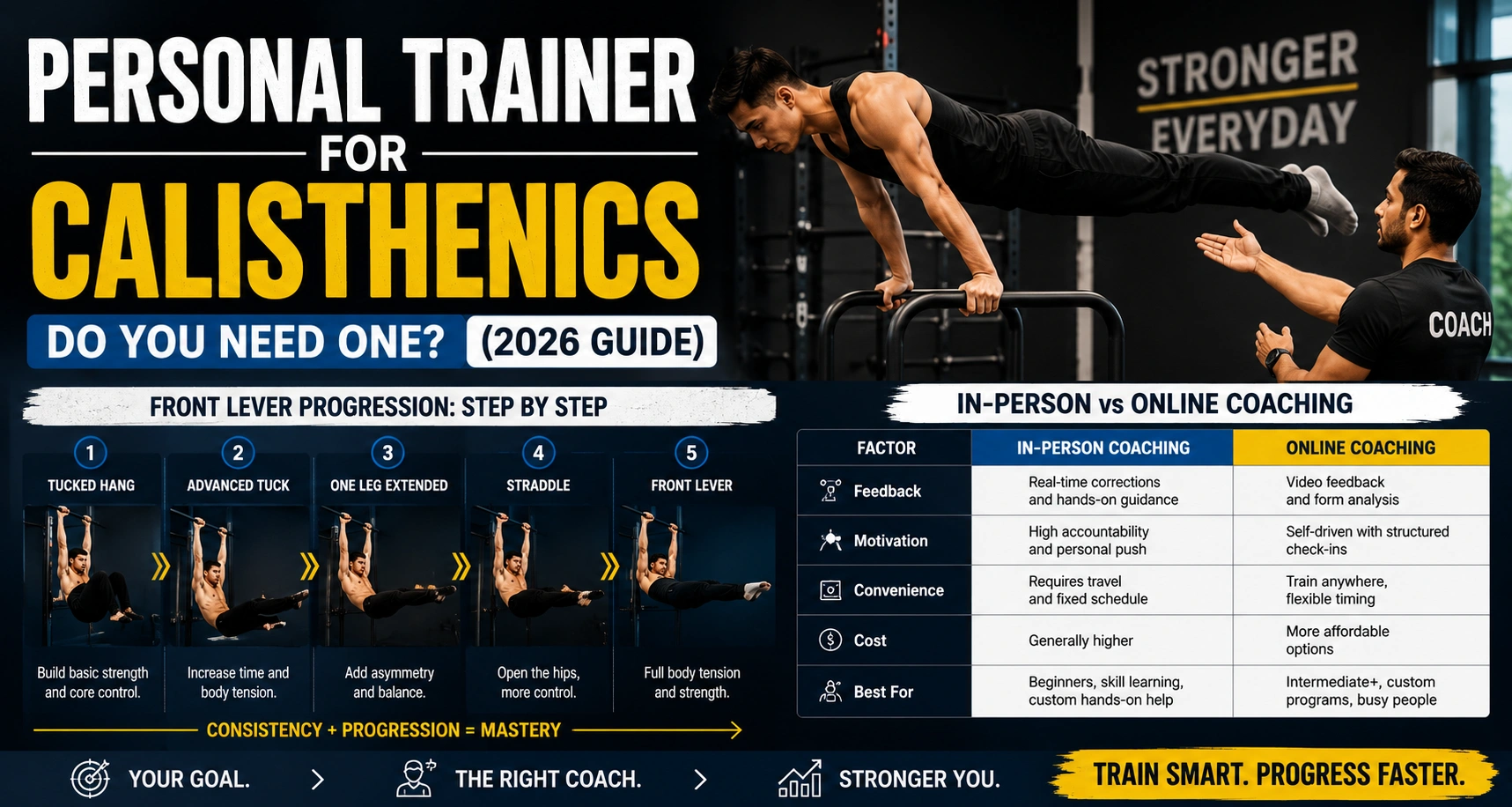
Calisthenics looks simple from the outside — pull-ups, push-ups, dips, no equipment required. Then you try to actually build toward a muscle-up or a front lever and discover it’s less like “bodyweight fitness” and more like a skill sport, with its own progressions, joint-prep requirements, and very real ways to get hurt if you rush the sequence. That gap between “looks simple” and “is actually a skill discipline” is exactly where a good personal trainer for calisthenics earns their fee.
Quick answer: A personal trainer for calisthenics is worth considering if you’re working toward advanced skills (muscle-ups, planche, front lever, handstands) and want a structured, injury-aware progression rather than guessing your way there. In-person calisthenics coaching typically runs €50–€100 (roughly $55–$110) per session, or €500–€2,000/month for multiple weekly sessions with full programming. Online calisthenics coaching is generally more affordable, with solid mid-range programs running €200–€300 (roughly $220–$330) per month. For general fitness or early beginner strength building, self-directed programs and free resources are often genuinely sufficient — a coach becomes more valuable as your goals get more skill-specific and technical.
What a Calisthenics Personal Trainer Actually Does
This is worth being specific about, because it’s meaningfully different from a typical gym personal trainer’s job. A calisthenics-focused coach generally works on:
- Skill progressions — structured pathways toward advanced movements like the muscle-up, planche, front lever, back lever, and handstand, broken into intermediate steps rather than attempting the full skill directly.
- Joint preparation and injury prevention — many advanced calisthenics skills place significant, unusual stress on the shoulders, elbows, and wrists; a good coach builds in specific prehab and conditioning work before introducing high-stress positions.
- Leverage-based programming — instead of adding external weight, calisthenics progression typically works by changing body leverage and positioning (e.g., moving from a bent-arm to straight-arm planche progression) — a genuinely different programming skill than standard weight-room periodization.
- Form correction on technical movements — skills like the front lever or planche have narrow margins for technique error, and small form issues can both slow progress and increase injury risk.
- Realistic timeline-setting — advanced skills often take months to years of consistent, correctly sequenced training; an experienced coach can set expectations accurately rather than leaving you guessing whether your progress is normal.
Do You Actually Need One?
Not always — this depends heavily on your goals and current level.
A coach is genuinely valuable if:
- You’re targeting advanced, high-skill movements (muscle-up, planche, front lever, handstand push-up) where injury risk from poor progression is real.
- You’ve plateaued on a specific skill for months and can’t self-diagnose why.
- You want accountability and a structured plan rather than piecing one together from scattered YouTube videos.
- You have a previous injury history and want programming that specifically accounts for it.
Self-directed training is often genuinely sufficient if:
- You’re a beginner building general strength (basic push-ups, pull-ups, dips, squats) — well-established, free progression frameworks cover this well.
- You’re not yet targeting the specific high-skill movements where technical coaching matters most.
- You’re comfortable following a structured program (many reputable free and low-cost calisthenics programs exist) and self-assessing form via video.
In-Person vs. Online Calisthenics Coaching
| Factor | In-Person Coaching | Online Coaching |
|---|---|---|
| Typical cost | €50–€100 (~$55–$110) per session | €200–€300 (~$220–$330) per month for a solid mid-range program |
| Hands-on correction | Real-time, physical spotting and adjustment | Video review and feedback, not real-time physical correction |
| Best for | Complex skill work where physical spotting matters (e.g., early muscle-up attempts) | Ongoing programming, accountability, and general skill progression |
| Flexibility | Tied to trainer’s schedule and location | Train anywhere, any time, following the provided program |
| Cost at higher frequency | €500–€2,000/month for multiple sessions weekly | Generally stays within the flat monthly rate regardless of frequency |
When comparing online calisthenics coaching vs in-person options, neither format is objectively better — in-person coaching has a real edge for the specific moments where physical spotting reduces injury risk (like early attempts at inverted or high-skill movements), while online coaching tends to offer better value for ongoing structured programming and accountability over a longer training block.
What Calisthenics Coaching Actually Costs
| Coaching Type | Typical Price |
|---|---|
| In-person, single session | €50–€100 (~$55–$110) |
| In-person, multiple sessions/week | €500–€2,000/month |
| Online, budget/app-based | Roughly $75–$150/month |
| Online, standard 1:1 coaching | €200–€300 (~$220–$330)/month |
| General personal training (non-calisthenics-specific), for comparison | $40–$150 per session nationally in the US |
Understanding real calisthenics coach cost ranges upfront makes it much easier to spot a fair price versus an outlier. Pricing varies significantly by coach experience, location, and exactly what’s included (programming only vs. programming plus regular check-ins and video review) — confirm current rates directly with any coach you’re considering rather than relying on these ranges as fixed prices.
How to Choose a Good Calisthenics Coach
- Check for calisthenics-specific experience, not just a general certification. A standard personal training certification (NASM, ACE, etc.) doesn’t automatically mean deep expertise in skill-based bodyweight progressions — look for a track record specifically coaching movements like the front lever, planche, and muscle-up.
- Look at how they program joint preparation. A coach who jumps straight into advanced skill attempts without structured shoulder, elbow, and wrist conditioning first is a meaningful red flag, not a sign of an aggressive, results-focused approach.
- Ask how they handle plateaus. A good coach should be able to explain how they’d adjust programming if you stall on a specific skill for several weeks, not just repeat the same progression indefinitely.
- Review actual client progress, not just the coach’s own skill demonstrations. A coach being able to perform advanced skills themselves doesn’t necessarily mean they can teach someone else to get there safely and efficiently.
- Confirm what’s actually included in the price — programming only, or programming plus regular check-ins, form review, and adjustments. This is where online coaching pricing varies most and where comparisons can be misleading if you don’t check.
Questions to Ask Before Hiring
- “How do you structure progression toward [your specific goal skill]?”
- “What does your joint preparation and injury prevention approach look like before introducing high-stress positions?”
- “How often will you review my form, and how?” (especially relevant for online coaching)
- “What’s a realistic timeline for someone at my current level to reach [specific skill]?”
- “What happens if I plateau — how does your programming adjust?”
A coach who gives vague, generic answers to these — especially the injury-prevention question — is worth being cautious about, regardless of how impressive their own skill level looks on social media.
Red Flags to Watch For
- Pushing advanced skill attempts before basic strength and joint conditioning are established. This is the single most common cause of preventable calisthenics injuries.
- No individualized assessment before programming begins. A generic program with no adjustment for your current strength, mobility, or injury history is a weaker offering than genuinely personalized coaching, regardless of price.
- Pricing far below typical market rates with no clear explanation. This can sometimes reflect a legitimately lower cost-of-living region for the coach, but it’s worth verifying experience and credentials more carefully rather than assuming a bargain is risk-free.
- No willingness to explain their programming logic. A coach confident in their approach should be able to explain why they’re sequencing your training a specific way, not just tell you to trust the process.
FAQs
Q.1 Do I need a personal trainer to learn calisthenics?
Not necessarily for general fitness and beginner-level movements, where free, well-established progression resources are often sufficient. A coach becomes more valuable as you target advanced, high-skill movements like the planche or front lever, where injury risk from poor progression is real.
Q.2 How much does a calisthenics coach cost?
In-person coaching typically runs €50–€100 (roughly $55–$110) per session, or €500–€2,000/month for multiple weekly sessions. Online coaching is generally more affordable, with solid mid-range 1:1 programs running €200–€300 (roughly $220–$330) per month.
Q.3 Is online calisthenics coaching as effective as in-person?
For ongoing programming and general skill progression, yes, for many people — online coaching offers strong value and flexibility. In-person coaching has a real edge specifically for moments requiring physical spotting, like early attempts at certain inverted or high-skill movements.
Q.4 How long does it take to learn advanced calisthenics skills like the muscle-up or planche?
This varies significantly by starting strength level and training consistency, but advanced skills commonly take many months to a few years of correctly sequenced, consistent training — a coach with calisthenics-specific experience can typically give you a more accurate, individualized estimate than a generic timeline.
Q.5 What should I look for in a calisthenics coach’s credentials?
Beyond a general personal training certification, look specifically for demonstrated experience coaching calisthenics skill progressions, a clear approach to joint preparation and injury prevention, and evidence of actual client results, not just the coach’s own skill demonstrations.
Conclusion
Whether you need a personal trainer for calisthenics comes down to your goals: general bodyweight fitness is well served by free, structured self-directed programs, while advanced skill work benefits genuinely from coached, injury-aware progression. If you do hire one, prioritize calisthenics-specific experience and a clear approach to joint preparation over price or flashy skill demonstrations alone. If you’re still building foundational strength before considering coached skill work, our guide on How to Build a Beginner Workout Split for Muscle Gain is a solid starting point, or explore the full Fitness & Workout Guide.