

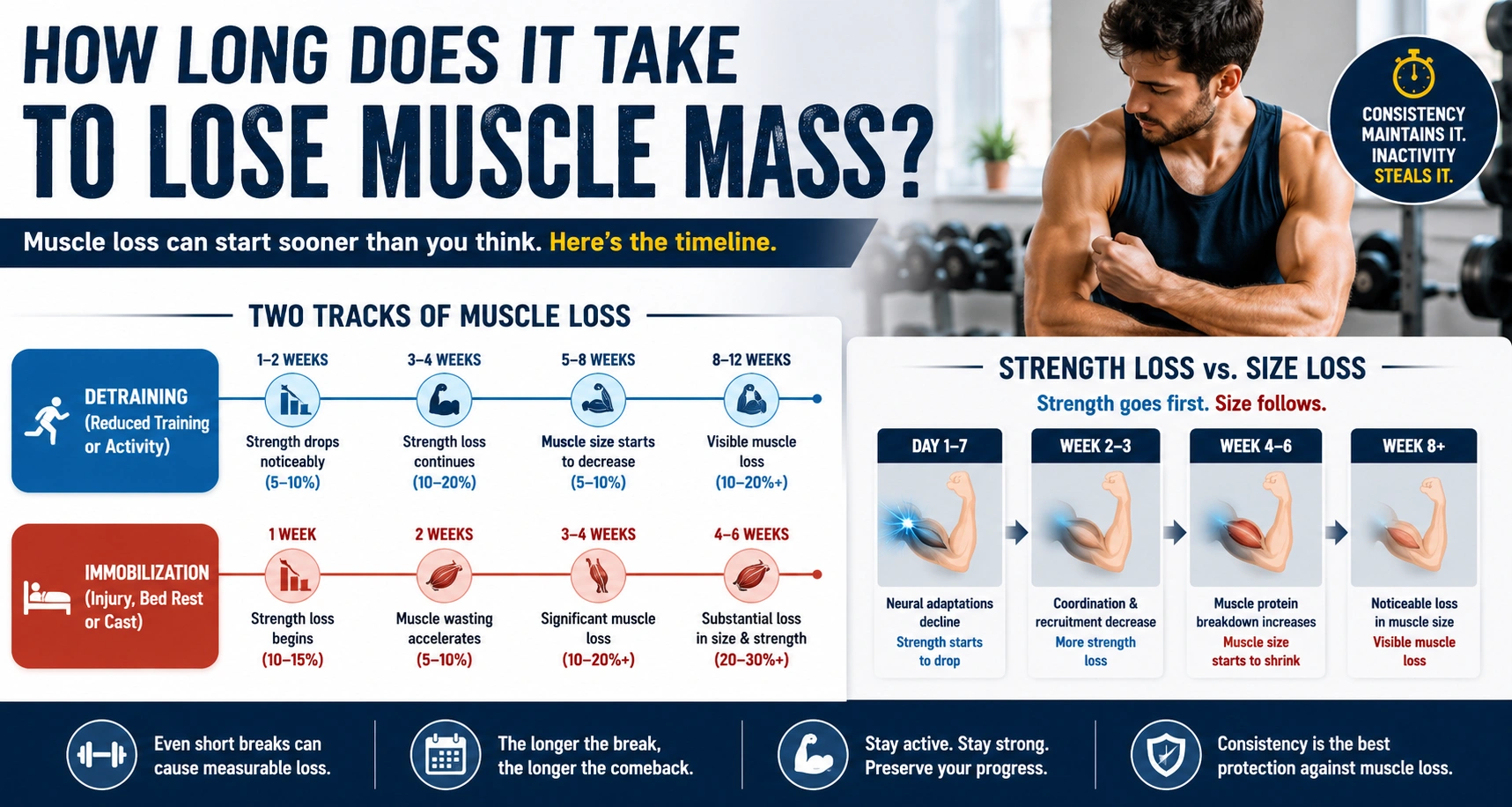
Miss one workout and your muscles are fine. Miss a few weeks and the worry starts creeping in — did all that progress disappear? The honest answer is more reassuring than most people expect, but it depends heavily on one factor most articles gloss over: whether you’re simply not training, or genuinely immobilized.
Quick answer: If you’re just skipping the gym but still moving around normally, meaningful muscle loss typically doesn’t become visible for about 2–4 weeks, with most people noticing visible shrinkage somewhere between 4 and 12 weeks. If you’re fully immobilized — a cast, bed rest, or post-surgery — the timeline is dramatically faster: measurable muscle loss can begin within 24–72 hours, since even normal daily movement provides enough muscle loading to slow the process, and immobilization removes that entirely.
The Two Timelines: Detraining vs. Immobilization
This distinction matters more than almost anything else in this topic, and most people conflate the two:
- Voluntary detraining — you stop structured training but still walk, stand, and move through a normal day. Muscle loss is real but gradual, because everyday activity provides a low-level maintenance stimulus.
- Complete immobilization — a cast, bed rest, or an inactive limb after surgery. There’s no baseline muscle loading at all, and research shows this triggers a dramatically faster atrophy process, sometimes 5–10 times quicker than simple detraining.
Muscle Loss Timeline: Voluntary Detraining (Still Moving Normally)
| Timeframe | What’s Happening |
|---|---|
| Days 1–7 | Minimal visible change; some studies show muscle protein synthesis beginning to shift within days, but this isn’t yet meaningful loss |
| Week 2–3 | Strength starts to decline first (roughly 5–10%), driven by reduced neuromuscular efficiency — the nervous system recruiting muscle fibers less effectively, not the muscle tissue itself shrinking yet |
| Week 3–4 | Muscle size itself begins measurably decreasing, at a rate cited around 0.5–1% of muscle mass per week of continued inactivity |
| Week 4–12 | This is the window most people report visible, in-the-mirror muscle shrinkage — one board-certified physiatrist cited in recent reporting puts the typical range for noticeable change at 4 to 12 weeks for most people |
| 12 weeks | Research on well-trained athletes found a 2–5.7% loss in fat-free mass and an 8.2% strength decline after 12 weeks of detraining — meaningful, but recoverable |
The key pattern to remember: strength drops before size does. You’ll likely feel weaker before you look smaller, because the initial decline is mostly neural (how efficiently your nervous system recruits muscle fibers), not a loss of actual muscle tissue.
Muscle Loss Timeline: Complete Immobilization (Cast, Bed Rest, Post-Surgery)
| Timeframe | What’s Happening |
|---|---|
| 24–72 hours | Research shows measurable atrophy can begin this quickly under full immobilization — muscle protein synthesis drops and the catabolic process starts almost immediately |
| 1 week | A well-cited bed rest study found approximately 1.4kg of lean tissue loss, a 3.2% decline in quadriceps cross-sectional area, and a roughly 6.9% drop in one-rep max strength — all within just seven days |
| 2 weeks | Total leg muscle quantity can decline by roughly 5% under continued bed rest conditions |
| 3–5 weeks | Significant functional strength decline becomes clinically apparent, particularly in older adults or those with lower baseline fitness before immobilization began |
| 6+ weeks | Atrophy becomes visible and functionally limiting, affecting daily tasks like walking, stairs, and return to sport or work |
If you’re recovering from surgery or an injury requiring immobilization, this faster timeline is a normal, expected part of recovery — not a sign anything has gone wrong. Structured rehabilitation typically restores lost function over a comparable timeframe to how long the immobilization lasted.
What Affects How Fast You Lose Muscle
- Training background. More trained individuals tend to lose muscle more slowly during a break than beginners, though they also have more absolute muscle to lose — net effect, well-trained people generally hold onto a higher proportion of their gains during time off.
- Age. Older adults typically experience faster and more pronounced strength and muscle loss during both detraining and immobilization compared to younger individuals.
- Nutrition, especially protein intake. Inadequate protein during a break accelerates muscle loss regardless of activity level — this is one of the most controllable factors in the entire equation.
- How completely inactive you are. Someone who stays lightly active (walking, light activity) during a break loses muscle more slowly than someone who is fully sedentary, even without structured training.
- Illness or major stress. Being sick, especially with a fever or significant inflammatory response, can accelerate muscle breakdown beyond what inactivity alone would cause.
The Good News: Muscle Memory Is Real
Regaining muscle after a break is measurably faster than building it the first time. This is commonly attributed to “muscle memory” — a combination of retained neuromuscular adaptations and evidence that muscle cells may retain some structural changes from previous training, making it easier to rebuild size and strength once you resume. Practically, this means a few weeks or even a couple of months away from training rarely sets you back to square one — most people who return to consistent training recover lost strength and size considerably faster than their original timeline to build it.
Muscle Loss vs. Other Changes You Might Notice First
Before assuming any early change how long does it take to lose muscle mass, it’s worth ruling out a few things that happen much faster and often get mistaken for it. Reduced muscle glycogen and water content can make muscles look slightly flatter or less full within just one to two weeks of stopping training — this is a real, visible change, but it’s not muscle tissue loss, and it reverses quickly once you resume training and carbohydrate intake returns to normal. Similarly, a slightly higher body fat percentage from a change in activity level and eating patterns during a break can make muscle definition look reduced even if the underlying muscle mass hasn’t changed much yet. Genuine muscle atrophy — an actual reduction in muscle fiber size — is the slower process described in the timelines above, and distinguishing it from these faster, more superficial changes can help avoid unnecessary panic during the first couple of weeks of a break.
How to Minimize Muscle Loss During a Break
- Stay lightly active even if you can’t train fully. Walking, light resistance work, or bodyweight movements provide a maintenance stimulus that meaningfully slows the rate of loss compared to complete inactivity.
- Keep protein intake consistent, even if your training volume drops — this is one of the most effective, fully controllable levers you have.
- One low-volume session per week can preserve most of your strength and size for a limited period, according to maintenance-training research — useful if you’re dealing with a busy stretch rather than a true extended break.
- Prioritize compound, multi-joint movements if you can fit in any training at all — they provide more total stimulus per session than isolation work.
- Don’t panic and overcorrect once you’re back. Ease back into your previous training load over 1–2 weeks rather than jumping straight to your pre-break volume and intensity, which raises injury risk.
FAQs
Q.1 How many weeks off before you start losing muscle?
For voluntary detraining (still moving normally day to day), most research suggests strength begins declining around 2–3 weeks, with visible muscle size changes typically following around 3–4 weeks and becoming more noticeable between 4–12 weeks. Complete immobilization accelerates this dramatically, with measurable loss possible within 24–72 hours.
Q.2 Do you lose muscle faster than you gain it?
Generally no — regaining muscle after a break is typically faster than the original process of building it, thanks to retained neuromuscular adaptations often referred to as muscle memory.
Q.3 Is a week off from the gym enough to lose muscle?
For most people who remain otherwise active, no — a single week of reduced training with normal daily movement is unlikely to cause meaningful, visible muscle loss. A week of complete bed rest or immobilization is a very different story and can cause measurable loss even in that short window.
Q.4 Does age affect how fast you lose muscle?
Yes — older adults generally experience faster and more significant strength and muscle loss during both detraining and immobilization compared to younger people, which is part of why maintaining some activity becomes increasingly important with age.
Q.5 Can you prevent muscle loss during a forced break, like recovering from injury?
You can meaningfully slow it, even if you can’t fully prevent it — staying as active as your recovery allows, maintaining protein intake, and starting light, doctor-approved movement as early as safely possible all help reduce the rate of loss compared to complete inactivity.
Conclusion
How long does it take to lose muscle mass, and for most people simply taking a break from the gym, it’s a gradual process that takes several weeks to become noticeable — not the rapid disappearance many worry about. The real acceleration point is complete immobilization, not just skipping workouts. Stay lightly active, keep protein intake steady, and trust that muscle memory will make the comeback faster than the original build. For a structured plan once you’re ready to get back into it, see our guide on How to Build a Beginner Workout Split for Muscle Gain, or explore the full Fitness & Workout Guide.