

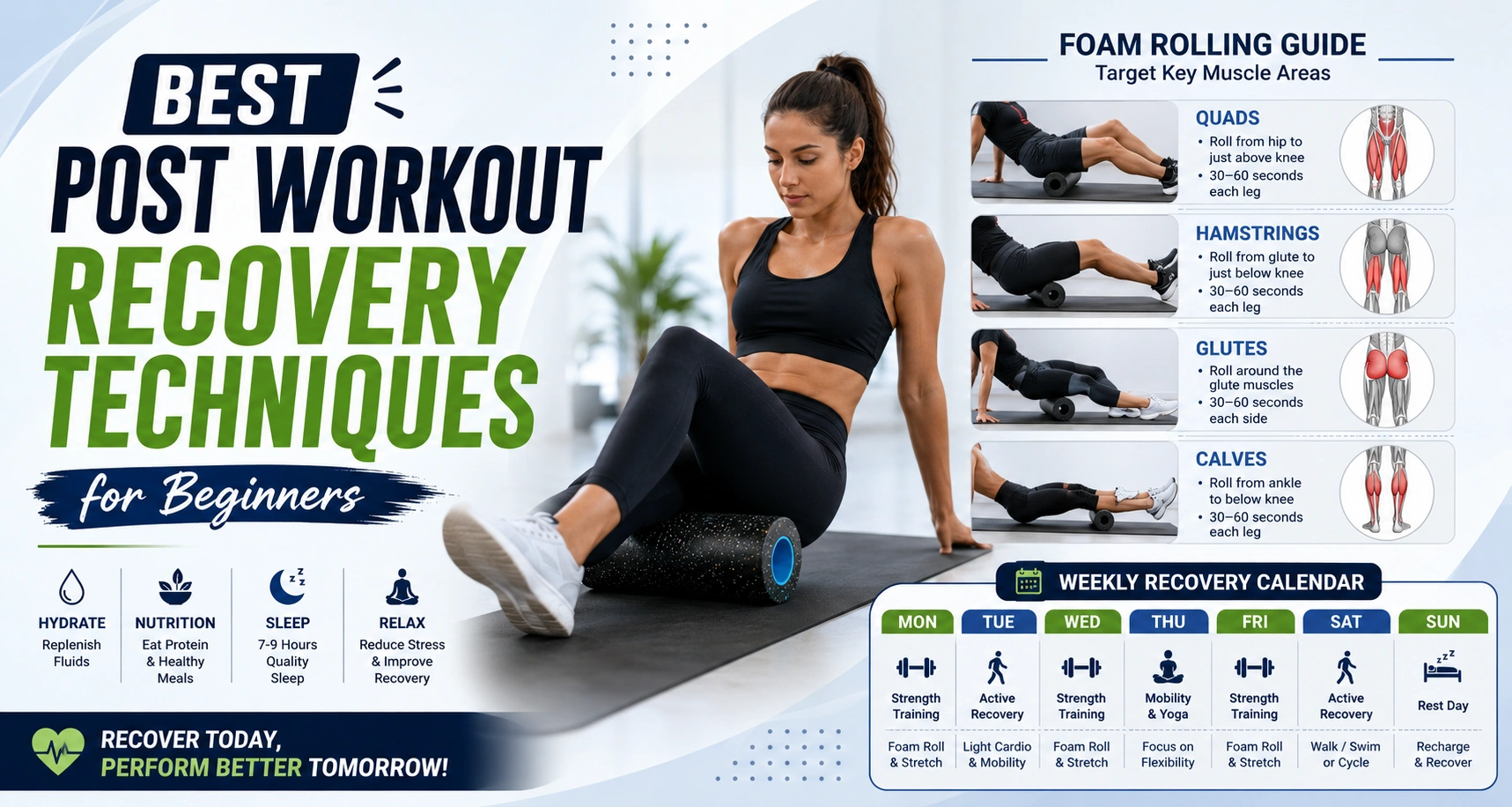
The workout isn’t where you get stronger — recovery is. Training creates the stimulus that tells your muscles to adapt, but the actual adaptation, the part where you come back faster, stronger, or more capable, happens in the hours and days after you’ve left the gym. Skip recovery, and you’re leaving a real chunk of your training’s benefit on the table.
Quick answer: Best post workout recovery techniques for beginners: Rehydrate, protein and carbs within a couple of hours of your workout, get 7-9 hours of quality sleep, light activity (walking or easy cycling) and foam rolling 10-15 minutes on the muscles worked. You should give a muscle group 48 hours to recover before training it again at high intensity, but you can do light activity on a day in between.
Why Recovery Deserves as Much Attention as Training
It’s tempting to think of rest days as time off, but that framing undersells what’s actually happening. During recovery, your body repairs the microscopic muscle damage caused by training, replenishes energy stores, and adapts to handle a bit more stress next time — which is the entire mechanism behind getting stronger or fitter. Skip proper recovery consistently, and you’re not just uncomfortable; you slow your own progress and raise your injury risk, since undereovered muscles and connective tissue are more vulnerable under load.
How Long to Rest Between Workouts
| Training Type | Recommended Rest |
|---|---|
| Same muscle group, high intensity (strength training) | 48 hours minimum before training it hard again |
| Full-body workouts | 1 rest or active-recovery day between sessions |
| Light cardio (walking, easy cycling) | Can be done daily; doesn’t require dedicated rest days |
| High-intensity cardio or HIIT | 1–2 rest days per week, depending on frequency |
| Beginners overall | At least 1–2 full rest or active-recovery days per week |
The 48-hour guideline for muscle groups exists because that’s roughly how long the repair process from a hard training session typically takes for most people — training the same muscles again before that window closes generally means training on incomplete recovery, which compounds rather than helps.
Post Workout Recovery Techniques, Ranked by Impact
| Technique | Time Needed | Primary Benefit |
|---|---|---|
| Hydration | Ongoing | Supports circulation, nutrient delivery, and muscle function |
| Protein + carbs within 2 hours | 10 minutes to eat | Supplies materials for muscle repair and glycogen replenishment |
| Sleep (7–9 hours) | Nightly | The primary window for physical repair and adaptation |
| Active recovery | 20–30 minutes | Improves circulation and lactate clearance versus complete rest |
| Foam rolling | 10–15 minutes | Reduces perceived soreness and supports mobility |
| Stretching/mobility work | 10–15 minutes | Maintains range of motion, reduces stiffness |
| Cold or hot therapy | 10–15 minutes | May reduce inflammation and support faster perceived recovery |
Foam Rolling: What It Actually Does
Foam rolling, technically called self-myofascial release, involves applying steady body-weight pressure to a muscle using a roller to relieve tension and reduce soreness. Research on its effects shows real, if modest, benefits: studies have found foam rolling after exercise reduces the prevalence of delayed-onset muscle soreness (DOMS), with some research showing soreness reductions in the range of 6–30% depending on the study and methodology, alongside improvements in mobility and range of motion.
How to foam roll correctly:
- Target the muscles you just trained — quads, hamstrings, glutes, and calves are common areas for lower-body sessions.
- Apply steady pressure and roll slowly, spending roughly 30–90 seconds per muscle group rather than rushing through.
- If you come to a particularly tight or tender area, stop and apply gentle pressure to that area for a few extra seconds, before continuing on.
- Keep total sessions to about 10–15 minutes — more isn’t necessarily better, and quality of technique matters more than duration.
Before or after a workout? Both have value, but for slightly different reasons: foam rolling before training tends to improve mobility and range of motion for the session ahead, while rolling after training is more effective specifically for reducing next-day soreness. If you only have time for one, post-workout generally offers more direct recovery benefit for beginners.
A few situations where foam rolling isn’t appropriate: avoid rolling directly over an acute injury, a recent strain, or an area with significant swelling — check with a professional first if you’re unsure whether it’s appropriate for a specific issue.
Active Recovery vs. Complete Rest
For most beginners, gentle movement on a rest day tends to work better than doing absolutely nothing. Active recovery — light activity at roughly 30–50% effort, like an easy walk, gentle cycling, or light swimming — improves blood flow and helps clear metabolic waste from muscles more effectively than sitting still all day, which is part of why many recovery routines favor a 20–30 minute walk over a fully sedentary rest day.
That said, complete rest still has its place, particularly if you’re dealing with significant fatigue, illness, or a niggling injury — active recovery is meant to be genuinely light, not a workaround for skipping rest entirely. If a “recovery walk” leaves you more tired than when you started, you’ve overshot the intensity it’s meant to be.
Nutrition and Hydration for Recovery
What you eat and drink after training matters nearly as much as the techniques above:
- In most cases, protein provides the muscle repair after training — so a source such as eggs, paneer, chicken, or a protein shake within a couple of hours of training is a good amount for a beginner.
- Carbohydrates replenish glycogen (your muscles’ stored energy), which matters more the harder or longer your session was.
- Water supports nearly every recovery process, from circulation to nutrient delivery — a simple, practical check is whether your urine is pale yellow; if it’s notably darker, that’s a sign to drink more.
Sleep: The Recovery Tool Most People Underrate
The bulk of the physical changes that occur as a result of training takes place while you sleep, not while you are training. The number one recovery habit on this list is getting 7–9 hours of good, solid sleep, and it’s the one that most people ignore, even after they’ve learned all the other foam rolling, supplementing and other things associated with recovery.
A Simple 15-Minute Post Workout Recovery Routine
- Hydrate immediately — a full glass of water right after finishing your session.
- Foam roll for 8–10 minutes, focusing on the muscles you just trained.
- Stretch for 5 minutes, holding each stretch for 20–30 seconds without bouncing.
- Eat a protein-and-carb snack or meal within the next couple of hours — this doesn’t need to happen in the gym, just within a reasonable window afterward.
Common Recovery Mistakes Beginners Make
- Treating rest days as entirely optional. Skipping recovery consistently slows progress rather than accelerating it.
- Foam rolling too aggressively or for too long. More pressure and more time isn’t automatically better — steady, moderate pressure for the recommended duration is enough.
- Ignoring sleep while focusing on other recovery tools. Foam rolling and stretching are genuinely useful, but they don’t substitute for the recovery that happens during sleep.
- Doing “active recovery” that’s actually just another hard workout. The point is low intensity — if you’re breathing hard and sweating heavily, that’s training, not recovery.
- Under-eating after training. Skipping post-workout nutrition, especially protein, slows the repair process your training is trying to trigger in the first place.
Frequently Asked Questions
Q.1 How long should I rest between workouts as a beginner?
For the same muscle group trained at high intensity, 48 hours is a reasonable general guideline. Light activity like walking doesn’t require the same rest window and can be done most days.
Q.2 Does foam rolling actually work, or is it just placebo?
Research does show real, if modest, benefits — studies have found foam rolling after exercise reduces measures of muscle soreness and improves mobility, though the effect size varies by study.
Q.3 Is active recovery better than complete rest?
For most people, yes — light movement improves circulation and helps clear metabolic waste more effectively than sitting completely still, though genuine complete rest still has its place during illness, injury, or significant fatigue.
Q.4 What should I eat after a workout to recover faster?
A combination of protein (to support muscle repair) and carbohydrates (to replenish energy stores), ideally within about two hours of finishing your session.
Q.5 How many hours of sleep does it take to rebuild muscle?
The amount of sleep that most adults need is 7–9 hours per night, as this is when physical adaptation and repair occurs.
Conclusion
Recovery isn’t the passive part of training — it’s where the actual progress happens. Build a simple routine around hydration, post-workout nutrition, foam rolling, and consistent sleep, and respect the roughly 48-hour window before training the same muscles hard again. If you’re looking for a low-impact way to stay active on recovery days, our 30 Day Walking Plan Weight Loss guide is a solid fit, or explore the full Fitness & Workout Guide for more.