
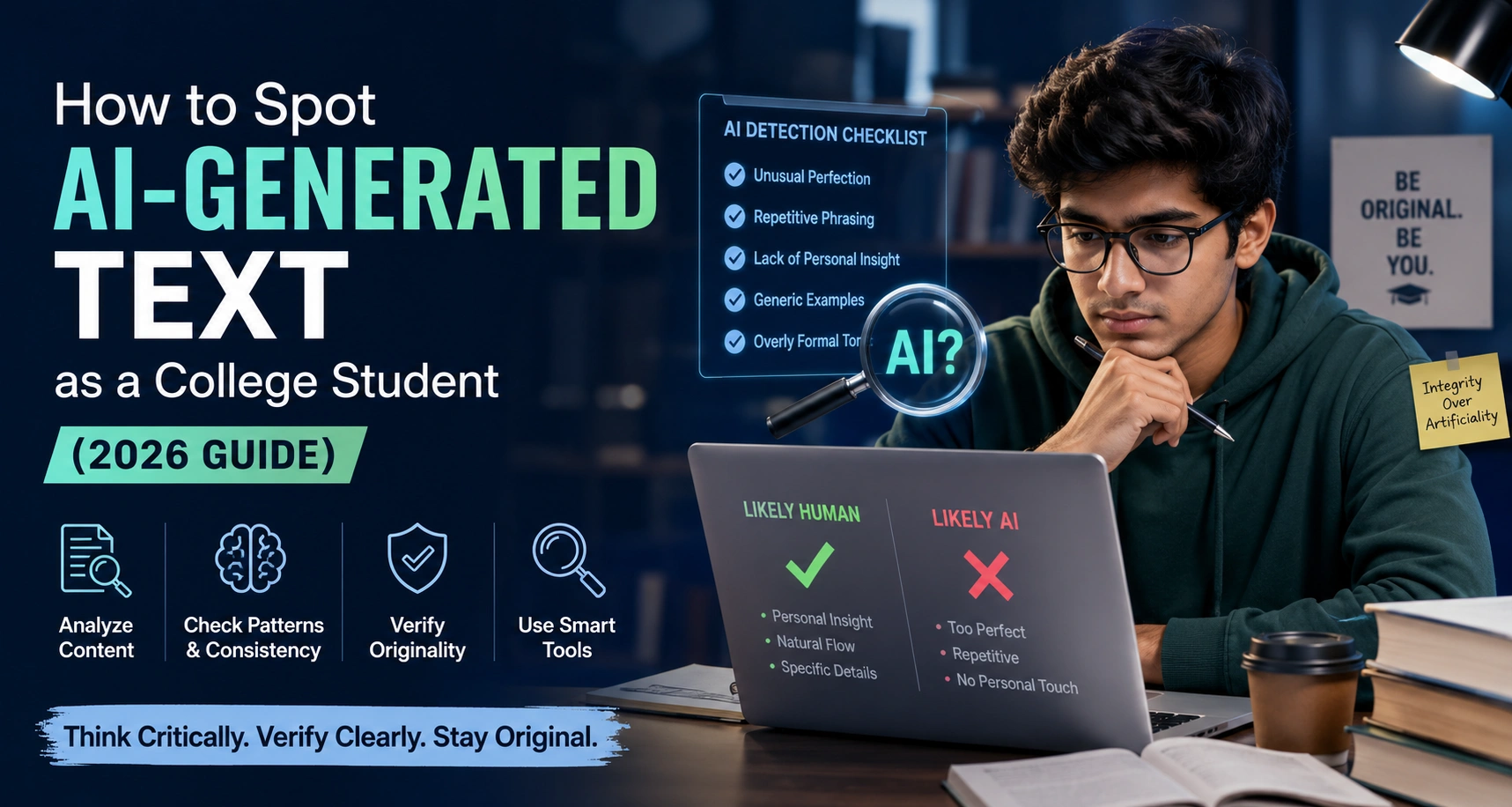
Whether you’re evaluating a source for a research paper, checking a group project teammate’s contribution, or just curious what your professor’s AI detector is actually looking at, spotting AI-generated text has become a genuinely useful skill in 2026. It’s also a more complicated one than it sounds — modern AI models write far more naturally than the tools from a couple of years ago, and detection software is nowhere near as reliable as most students assume.
Quick answer: AI-generated text tends to be unusually consistent in sentence length, leans on a specific set of overused words and transition phrases, stays vague rather than taking a clear position, and is often suspiciously free of the small errors real writers make. AI detectors like GPTZero and Originality.ai can support that judgment but shouldn’t be treated as definitive proof — research shows human editing alone can cut detection accuracy by 20–60%.
Why This Matters More in 2026 Than It Used To
Early AI writing had obvious tells: robotic phrasing, repetitive transitions, and a flatness that was easy to spot on a skim-read. That era is largely over. Current-generation models produce text with far more natural variation, and a growing ecosystem of “humanizer” tools exists specifically to strip out the patterns detectors look for. At the same time, AI detection tools have gotten more sophisticated too — some now claim to spot not just raw AI output, but AI text that’s been paraphrased or lightly edited afterward.
The practical result: neither manual reading nor automated detection is reliable enough on its own anymore. The best approach combines both, while staying realistic about how often each one gets it wrong.
Manual Red Flags: What to Look For When Reading
1. Unnaturally consistent sentence length (“low burstiness”)
Human writing naturally mixes short, punchy sentences with longer, more complex ones. AI-generated text tends to fall into a steadier rhythm — sentences of similar length and structure, one after another. This “burstiness” gap is one of the more reliable manual signals, though a skilled human editor can smooth it out.
2. Vague, safe, and overly balanced
AI models are trained to be broadly helpful and inoffensive, which often produces writing that hedges rather than commits to a clear position. If a piece of writing could plausibly answer several different versions of the same prompt without needing significant changes, that genericness is a signal — human writing is usually more tightly tied to the specific assignment or argument at hand.
3. A specific set of overused words and phrases
AI models disproportionately favor certain vocabulary — words like “delve,” “tapestry,” “boundaries,” “furthermore,” and phrases like “it’s important to note” or “in today’s fast-paced world” show up far more often in AI output than in typical human writing. No single word proves anything, but several of these clustered together in one piece is a meaningful signal.
4. Suspiciously clean grammar
Real writers make small mistakes — typos, awkward phrasing, inconsistent formatting. Text that reads as flawless throughout, with zero rough edges anywhere, can actually be a red flag rather than a sign of quality, especially in first-draft student work.
5. Predictable structure
AI-generated essays and articles often follow a very tidy structure: an intro that restates the prompt, evenly balanced body paragraphs, and a conclusion that neatly summarizes everything already said. Human writing is often messier — uneven paragraph lengths, digressions, and arguments that build rather than simply restate.
AI Detection Tools: What They Actually Do and How Accurate They Are
| Tool | Known For | Key Limitation |
|---|---|---|
| GPTZero | Widely used in academic settings; gives a probability score and highlights suspect sentences | Probability scores fluctuate across model updates and edits |
| Originality.ai | Popular for combined AI + plagiarism scanning | Best on raw, unedited AI text |
| Turnitin | Common institutional tool integrated into many college LMS platforms | Flags likelihood, not certainty — most universities pair it with human review |
| ZeroGPT | Free, widely accessible option | Generally less reliable on edited or paraphrased text |
| Winston AI | Sentence-level highlighting (AI, human, or mixed) | Newer entrant; accuracy claims should be checked against independent reviews, not just vendor marketing |
How detection actually works: Most tools analyze statistical patterns — how predictable each word choice is given the words before it, since AI models tend to choose more statistically “expected” words than humans do. Some newer tools also try to match text against model-specific writing signatures, and a few can detect invisible digital watermarks — like Google’s SynthID for Gemini output — embedded during generation. As of mid-2026, that kind of watermarking isn’t universal: it applies to some Gemini text but generally misses output from other major models and open-source tools entirely.
Why You Shouldn’t Rely on a Detector Score Alone
This is the part students most often get wrong: detector scores are far less definitive than they look. A few things worth knowing before trusting one:
- Editing dramatically lowers accuracy. Detection tools work best on raw, unedited AI output. Once a human edits the text, adds personal examples, or restructures paragraphs, research indicates detection accuracy can drop by 20% to 60%. Paraphrasing tools reduce it further still.
- False positives happen — including on real human writing. Non-native English writers and students with a naturally formal, structured writing style are disproportionately likely to be flagged incorrectly by some detectors.
- Humans aren’t much better at guessing. In research testing how well people can manually identify AI writing, participants correctly told AI and human text apart only slightly better than a coin flip — and training people on common AI patterns barely improved that.
- No single tool should be the sole basis for an academic integrity accusation. Most universities that use detection software (commonly Turnitin) pair it with a human review process rather than treating a score as final proof, precisely because false positives are a known, documented problem.
What to Do If You’re Trying to Verify a Source (Not Accuse Someone)
If your goal is evaluating whether an article or source you’re citing was AI-written — a genuinely useful research skill — a few extra steps help:
- Check the author and publication. A named author with a verifiable background is a stronger trust signal than an anonymous byline on an unfamiliar site.
- Look for a factual anchor. Does the piece cite specific, checkable data, or does it stay in generalities that would apply to almost any similar topic?
- Cross-reference claims elsewhere. If a “fact” only appears in one obscure source and nowhere else, treat it skeptically regardless of whether it’s AI-written or not — that’s a research red flag either way.
- Use a detector as one input, not the verdict. Run the text through a tool if you’re genuinely unsure, but weigh it alongside the manual signals above rather than trusting the percentage on its own.
What to Do If You’re Worried About Being Falsely Flagged
If you write in a naturally structured, formal style, or you’re a non-native English speaker, it’s worth protecting yourself proactively:
- Keep your drafts and revision history. Google Docs’ version history or Word’s track changes can show your actual writing and editing process if a false flag ever comes up.
- Talk to your professor early if you’re unsure of their policy. Many instructors are aware of false-positive issues and have a process for it — it’s much easier to raise this before a problem than after.
- Don’t panic over a single score. A moderate AI-probability score on a detector, especially on formal academic writing, isn’t unusual and isn’t proof of anything by itself.
Frequently Asked Questions
Q.1 Can AI detectors be wrong?
Yes, regularly. False positives on genuinely human-written text are a well-documented limitation, especially for formal or non-native-English writing styles, and detection accuracy drops significantly once AI text has been edited or paraphrased.
Q.2 What’s the most reliable sign that text is AI-generated?
No single sign is conclusive, but a cluster of signals together — unusually consistent sentence length, an overused-word pattern, generic content that avoids taking a clear position, and suspiciously error-free grammar — is a stronger indicator than any one factor alone.
Q.3 Do AI detectors work on ChatGPT, Gemini, and Claude equally well?
Not necessarily. Detection accuracy varies by model, and watermark-based detection (like SynthID) currently applies to some Gemini output but generally doesn’t cover other major models, so a “clean” result on one detector doesn’t rule out AI involvement.
Q.4 Can editing AI text make it undetectable?
It significantly reduces detection accuracy rather than eliminating the possibility of detection entirely — research suggests substantial edits and rewriting can drop accuracy by 20–60%, and dedicated paraphrasing tools reduce it further.
Q.5 Should I trust a single AI detector score for something serious, like an academic integrity concern?
No. Most universities that use detection tools pair the score with human review rather than treating it as definitive proof, specifically because of known false-positive risks — a single percentage score isn’t a reliable sole basis for a high-stakes judgment.
Conclusion
How to spot AI generated text in 2026 is a combination skill, not a single trick: read for the manual patterns — flat rhythm, generic content, an oddly clean finish — and treat detector tools as one supporting data point rather than a verdict. If you’re evaluating sources for research or just want to understand the technology better, our guide on How AI Overviews Work is a useful next read, or explore the full AI & Technology Guide for more on how these systems work.