
Choosing an AI assistant used to be simple — everyone just used ChatGPT. In 2026, that’s no longer true. Google’s Gemini and Anthropic’s Claude have both closed the gap significantly, and depending on what you actually need an AI for, one of them might genuinely serve you better than the household name. This guide breaks down the real, practical differences between the best AI chatbot 2026 has to offer, without the hype.
Why This Comparison Matters More in 2026
A year or two ago, this article would have been much shorter, because there wasn’t much of a contest. ChatGPT had the brand recognition, the user base, and the head start. That’s changed. Google poured years of DeepMind research into Gemini, and Anthropic built Claude around a very specific philosophy — safety-first design paired with a strong focus on writing and reasoning quality. The result is a genuine three-way race, and for the first time, picking the “default” option isn’t automatically the right call for every use case.
This matters practically because more people now pay for two or even three of these tools simultaneously, treating them like specialized instruments rather than one all-purpose assistant. Understanding where each one actually excels — rather than which one has the loudest marketing — is what determines whether you’re getting real value from your subscription or just paying for a familiar name.
The Short Answer
If you just want the short answer rather than all the spelling details:
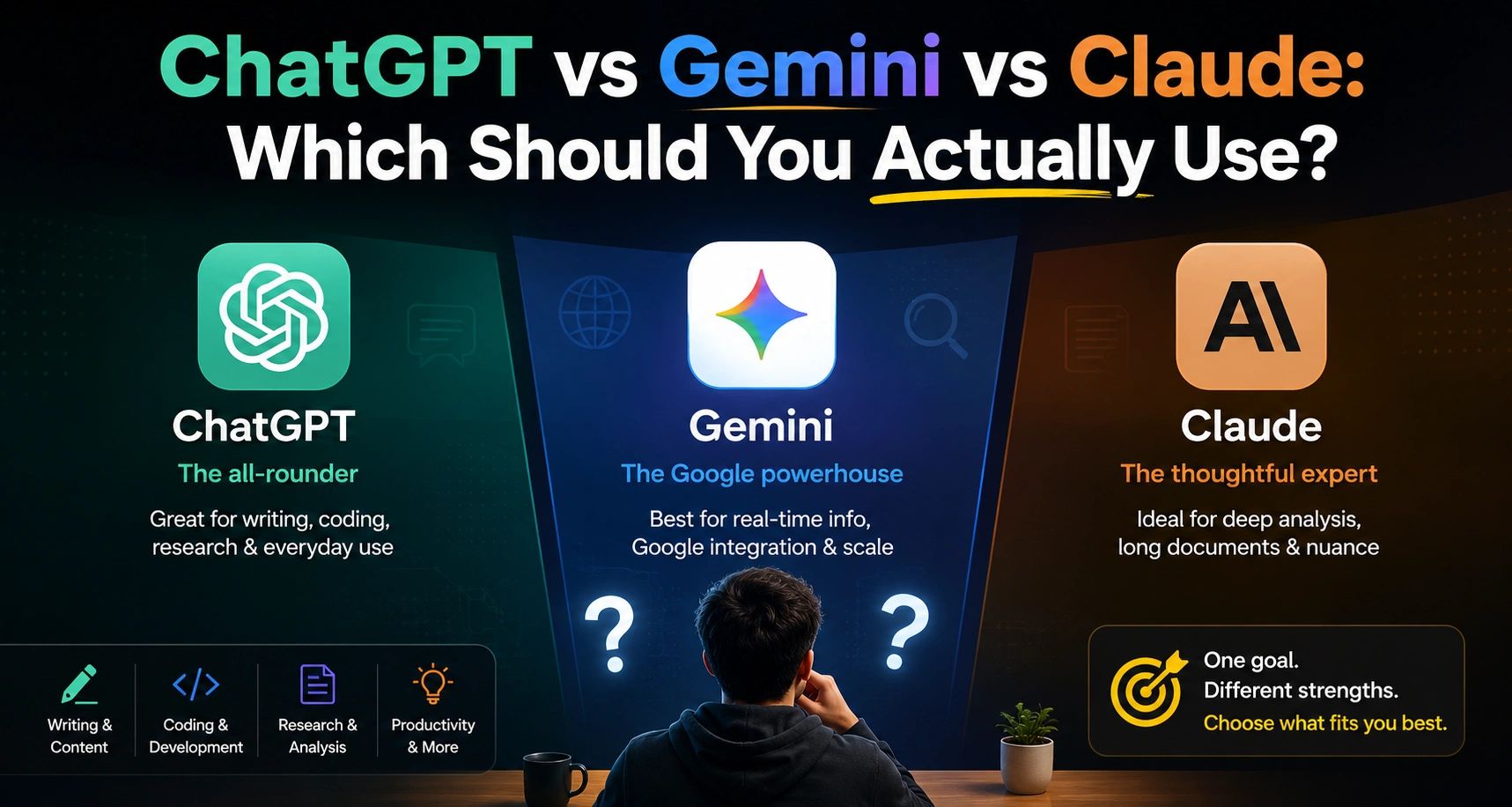
- Claude’s features include its coding accuracy, its ability to process lengthy documents, and its robust writing capabilities.
- ChatGPT has the widest array of features and the most advanced ecosystem of integrations and third-party tools.
- One of the standout features of the Gemini is that it has a very large context window, also supports multimodal inputs (images, audio, video), and it’s tightly integrated with Google Workspace.
There’s no one “better” — it all depends on the main use case and that’s why this comparison is more important than a single winner-takes-all verdict.
Pricing: Mostly a Tie
At the consumer level, all three AI chatbot 2026 options are priced almost identically:
| Plan | Price |
|---|---|
| ChatGPT Plus | ~$20/month |
| Claude Pro | ~$20/month |
| Gemini Advanced | ~$20/month |
All three also offer usable free tiers with limited daily access. The real pricing differences show up at the API and enterprise level, where Gemini tends to be the cheapest per token, ChatGPT offers straightforward team pricing, and Claude leans toward custom enterprise agreements for larger organizations.
Writing and Content Creation
For anyone using AI for blogging, emails, or long-form writing, output quality varies more than most people expect.
- Claude is frequently noted for producing writing that reads naturally rather than sounding formulaic, and for following specific style instructions closely — useful if you’re drafting content that needs a consistent voice.
- ChatGPT tends toward more structured, occasionally repetitive phrasing, but its broader plugin ecosystem makes it convenient for combining writing with other tasks in one session.
- Gemini writes competently and integrates smoothly if your documents already live in Google Docs, though it’s generally seen as less adaptable in matching a specific tone compared to the other two.
Coding and Technical Work
This is one of the clearest areas of differentiation among the three.
- Claude is widely regarded as the strongest for complex reasoning, debugging, and working across large codebases, aided by a dedicated coding-focused tool that integrates with common development environments.
- ChatGPT remains a strong, versatile option for quick scripts and general-purpose coding help, with a code interpreter feature that can actually execute code and show results.
- Gemini is notably fast and benefits from an enormous context window, making it useful for processing large repositories at once, though it tends to trail slightly on complex logic and debugging accuracy.
Multimodal and Research Capabilities
If your work involves images, audio, video, or real-time information, this is where things shift.
- Gemini stands out clearly here, with strong native handling of images, audio, and video, plus one of the largest context windows available among frontier models.
- ChatGPT performs well with video analysis and has a polished voice mode that many users find natural for conversation practice or quick queries.
- Claude has historically focused less on multimodal breadth and more on depth in text-based reasoning and document analysis, though this continues to evolve.
Context Window: How Much Can Each One “Remember”?
The amount of information that a model can handle at once is called its context window size. For example, if a model has a large context window, it can process a long document, a large codebase, or a long conversation.
- Gemini generally offers the largest context window among the three, which matters most for very long documents or large-scale codebases.
- Claude offers a large and consistently reliable context window, which many users find holds up well in practice even at length.
- ChatGPT has expanded its context window significantly in recent releases, closing much of the gap with the other two.
Which One Should You Actually Choose?
Rather than picking one AI chatbot 2026 tool and sticking with it forever, most regular users benefit from thinking about their primary task first:
- Choose Claude if: you write, edit, or code regularly, or work with long documents that need multiple rounds of revision
- Choose ChatGPT if: you want one flexible tool for a wide mix of tasks, value a mature plugin ecosystem, or rely heavily on voice mode
- Choose Gemini if: you’re already deep into Google Workspace, need to process large files or long videos, or want the largest context window available
Privacy and Data Handling
For anyone using these tools for work or sensitive projects, how each company handles your data is worth understanding before you commit to a subscription.
- Claude’s enterprise offering is built around allowing organizations to bring their own proprietary knowledge bases for the model to reference, with added controls like single sign-on and role-based access for teams that need stricter governance.
- ChatGPT’s enterprise tier is positioned around not training on customer data by default, paired with longer context windows and faster processing for business users.
- Gemini’s enterprise approach leans on Google’s existing infrastructure, connecting securely across tools like Google Workspace, Salesforce, and SAP, with centralized oversight for teams managing multiple AI agents across their workflows.
For everyday personal use, all three offer reasonable privacy controls, but if you’re feeding sensitive business documents into any of them, it’s worth checking each provider’s current data-usage policy directly, since these terms are updated periodically as regulations and enterprise demand shift.
Mobile Apps and Everyday Usability
Beyond raw capability, day-to-day usability often decides which tool people actually keep opening.
- ChatGPT’s mobile app has the most mature voice mode of the three, with a natural conversational flow that many users find genuinely useful for practicing a new language or getting quick answers hands-free.
- Gemini’s mobile experience benefits from tight integration with Android and Google’s broader hardware ecosystem, making it convenient if you’re already living inside Gmail, Docs, and Google Photos.
- Claude’s apps are generally seen as more minimal and focused, prioritizing fast, clean access to writing and reasoning tasks over a wide feature surface.
None of these differences are dramatic enough to be a dealbreaker on their own, but they do add up over weeks of daily use, especially if you have a strong preference for voice interaction or already rely heavily on one company’s other products.
Can You Just Use All Three?
Increasingly, yes. Since all three are billed monthly with no long-term lock-in, plenty of people subscribe to more than one and switch based on the task at hand — Gemini for research and Google-integrated work, ChatGPT for everyday conversational tasks, and Claude for serious writing or coding. If you do switch between tools, keep in mind that saved chats, custom instructions, and memory typically don’t transfer between platforms, so it’s worth exporting anything important before you cancel a subscription.
Also Read :- Claude vs ChatGPT vs Gemini in 2026: Which AI Is Actually Better for Daily Use?
Final Thoughts
The gap at the top of the AI assistant market has never been smaller than it is in 2026, which is genuinely good news for users — it means the “best” choice comes down to what you’re actually trying to do, not which company has the biggest marketing budget. Whether that’s writing, coding, research, or simply having a reliable everyday assistant, all three options are strong enough that you’re unlikely to pick a “bad” one — only one that’s slightly better suited to your specific needs.
Frequently Asked Questions
Q.1 Which AI is best overall in 2026: ChatGPT vs Gemini vs Claude?
There isn’t a single universal winner. Claude tends to lead in writing and coding quality, ChatGPT offers the broadest general-purpose feature set, and Gemini excels at multimodal tasks and large-context processing.
Q.2 Is Claude better than ChatGPT for writing?
Many users and reviewers find Claude produces more natural-sounding, less repetitive writing and follows specific style instructions more closely, making it a strong choice for long-form content.
Q.3 Which AI has the biggest context window: ChatGPT, Gemini, or Claude?
Gemini generally offers the largest context window among the three, which is especially useful for processing lengthy documents or large codebases in a single session.
Q.4 Do ChatGPT, Gemini, and Claude cost the same?
At the consumer level, yes — all three currently price their premium plans around $20 per month, with differences mainly appearing in API and enterprise pricing tiers.
Q.5 Can I use more than one AI chatbot at the same time?
Yes. Since all three are month-to-month subscriptions, many users subscribe to more than one and switch between them depending on the task, such as using Gemini for research and Claude for writing or coding.