

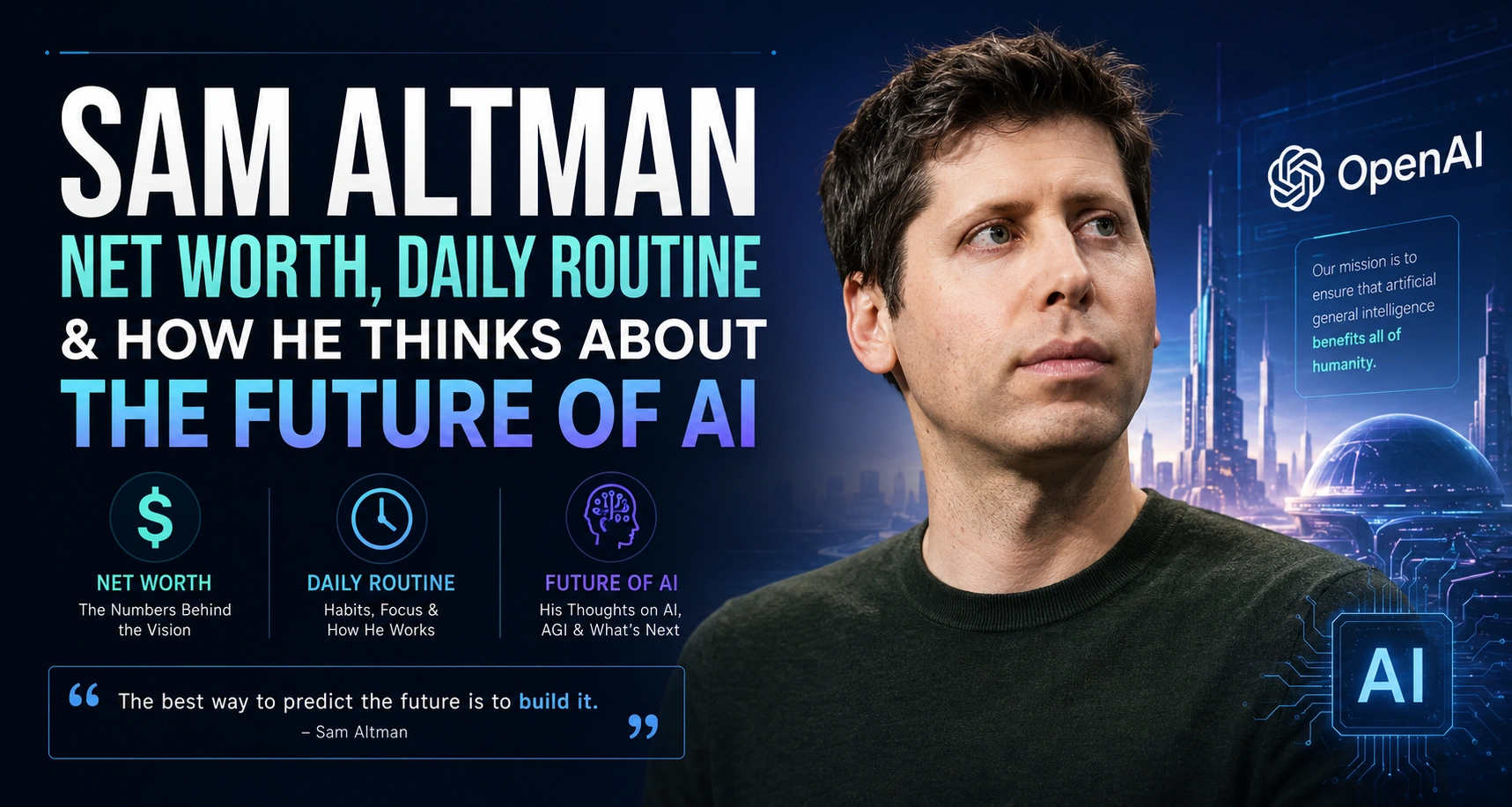
Here’s a fact that stops most people mid-sentence: the CEO of the world’s most valuable AI company — a business currently worth $730 billion — earns a salary of $76,001 a year and owns zero equity in the company he runs.
That man is Sam Altman, and his story is unlike almost any other in the history of Silicon Valley. Sam Altman net worth 2026 sits at approximately $3.3 billion according to Forbes — but none of it came from OpenAI. Not a single dollar. Instead, his fortune was built patiently over two decades through early-stage startup bets, a relentless eye for founders who’d go on to build generational companies, and a calculated willingness to run the most scrutinised organisation in modern technology for reasons that have nothing to do with personal financial gain.
This article covers everything: his biography, how he built his wealth, his daily habits, and the way he thinks about where artificial intelligence is taking the world.
Sam Altman Biography: From St. Louis Bedroom Coder to OpenAI CEO
Samuel Harris Altman was born in April 22, 1985 in Chicago, Illinois and raised in St. Louis, Missouri. He learned to program at the age of eight, when computers were barely known to most people or even repurposed for computers. It was the first indication of a mind that was more concerned with how a system scales than what has been done.
In 2003, he enrolled at Stanford University to study computer science, but left after two years—not due to academic difficulties, but to focus on building something he believed could make a far greater impact.
Loopt: The Beginning
In 2005, Altman co-founded Loopt, a location-based social networking app that let users share their location with friends in real time. It was ahead of its moment — the iPhone hadn’t launched yet — and it became one of the first batch of companies to go through Y Combinator, the startup accelerator that would later define a generation of Silicon Valley founders.
Loopt never reached escape velocity as a consumer product, but in 2012 it was acquired by Green Dot Corporation for $43 million. Altman walked away with enough capital to seed his own investment activity — and a deep, firsthand education in what it takes to build a company under pressure.
Y Combinator: Building the Network That Built the Fortune
After Loopt, Altman joined Y Combinator as a partner and was appointed President in 2014. Over five years, he oversaw YC’s expansion from a scrappy accelerator into the most influential startup programme in the world — backing companies like Airbnb, Stripe, Dropbox, and Reddit in their earliest stages.
This is where Sam Altman’s net worth was quietly taking shape. His role provided access, insight, and co-investment opportunities that no salary alone could ever match. By investing early in startups that later grew into multi-billion-dollar companies, he built substantial wealth long before OpenAI became a household name. One of the most notable examples is his stake in Reddit, accumulated during his Y Combinator years, which was estimated to be worth approximately $1.59 billion as of early 2026.
Sam Altman’s Success Story: Key Career Milestones
| Year | Milestone | Significance |
|---|---|---|
| 1985 | Born in Chicago, raised in St. Louis, MO | Learned to code by age 8 |
| 2003 | Enrolled at Stanford University (CS) | Dropped out after 2 years |
| 2005 | Co-founded Loopt (location social app) | First entrepreneurial venture |
| 2012 | Loopt acquired for $43M | Seed capital for future investments |
| 2014 | Became President of Y Combinator | Mentored 1,000s of startups; built his network |
| 2015 | Co-founded OpenAI with Elon Musk & others | The decision that defined his legacy |
| 2019 | Became CEO of OpenAI | Left YC; went all-in on AI |
| Nov 2023 | Fired — then reinstated as CEO in 5 days | Most dramatic AI industry story of the decade |
| 2024 | Married Oliver Mulherin in Hawaii | Personal milestone amid professional chaos |
| Feb 2025 | Son born via surrogacy | Rewired his priorities and daily routine |
| 2026 | Net worth ~$3.3B; OpenAI valued at $730B | World’s most influential AI leader |
Sam Altman Net Worth 2026: How He Built $3.3 Billion Without Owning OpenAI
The most counterintuitive part of Sam Altman’s financial story is what’s missing from it. OpenAI — the company he co-founded in 2015 and has led since 2019 — is now valued at $730 billion. If he had negotiated a standard founding CEO equity package, even a modest 2% stake would be worth roughly $14 billion at today’s valuation. A more typical 5% would be worth over $36 billion.
He owns none of it.
⚡ THE PARADOX: The most powerful person in AI earns $76,001 a year running a $730 billion company he has no equity in. His $3.3 billion net worth was built entirely before OpenAI’s rise — through patient, early-stage investing across 400+ companies.
His wealth instead comes from a portfolio of over 400 companies that he invested in during his years at Y Combinator and afterward, using his own capital. Here’s a snapshot of the key holdings that anchor his fortune:
| Investment | Category | Approx. Value / Stake | When Invested |
|---|---|---|---|
| Reddit (RDDT) | Social media / public stock | ~$1.59B (12M+ shares) | Early 2010s via YC |
| Stripe | Fintech / payments | Early stake — private | Via Y Combinator |
| Airbnb | Travel / marketplace | Early-stage investment | Via Y Combinator |
| Helion Energy | Nuclear fusion / clean energy | $375M invested (chair) | 2021 |
| Retro Biosciences | Longevity / biotech | $180M invested | 2021 |
| World Coin / Tools for Humanity | Crypto / digital identity | Co-founded | 2019 |
| OpenAI | Artificial intelligence | No direct equity (CEO only) | 2015 — co-founded |
📌 KEY FACT: Sam Altman’s Reddit stake — acquired when the platform was still a scrappy early-stage bet — was worth approximately $1.59 billion in February 2026, making it the single largest component of his publicly trackable net worth.
His investments also extend into frontier science. He invested $180 million into Retro Biosciences, a longevity startup aiming to add ten years to healthy human lifespan, and chairs Helion Energy, a nuclear fusion company in which he’s invested $375 million. These aren’t financial bets as much as they are expressions of what he actually thinks matters for the long arc of civilization.
Sam Altman Daily Routine: What Changed After Fatherhood
For years, Sam Altman’s daily routine was a textbook study in Silicon Valley optimization. He wrote about it openly in a 2018 blog post — a highly structured day built around protecting his most productive hours, fasting, heavy lifting, and data-driven sleep management.
Then, in February 2025, he and his husband Oliver Mulherin welcomed a son born via surrogacy. And everything changed.
“Now it has all fallen to crap. I’ve just accepted that life is going to be chaotic for a few years.” — Sam Altman, Fortune, February 2026
His description of fatherhood, though, was anything but regretful:
“It has been my favorite thing ever in life by far. I thought it was going to be great, and it’s much better than I thought it was going to be.” — Sam Altman, Fortune, 2026
The Routine (Before Fatherhood)
Based on his 2018 blog post and multiple interviews, Altman’s pre-fatherhood daily habits included:
- Morning espresso immediately upon waking — he skipped breakfast and typically fasted for about 15 hours
- Full-spectrum LED light exposure for 10–15 minutes each morning, which he described as a meaningful productivity gain
- No early morning meetings — mornings were protected for deep, focused work
- Short meetings by default: his preference was 15–20 minutes or 2 hours, calling the standard 1-hour meeting “usually wrong”
- Heavy weight training three times per week, plus occasional high-intensity interval sessions
- Paper lists — not digital — tracking annual, monthly, and daily goals
- Sleep as the top priority: a sleep tracker, a cold dark room, and occasionally a low dose of cannabis or sleep aids
- Meditation three times per week and time outdoors, particularly at his Napa Valley ranch
The OpenAI Lifestyle: Isolated Fame
One thing that rarely gets discussed in profiles of Altman is the strangeness of his social position. Being one of the most recognised faces in AI — in the heart of Silicon Valley — creates an unusual kind of isolation.
“I end up living in a weirdly isolated world. I fight that every inch… the more you let the world build a bubble around you, the more insane you go.” — Sam Altman, Fortune, 2026
He lives in a $27 million home in San Francisco’s Russian Hill neighbourhood during the week and retreats to his Napa Valley ranch at weekends — hiking, spending time offline, and recharging away from the relentless pace of OpenAI’s work.
How Sam Altman Thinks About the Future of AI
No article on Sam Altman is complete without addressing the thing he’s dedicated his professional life to — and his worldview on AI is more nuanced than most headlines suggest.
He Takes the Risks Seriously
Altman has been more publicly candid about AI risk than most technology leaders. He has testified before the US Senate, called for AI regulation, and spoken openly about scenarios where AI development goes badly wrong. He’s described the stakes involved as “one of the most potentially dangerous and transformative technologies in human history” — and yet continues to push it forward, which he acknowledges is a moral position that requires active justification.
His argument is essentially: if powerful AI is coming regardless, it’s better for safety-focused organisations to be leading the frontier than to leave that space to those with less concern for the consequences.
His Biggest Bet: AGI Within His Lifetime
Altman has publicly stated that he believes artificial general intelligence (AGI)—AI capable of performing any intellectual task that a human can—could emerge within his lifetime, and possibly within the next decade. He presents this view not as a marketing claim, but as a serious planning assumption that informs OpenAI’s long-term strategy.
“I believe we are now confident we know how to build AGI as we have traditionally understood it.” — Sam Altman, OpenAI blog, 2025
He has also spoken about a future where AI agents handle much of the world’s knowledge work — not replacing humans but fundamentally changing what humans are needed to do. His vision isn’t dystopian; it’s closer to radical abundance, where the constraint on human progress shifts from scarcity to deciding what to prioritise.
On Productivity and Working on the Right Things
One of the most quoted lines from Altman’s personal blog is deceptively simple:
“Productivity in the wrong direction isn’t worth anything at all.” — Sam Altman, samaltman.com
It’s a principle that runs through everything — his investment philosophy, his leadership style, and the way he talks about AI. The question he returns to constantly isn’t “how do we go faster?” but “what is actually worth doing?”
💡 LESSON: Altman’s career offers a consistent lesson for founders and operators: the choice of what to work on matters more than how hard you work on it. His wealth wasn’t built by grinding — it was built by being early on problems that turned out to matter enormously.
Final Thoughts
Sam Altman net worth 2026 tells one part of a much larger story — and it’s not the most interesting part. The more compelling question is why someone worth $3.3 billion chooses to lead the most scrutinised, most consequential, and most publicly pressured technology company in the world for a salary that wouldn’t get you an apartment in San Francisco.
The answer he keeps giving is that the problem is simply too important not to work on. Whether you find that credible or convenient depends on your read of his character. But the consistency of his public positions — on AI risk, on safety, on the obligation of those at the frontier to think carefully about what they’re building — suggests that at least some of the idealism is genuine.
His success story is ultimately not about money. It’s about what happens when someone spends two decades thinking carefully about which problems actually matter, invests in the people trying to solve them, and then bets their professional life on seeing those problems through. In 2026, the results of that bet are reshaping the world.
Frequently Asked Questions (FAQs)
Q1. What is Sam Altman’s net worth in 2026?
Sam Altman net worth 2026 is estimated at approximately $3.3 billion according to Forbes, with some sources citing figures between $2 billion and $3.4 billion due to the private nature of many of his investments. His wealth comes entirely from venture capital investments and early startup stakes — not from OpenAI, where he holds no direct equity.
Q2. Does Sam Altman own shares in OpenAI?
No. Sam Altman has confirmed publicly and under oath that he does not own direct equity in OpenAI. He earns a salary of $76,001 per year as CEO — described by him as roughly whatever the minimum needed for health insurance is. OpenAI’s planned transition to a for-profit structure may eventually change this, with reports suggesting he could receive a 7% stake, but as of 2026 he holds no equity.
Q3. How did Sam Altman make his money if not from OpenAI?
Sam Altman built his net worth through early-stage venture investments made during and before his time as President of Y Combinator (2014–2019). His most significant holding is a large stake in Reddit, worth approximately $1.59 billion in early 2026. He also holds early investments in Stripe, Airbnb, Helion Energy (where he’s invested $375 million), and Retro Biosciences, among 400+ other companies.
Q4. What is Sam Altman’s daily routine in 2026?
Sam Altman has acknowledged that his previously disciplined daily routine — built around 15-hour fasts, heavy weight training three times weekly, structured deep work mornings, and rigorous sleep tracking — has become more chaotic since his son was born in February 2025. He’s described fatherhood as “my favorite thing ever in life” and accepted that his routine will remain less structured “for a few years.”
Q5. What does Sam Altman think about the future of AI?
Sam Altman thinks it’s likely that by this decade, AI will be capable of doing everything a human can, which he calls ‘AGI’ (artificial general intelligence), and he says OpenAI is now “sure they know how to do it. He views the risks of AI seriously, has spoken to the Congress on its need for regulation, and believes that those organisations that are working on safety should be on the cutting edge. He has a longer-term vision of how AI will empower radical abundance, transforming global constraints from scarcity to priority and value.
Related Topics:-