

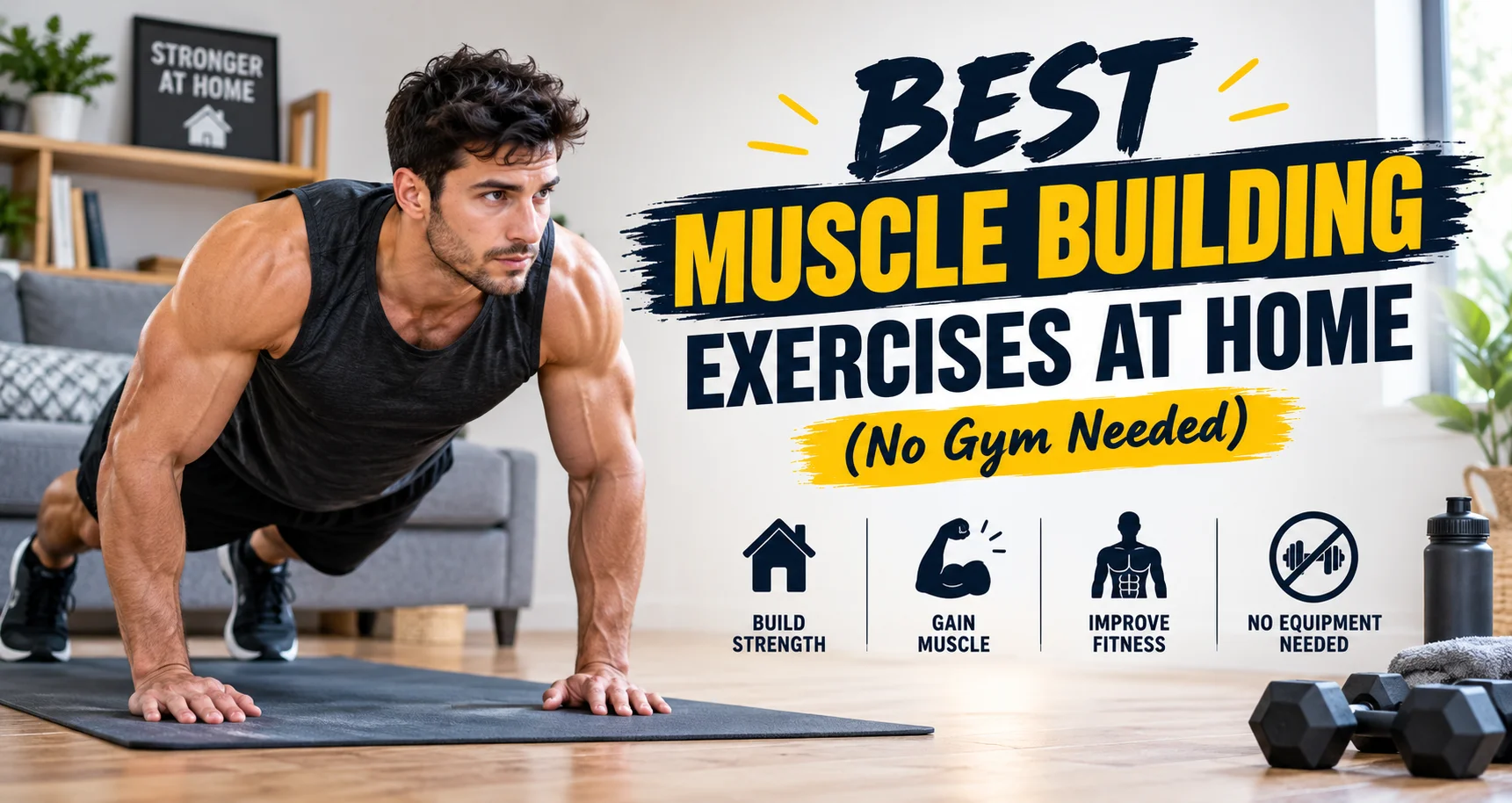
Think you need an expensive gym membership to build muscle? Think again. Millions of people across India are getting stronger, leaner, and more confident from their bedrooms and balconies. With the right moves, a little consistency, and smart eating, your living room can become a perfectly good training ground.
This guide covers the best muscle building exercises at home, how to structure your week, and what to eat so your effort actually shows up in the mirror. Whether you are a college student, a working professional, or a busy parent, there is a plan here for you.
Can You Really Build Muscle at Home?
Yes, you can. Muscles grow when they are challenged enough to adapt. Your body does not care whether that challenge comes from a barbell or from your own body weight. What matters is progressive overload, which simply means making your workouts a little harder over time.
At home, you can do this by:
- Adding more repetitions
- Slowing down each rep
- Trying harder exercise variations
- Reducing rest time between sets
- Adding simple weights like a backpack, water cans, or resistance bands
Home workouts are especially useful in India, where gym fees, travel time, hot weather, and crowded schedules put many people off. A short session at home removes most of those excuses.
The Best Muscle Building Exercises at Home
Here are the most effective moves, grouped by body part. Each one needs little or no equipment.
1. Push-Ups (Chest, Shoulders, Triceps)
The push-up is the king of bodyweight training. It works your chest, shoulders, triceps, and core together.
How to do it: Hands slightly wider than shoulders, body in a straight line, lower chest towards floor and push back up.
Make it easier: Do them on your knees or against a wall.
Make it harder: Try diamond push-ups, decline push-ups (feet on a chair), or slow tempo push-ups.
2. Squats and Their Variations (Legs and Glutes)
Strong legs build a strong foundation. Squats hit your quadriceps, hamstrings, and glutes.
- Bodyweight squats: Great for beginners
- Jump squats: Add power and burn extra calories
- Pistol squats: An advanced single-leg option
3. Lunges (Quads, Glutes, Balance)
Lunges fix strength gaps between your left and right legs. Try forward lunges, reverse lunges, and walking lunges. Hold a bag filled with books to make them tougher.
4. Pike Push-Ups (Shoulders)
Shoulders are often neglected in home routines. Get into a downward-dog position with hips high, then lower your head toward the floor. This mimics an overhead press and builds impressive shoulders.
5. Chair or Bench Dips (Triceps)
Place hands on sides of hips, sit down to edge of a sturdy chair, slide forward and drop your body. Elbows are level with the back. Dips are one of the easiest exercises to do at home to increase arm size.
6. Inverted Rows (Back and Biceps)
Back training is the hardest part of working out at home, but it is not impossible. Lie under a sturdy table, grip the edge, keep your body straight, and pull your chest up. If you have a pull-up bar, pull-ups and chin-ups are even better.
7. Hip Circles (Glutes)
Pressure on glutes while lying on your back with knees bent as you drive hips up then squeeze glutes at the top. To increase the range of motion, lift shoulders on the sofa for a hip thrust.
8. Planks and Core Work (Abs and Stability)
A strong core supports every other lift. Add these to your routine:
- Standard plank
- Side plank
- Mountain climbers
- Leg raises
- Bicycle crunches
A Simple Weekly Plan for Beginners
You do not need to train every day. Muscles grow during rest, not during the workout. Here is an easy split to start with:
| Day | Focus |
| Monday | Push (push-ups, pike push-ups, dips) |
| Tuesday | Legs (squats, lunges, glute bridges) |
| Wednesday | Rest or light walk |
| Thursday | Pull and core (inverted rows, planks, leg raises) |
| Friday | Full body circuit |
| Saturday | Light activity or stretching |
| Sunday | Rest |
Tip: Do 3 to 4 sets of 8 to 15 reps for each exercise, resting 45 to 90 seconds between sets. Stop each set when you have about two reps left in the tank.
Muscle Building Tips That Actually Work
Focus on Progressive Overload
If you do the same 20 push-ups every week, your body stops adapting. Keep a small notebook or phone note and try to beat your previous numbers.
Control Your Tempo
Lower yourself for three seconds, pause briefly, then push up. Slow reps increase time under tension, which is a key driver of muscle growth.
Prioritise Form Over Numbers
Sloppy reps invite injury and cheat your muscles of the work. If your form breaks down, stop the set.
Be Patient
Visible results usually take 8 to 12 weeks of consistent effort. Do not compare your day 10 to someone else’s year 3.
Eating for Muscle Growth: An Indian Perspective
Training is only half the story. Without enough protein and calories, your muscles cannot rebuild properly. The good news is that Indian kitchens already offer plenty of muscle-friendly foods.
Vegetarian protein sources:
- Paneer, curd, and milk
- Dals, rajma, chana, and soya chunks
- Sprouts and besan chilla
- Nuts and seeds
Non-vegetarian protein sources:
- Eggs
- Chicken breast
- Fish
Other essentials:
- Complex carbs like roti, brown rice, oats, and poha for energy
- Healthy fats from ghee in moderation, peanuts, and almonds
- Plenty of water, especially in hot weather
As a general guide, many active adults aim for roughly 1.2 to 2 grams of protein per kilogram of body weight daily. Check with a doctor or registered dietitian if you have any medical condition before making big dietary changes.
Common Mistakes to Avoid
- Skipping warm-ups: Spend five minutes on arm circles, leg swings, and light jogging in place.
- Training the same muscles daily: Recovery matters.
- Ignoring sleep: Aim for 7 to 8 hours. This is when growth hormone does its best work.
- Doing only chest and arms: Balanced training prevents posture problems.
- Quitting too early: Consistency beats intensity.
Equipment That Helps (But Is Not Required)
If you want to level up later, a few affordable items go a long way:
- Resistance bands
- A doorway pull-up bar
- A pair of adjustable dumbbells
- A yoga mat
Start without them, and add gear only when your body weight feels too easy.
Frequently Asked Questions
1. What are the best muscle building exercises at home for beginners?
Push-ups, bodyweight squats, lunges, glute bridges, planks, and inverted rows are ideal starting points. They are safe, simple, and work several muscle groups at once.
2. Can I build big muscles at home without weights?
You can build solid, visible muscle using bodyweight exercises, especially if you keep increasing difficulty with slower reps and harder variations. For maximum size, adding resistance bands or dumbbells later helps.
3. How many days a week should I work out at home?
Most beginners do well with 3 to 5 days a week, with rest days in between. Quality and recovery matter more than training every single day.
4. How long does it take to see results from home workouts?
With regular training and proper nutrition, most people notice improved strength within 3 to 4 weeks and visible changes in 8 to 12 weeks. Results vary by age, diet, sleep, and consistency.
Conclusion
Building a strong body does not require a fancy gym, a big budget, or hours of free time. The best muscle building exercises at home, from push-ups and squats to rows and planks, are simple, effective, and available to everyone. Pair them with progressive overload, balanced Indian meals, good sleep, and patience, and the results will come.
Start small today. Do one set, then another. Tomorrow, do a little more. Your future self will thank you.
Looking for more lifestyle, health, and trending reads? Explore fresh articles at Magzilla Trends.