

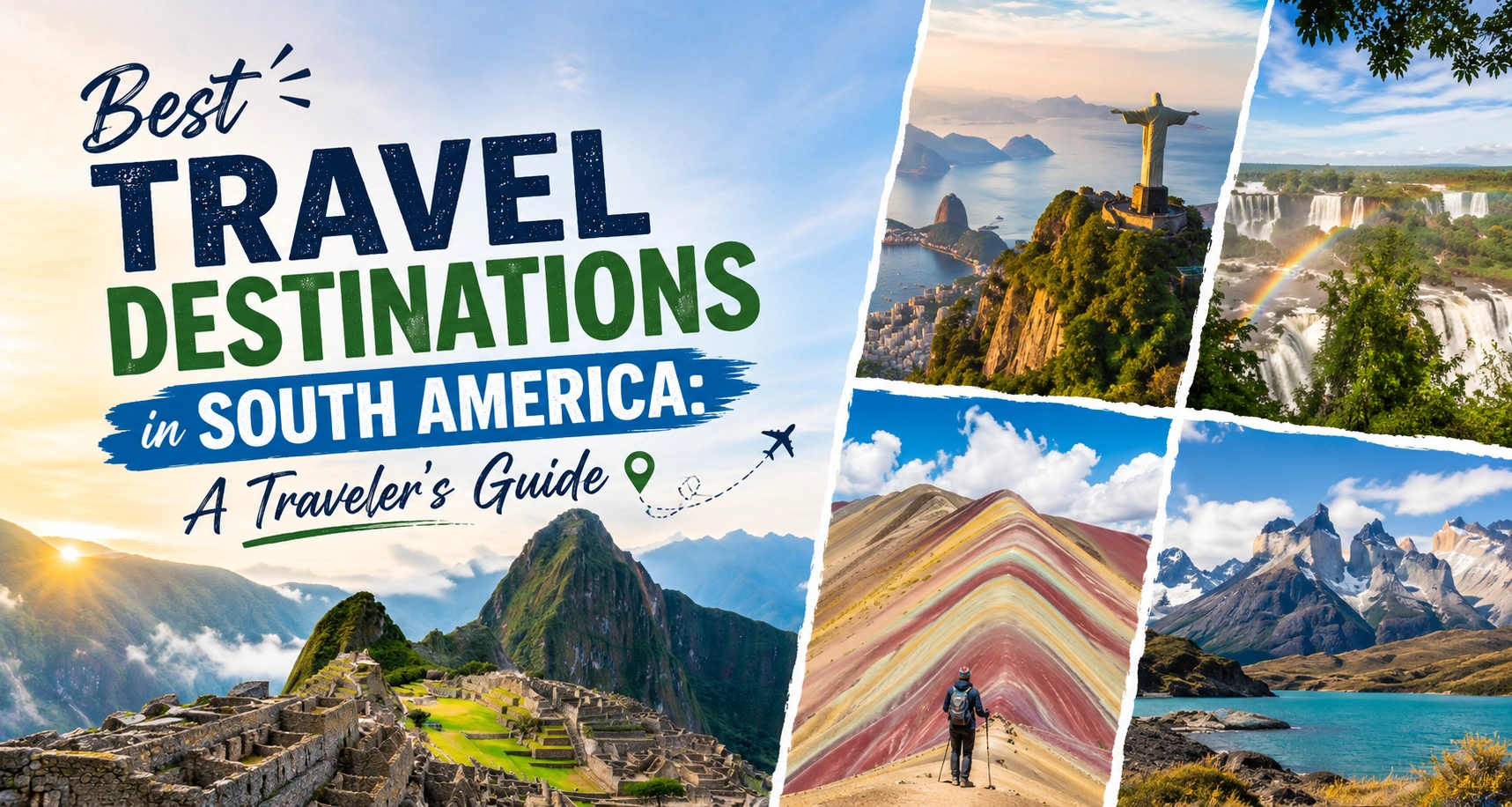
There’s a reason South America keeps showing up on bucket lists year after year. It’s a continent where ancient ruins sit above the clouds, glaciers calve into turquoise lakes, and cities pulse with music long after midnight. If you’ve been putting off a trip because the continent feels too big or too unfamiliar to plan, you’re not alone — and that’s exactly what this guide is here to fix.
Below, we’ll walk through the Best Travel Destinations in South America, what makes each one worth the flight, and practical tips to help American travelers plan a smoother, more memorable trip.
Why South America Deserves a Spot on Your Travel List
Unlike destinations that offer just one type of experience, South America packs an unusual amount of variety into a single continent. In one trip, you can hike through cloud forests, relax on white-sand beaches, and stand at the edge of a glacier — all without changing continents.
A few reasons travelers keep coming back:
- Dramatic natural landscapes, from the Andes to the Amazon
- Rich indigenous and colonial history layered into nearly every city
- Affordable travel compared to Western Europe or parts of Asia
- Distinct regional cultures, food, and music from country to country
- Increasing flight options from major U.S. hubs like Miami, Houston, and Atlanta
Now let’s get into the destinations that consistently rank among the best travel destinations in South America.
Top Travel Destinations in South America
Machu Picchu, Peru
No list of the best travel destinations in South America would be complete without Machu Picchu. This 15th-century Incan citadel, perched high in the Andes, remains one of the most awe-inspiring archaeological sites on Earth. Most travelers reach it via the town of Aguas Calientes, either by train or after several days on the classic Inca Trail.
Why visit: The mix of engineering, history, and mountain scenery is genuinely unmatched, and sunrise views over the ruins are worth the early wake-up call.
Patagonia, Argentina & Chile
Patagonia is the southern part of both Argentina and Chile, and it is quickly becoming a popular tourist destination for those who want to experience the wild and dramatic scenery of the area. The highlights are the Torres del Paine National Park in Chile and Los Glaciares National Park in Argentina where the massive glacier Perito Moreno is located.
Why visit: Few places on the continent offer this level of raw, rugged beauty — think jagged peaks, turquoise glacial lakes, and wildlife like guanacos and condors.
Rio de Janeiro, Brazil
Rio remains one of the most iconic cities in South America, blending beach culture, mountain views, and nonstop energy. Between Copacabana Beach, the Christ the Redeemer statue, and the lively neighborhoods of Santa Teresa and Lapa, there’s rarely a dull moment.
Why visit: It’s the perfect mix of natural beauty and urban culture, especially if you time your visit around Carnival or one of the city’s many music festivals.
Cartagena, Colombia
Cartagena has quickly become one of the most talked-about destinations in South America for U.S. travelers, thanks to its colorful colonial architecture, walled Old Town, and Caribbean coastline. It offers a slower pace than Bogotá or Medellín while still delivering great food and nightlife.
Why visit: The blend of history, beach access, and walkable charm makes it ideal for both couples and solo travelers.
The Galápagos Islands, Ecuador
For wildlife lovers, the Galápagos Islands are hard to beat. Made famous by Charles Darwin’s research on evolution, this remote archipelago is home to species found almost nowhere else on Earth, including giant tortoises, marine iguanas, and blue-footed boobies.
Why visit: Few destinations let you snorkel next to sea lions one hour and walk among century-old tortoises the next.
Buenos Aires, Argentina
Often called the “Paris of South America,” Buenos Aires offers grand European-style architecture, world-class steakhouses, and a tango culture that’s deeply woven into daily life. It’s also one of the more walkable big cities on the continent, making it easy to explore neighborhoods like Palermo, San Telmo, and Recoleta on foot.
Why visit: It’s a great entry point for first-time visitors to South America, with excellent infrastructure and a mix of culture, food, and nightlife.
Atacama Desert, Chile
Atacama Desert is one of the world’s best places to see the stars, and one of the driest areas in the world. From its stellar night sky to the vast salt flats, steam geysers, colorful lagoons, volcanic landscape and otherworldly rock formations, the Atacama Desert offers everything.
Why visit: The Atacama Desert is a tranquil, dramatic and surreal part of South America, and a place every nature lover, photographer and adventurer should visit.
Best Time to Visit South America
Because South America spans both hemispheres and multiple climate zones, timing depends heavily on where you’re headed.
- Peru (Machu Picchu): Dry season from May to September is ideal for hiking
- Patagonia: Best visited during the Southern Hemisphere summer, November to March
- Brazil (Rio de Janeiro): December to March for beach weather and Carnival season
- Galápagos Islands: Can be visited year-round, though June to November offers cooler temperatures and better wildlife viewing for marine species
- Atacama Desert: Year-round destination, though clearer night skies are common from April to August
Budgeting Tips for South America Travel
South America is often more affordable than travelers expect, especially compared to Western Europe. Still, a few tips go a long way:
- Mix accommodation types. Combine hostels or mid-range hotels with the occasional splurge stay.
- Travel overland when possible. Long-distance buses in countries like Argentina and Peru are comfortable and far cheaper than domestic flights.
- Eat where locals eat. Markets and neighborhood restaurants typically offer better value than tourist-zone dining.
- Book popular sites in advance. Machu Picchu and the Galápagos Islands often require permits or advance booking due to visitor limits.
Practical Travel Tips for U.S. Visitors
- Check visa requirements early. Most South American countries allow visa-free entry for U.S. citizens for short stays, but requirements vary by country and can change.
- Consider altitude when planning. Cities like Cusco and La Paz sit at high elevation, so building in a day or two to acclimatize can prevent altitude sickness.
- Learn a few Spanish or Portuguese phrases. English isn’t widely spoken outside major tourist areas, and basic phrases go a long way.
- Pack for multiple climates. If your itinerary spans the Andes, the Amazon, and the coast, layers are essential.
Common Mistakes First-Time Visitors Make
- Underestimating travel distances. South America is enormous, and moving between countries often takes longer than expected.
- Skipping travel insurance. Given the range of activities — hiking, high-altitude travel, remote regions — insurance is worth the investment.
- Overpacking the itinerary. Trying to see too many countries in one trip often means rushing through destinations that deserve more time.
- Ignoring local customs and safety guidance. A little research on each city’s specific safety tips goes a long way toward a smoother trip.
Conclusion
From the ancient stone paths of Machu Picchu to the wild, wind-swept landscapes of Patagonia, the best travel destinations in South America offer something for nearly every kind of traveler. Whether you’re drawn to vibrant cities like Rio de Janeiro and Buenos Aires, remote wildlife havens like the Galápagos Islands, or awe-inspiring natural wonders like Iguazu Falls and the Atacama Desert, this continent rewards those willing to explore beyond the usual tourist trail.
Start by picking one or two regions rather than trying to see it all in a single trip — South America has a way of pulling travelers back for a second, third, and fourth visit.
Frequently Asked Questions
Q.1 What are the best travel destinations in South America for first-time visitors?
Buenos Aires, Rio de Janeiro, and Machu Picchu are commonly recommended for first-time visitors, thanks to good infrastructure, iconic sights, and relatively straightforward travel logistics.
Q.2 What is the best time of year to visit South America?
It depends on the region. Patagonia and Brazil’s coast are best visited during the Southern Hemisphere summer (November to March), while Peru’s Machu Picchu is best explored during its dry season from May to September.
Q.3 Is South America safe for U.S. travelers?
Many parts of South America are safe for tourists who take standard precautions, though safety varies by city and neighborhood. It’s worth researching specific destinations and staying updated on current travel advisories before your trip.
Q.4 How many days do you need to travel through South America?
Two to three weeks is a reasonable amount of time to explore two or three countries without rushing, though even a one-week trip to a single destination like Peru or Argentina can be worthwhile.
Q.5 Do U.S. citizens need a visa to travel to South America?
Most South American countries allow visa-free entry for U.S. citizens for short tourist stays, though requirements vary by country and can change, so it’s important to check current entry requirements before booking your trip.