
Budgeting software built for regular businesses solves a different problem than nonprofit budgeting does — a for-profit company tracks one pool of money against one set of goals, while a nonprofit often has to track several restricted and unrestricted funding sources separately, prove to a board and to grant funders exactly where every dollar went, and prepare for annual filings that don’t exist in standard business accounting. That gap is why “just use QuickBooks” isn’t always the right answer, even though QuickBooks itself does offer a nonprofit-specific option.
Quick answer: For budgeting software for nonprofit organizations, Wave (free core accounting, no fund accounting) works for small, all-volunteer, or early-stage organizations with simple needs, while Aplos and Grain Ledger offer free plans that include actual fund accounting — Grain specifically free for churches under $20,000 in monthly expenses. For paid, dedicated nonprofit budgeting tools, Budgyt and Martus are built specifically around multi-fund budgeting and scenario planning, while QuickBooks and Xero (both offering nonprofit discounts) work well for organizations that want budgeting built into a broader accounting platform.
What Makes Nonprofit Budgeting Different
Before comparing tools, it’s worth understanding the one concept that separates real nonprofit-ready software from a general small business tool with a nonprofit label slapped on it: fund accounting.
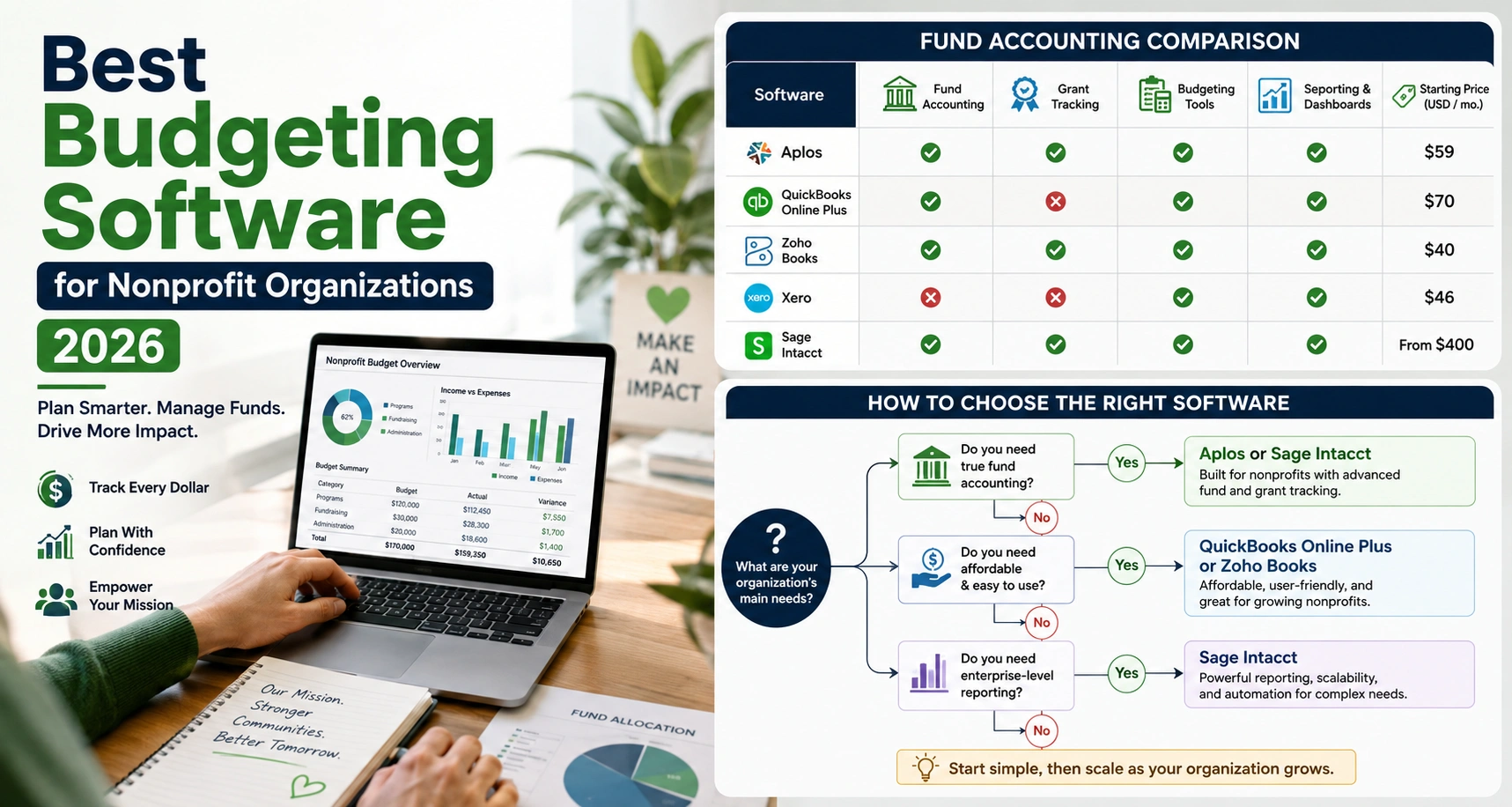
Fund accounting tracks money by its source and its restrictions — a grant that can only be spent on a specific program, a donation restricted to a building fund, unrestricted general operating money — as separate, trackable pools rather than one combined balance. This isn’t a nice-to-have; for many nonprofits, especially those receiving grants with donor-imposed restrictions, it’s close to a compliance necessity for accurate board reporting and annual filings like Form 990. Software without real fund accounting can still handle basic income and expense tracking, but it will struggle to answer “how much of our restricted grant money is left” without manual workarounds.
Comparison Table
| Software | Starting Price | Free Plan? | Fund Accounting? | Best For |
|---|---|---|---|---|
| Wave | $0 | Yes, permanently free core | No | All-volunteer orgs, early-stage nonprofits with simple needs |
| Grain Ledger | $0 (for qualifying churches) | Yes, free under $20K/month expenses | Yes | Churches and ministries |
| Aplos | Free core; paid add-ons | Yes, core features free | Yes | Small-to-mid nonprofits and churches |
| QuickBooks (Nonprofit) | Paid; nonprofit discounts often available | No | Limited | Growing nonprofits wanting an all-in-one platform |
| Xero | Paid; 25% discount for registered charities | No (30-day trial only) | No (project/job tracking, not true fund accounting) | Project-based budget tracking |
| Budgyt | Custom pricing; nonprofit discounts | No | Yes, purpose-built | Mid-size nonprofits wanting a dedicated budgeting tool |
| Martus | From $6,650/year base | No | Yes, with scenario planning | Larger orgs, faith-based organizations, complex multi-fund budgets |
| Sage Intacct / Blackbaud Financial Edge NXT | Enterprise, custom pricing | No | Yes, robust | Large nonprofits with complex grant structures |
Pricing and feature sets change relatively often in this category — confirm current details directly with each vendor, and specifically ask about nonprofit discount programs, which several providers offer but don’t always advertise prominently.
Best Free Budget Software for Nonprofit Organizations
Wave is the most accessible truly free option — permanently free core accounting, invoicing, and basic budgeting, with no time-limited trial. The real limitation for nonprofits specifically: no fund accounting, no grant management tools, and no Form 990 preparation support. It’s a genuinely solid starting point for an all-volunteer or very early-stage organization with simple, unrestricted funding, but most nonprofits should plan to migrate once they start managing restricted grants or donor-designated funds.
Grain Ledger stands out for a specific, well-defined use case: it’s completely free for churches and ministries with under $20,000 in monthly expenses (roughly a $240,000 annual budget), and unlike Wave, it includes genuine fund accounting, donor tracking, and direct integrations with giving platforms like Stripe, Pushpay, Planning Center Online, and Tithely. For a qualifying church or ministry, this is a meaningfully more nonprofit-appropriate free option than a general small-business tool.
Aplos offers free core accounting features specifically built for nonprofits and churches, including real fund accounting without requiring the enterprise-level price tag most fund accounting software carries. Paid add-ons cover payroll and payment processing as your organization grows.
Best Paid Budgeting Software for Nonprofit Organizations
Budgyt is a dedicated nonprofit budgeting platform (not a full accounting system) that lets organizations build multi-fund, departmental budgets and organize reports automatically by region, department, or time period. It offers nonprofit discounts, though you’ll need to contact them directly for current pricing.
Martus is built specifically for nonprofits, faith-based organizations, and associations, with fund-based budgeting, automatic roll-forwards, and scenario modeling, plus integration with over 25 accounting systems including Sage Intacct, Blackbaud Financial Edge NXT, and QuickBooks. It carries a genuinely enterprise-level starting price (from $6,650/year for the base tier, with personnel budgeting and scenario planning requiring the higher Plus tier), and licenses are sold in five-user packs — worth factoring into cost planning if your budgeting process involves more than a small core team. It holds strong review scores (4.8/5 on G2, 4.6/5 on Capterra) and is particularly well-suited to faith-based organizations and associations with simpler grant structures.
QuickBooks (Nonprofit edition) and Xero both work well if you want budgeting built into a broader accounting platform rather than a standalone budgeting tool. Xero specifically offers a 25% discount for registered charities and nonprofits, and its project/job tracking features let you link costs to specific initiatives — useful for budget accountability, even though it isn’t true fund accounting in the strict nonprofit sense.
Sage Intacct and Blackbaud Financial Edge NXT serve the top end of this market — large nonprofits with complex, multi-grant structures that have outgrown the mid-market tools above. These carry custom enterprise pricing and a significantly higher implementation investment, appropriate once an organization’s complexity genuinely justifies it.
How to Choose the Right Tool for Your Organization
- Do you manage restricted grants or donor-designated funds? If yes, fund accounting isn’t optional — rule out any tool (including free ones like Wave) that doesn’t offer it.
- What’s your realistic budget, including nonprofit discounts? Several providers (Xero, QuickBooks via TechSoup, and others) offer meaningful nonprofit-specific discounts that aren’t always visible on the standard pricing page — always ask directly.
- How many people need to build or review the budget? Tools like Martus price by user packs, which can shift the real cost significantly for a larger finance or board committee.
- Do you need board-ready reporting out of the box? Dedicated budgeting tools (Budgyt, Martus) tend to offer more polished, purpose-built reporting for board presentations than general accounting software.
- Will you outgrow a free tool within the next year or two? If your grant funding or organizational complexity is growing quickly, it may be worth starting with a tool that has fund accounting from day one rather than migrating data later.
Common Mistakes Nonprofits Make Choosing Budgeting Software
- Choosing a general small-business tool without checking for fund accounting. This is the single most common mismatch — a tool can look perfectly capable for basic bookkeeping while being genuinely unsuited to real nonprofit fund tracking.
- Not asking about nonprofit discounts. Providers like Xero and QuickBooks offer meaningful nonprofit pricing that isn’t always advertised prominently — always ask directly rather than assuming standard pricing applies.
- Underestimating per-user costs on tools priced in user packs. Martus and similar platforms price licenses in blocks, which can make the real annual cost considerably higher than the advertised starting price once your finance team or board committee is factored in.
- Picking a free tool without a migration plan. Free tools like Wave are a reasonable starting point, but organizations that grow into grant funding should plan the migration to a fund-accounting-capable tool before it becomes an urgent, disruptive scramble.
FAQs
Q.1 Is there truly free budgeting software for nonprofit organizations?
Yes — Wave offers permanently free core accounting and budgeting (though without fund accounting), and both Grain Ledger (for qualifying churches under $20K/month in expenses) and Aplos offer free plans that include genuine fund accounting, which is a meaningfully better fit for most nonprofits than Wave alone.
Q.2 What’s the difference between regular budgeting software and nonprofit-specific budgeting software?
The core difference is fund accounting — the ability to track restricted and unrestricted funds separately, which most nonprofits need for accurate grant reporting and annual filings like Form 990. General small-business tools typically lack this feature entirely.
Q.3 Do QuickBooks or Xero offer nonprofit discounts?
Yes — Xero offers a 25% discount for registered charities and nonprofits, and QuickBooks is commonly available at a discount through nonprofit technology programs like TechSoup. These discounts aren’t always visible on standard pricing pages, so it’s worth asking directly.
Q.4 What’s the best budgeting software for a small, all-volunteer nonprofit?
Wave is a reasonable starting point for very simple, unrestricted funding needs, though organizations expecting to manage grants or restricted donations soon may be better served starting with a free fund-accounting tool like Aplos instead.
Q.5 Is dedicated budgeting software (like Budgyt or Martus) worth it over just using accounting software’s built-in budgeting?
For nonprofits with more complex, multi-fund budgets or a need for polished board-ready reporting, dedicated tools generally offer more purpose-built functionality than the budgeting features bundled into general accounting software — the trade-off is a meaningfully higher cost, particularly for tools like Martus with enterprise-level starting pricing.
Conclusion
The right budgeting software for nonprofit organizations comes down to one central question: does your organization need real fund accounting, and can you afford it at your current size? Start with a free, fund-accounting-capable option like Aplos or Grain Ledger if you qualify, move to a dedicated tool like Budgyt as your budget complexity grows, and reserve enterprise platforms like Martus, Sage Intacct, or Blackbaud for organizations with genuinely complex, multi-grant structures. For more on the broader software landscape for organizations of any kind, see our guide to Best Software for Small Business Accounting, or explore the full Business, Money & Career Guide.