

AI voice cloning can fix a podcast flub without a re-record, narrate a course in five languages using your own voice, or give a genuine voice back to someone who’s lost theirs to illness. It can also be used to fake a phone call from a family member asking for emergency cash. Same underlying technology — the difference is entirely about consent, and in 2026, that difference has real legal teeth in India, not just an ethical guideline.
Quick answer: Legitimate AI voice cloning tools for creators — ElevenLabs, Descript, Resemble AI, and Murf among them — require documented consent before cloning any real person’s voice, and using one safely means getting explicit written permission, completing the platform’s consent-verification step, and clearly disclosing AI-generated audio to your audience. Cloning someone’s voice without consent isn’t a legal gray area in India anymore: it’s actionable under IT Act identity theft provisions, personality rights case law, and the 2026 IT Rules requiring AI content to be labeled.
What Creators Actually Use Voice Cloning For
Before getting into tools and rules, it’s worth being clear about the legitimate side of this technology, since it’s easy to lose sight of amid the deepfake headlines:
- Podcast and video fixes — patching a flubbed line without re-recording an entire episode.
- Multilingual dubbing and localization — narrating the same content in several languages while preserving a consistent voice identity.
- Audiobook and course narration — producing longer-form spoken content without marathon studio sessions.
- Accessibility — restore a recognizable voice for those who are no longer able to speak for themselves, through earlier recordings of their voice.
- Scaling content production — solo creators maintaining a consistent voice across a high volume of videos or ads.
These are all real, common use cases — the tools exist because the demand for them is real, not just as an edge case vendors point to for cover.
The One Rule That Actually Matters: Consent, Context, Control
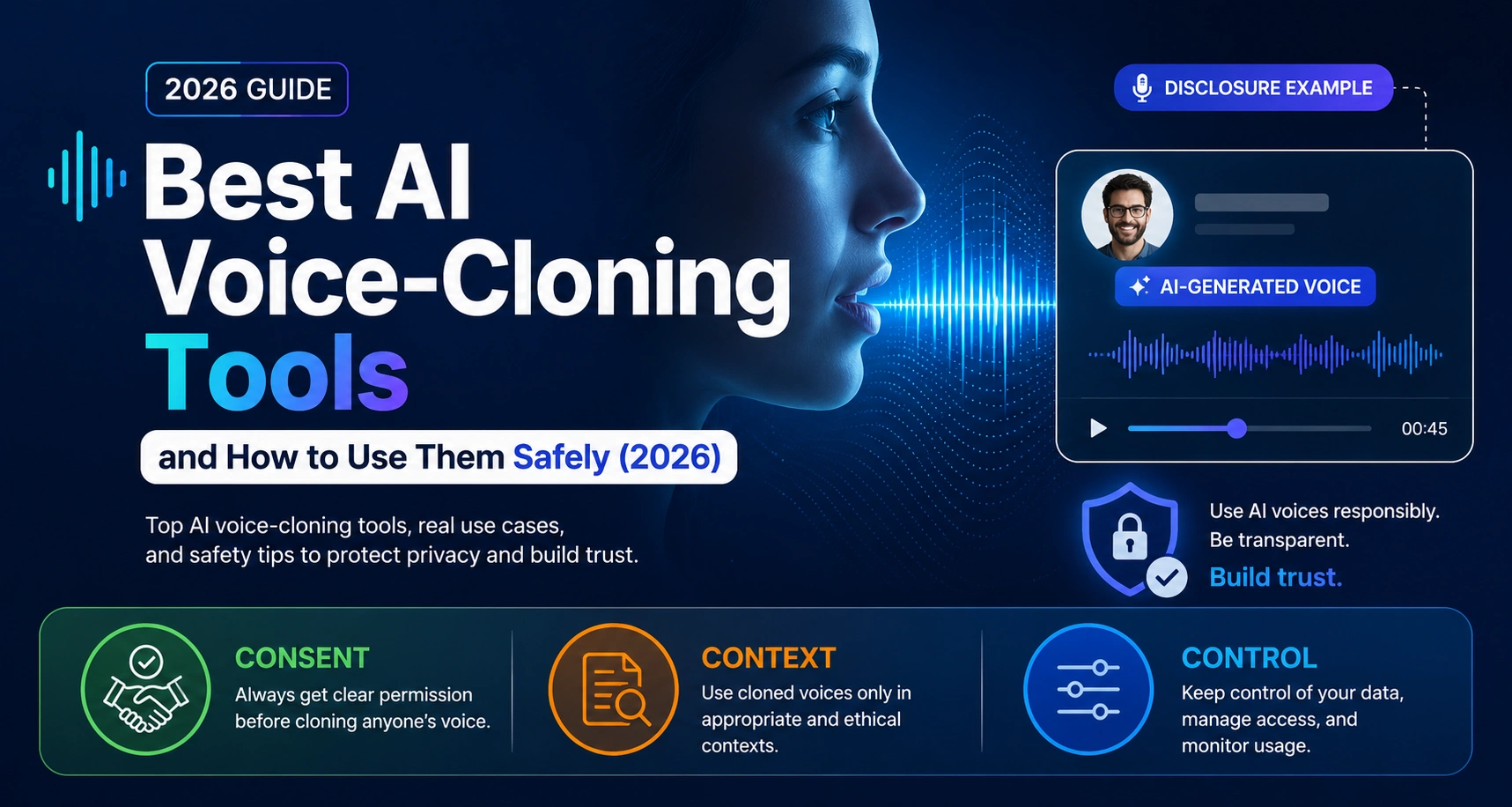
Every legitimate use case above shares three things: the person cloning the voice either owns it or has explicit permission, the resulting audio is used in a context the voice owner agreed to, and there’s a clear line of accountability for how it’s used. Strip out any one of those three, and you’ve crossed from “creative tool” into genuinely risky territory — legally and ethically.
In practice, this means: clone your own voice freely. Clone someone else’s voice only with their explicit written consent, ideally documented through the platform’s built-in verification step, not just a verbal “sure, go ahead.” And disclose AI-generated audio to your audience wherever it appears in commercial or public-facing content — several jurisdictions, India included, are moving toward requiring this explicitly rather than treating it as optional best practice.
Best AI Voice Cloning Tools for Creators (With Consent Safeguards)
| Tool | Best For | Consent Verification | Starting Price |
|---|---|---|---|
| ElevenLabs | Highest realism, multilingual narration | Required for professional cloning | Plans from ~$5/month |
| Descript (Overdub) | Podcast/video editors who want to patch their own voice | Required recorded consent statement | Free tier; Creator plan ~$24/month |
| Resemble AI | Enterprise and API use, security-focused teams | Required; includes deepfake detection tooling | Custom/usage-based |
| Murf AI | Business narration, training videos, marketing voiceovers | Required for custom clones | Plans from ~$26/month |
| PlayHT / PlayAI | High-volume content with pacing control | Required | Tiered plans |
Note: some newer tools in this space market themselves specifically around skipping consent verification for faster, “no questions asked” cloning. Deliberately avoid these — a tool that removes the consent step isn’t a convenience, it’s a liability you’d be taking on directly, and in India specifically, the legal exposure now falls on the person who created and published the clone, not just the tool.
Pricing and features shift quickly in this category — verify current plans and consent-workflow details directly on each platform before committing.
A Safe Workflow for Cloning a Voice
- Get explicit, written consent from the voice owner before recording or uploading any sample audio — a text message or email confirmation is a reasonable minimum; a signed release is better for any commercial use.
- Use the platform’s built-in consent-verification step, not a workaround. Reputable tools require the voice owner to record a specific consent statement as part of the cloning process — this exists precisely so there’s a documented record if the use is ever questioned.
- Keep the use within the agreed context. Consent to clone a voice for one project (say, an internal training video) doesn’t extend to a different, unrelated use (a public ad campaign) without separately agreeing to that too.
- Disclose AI-generated audio clearly wherever your content reaches an audience — a simple on-screen or verbal note is often enough, and it protects both you and your audience’s ability to make an informed judgment about what they’re hearing.
- Avoid cloning voices of public figures or celebrities for commercial content entirely unless you have a formal licensing agreement — recent Indian court rulings have been unambiguous that a well-known person’s voice carries commercial value protected under personality rights, regardless of whether the clone is labeled as AI-generated.
India’s Legal Landscape for Voice Cloning in 2026
This section matters more for an Indian audience than most global guides acknowledge, because India’s rules have moved fast in the past year:
- The 2026 IT Rules amendment introduced a formal category called “Synthetically Generated Information” (SGI), requiring AI-generated or AI-altered content — including cloned voices — to be clearly labeled or watermarked, with tight takedown windows for the most harmful categories once a complaint is filed.
- Section 66C of the IT Act treats non-consensual voice cloning as a form of identity theft, since courts have interpreted “unique identification features” to include voice biometrics — this carries potential imprisonment and financial penalties.
- Indian courts have been active and clear on personality rights. Rulings involving musicians and public figures have repeatedly held that unauthorized AI cloning of a person’s voice infringes their personality and publicity rights, independent of copyright law, and courts have granted injunctions specifically covering AI voice cloning tools and platforms.
- The practical takeaway for creators: if you wouldn’t be comfortable defending a specific use of someone’s cloned voice in front of a judge with the consent documentation to back it up, don’t publish it.
Deepfake Voice Scams: What Creators and Their Families Should Know
This is a genuine risk beyond content creation, and it’s worth understanding even if you never clone a voice yourself: scammers can now generate a convincing voice clone from as little as a few seconds of publicly posted audio — a video you posted, a voicemail greeting, a clip from a podcast. That clone can then be used to place a fake emergency call, asking a family member to urgently send money.
A few practical protections worth having in place, especially if you or your family have public-facing audio online:
- Agree on a family verification phrase that wouldn’t appear in any public content, to use if someone calls claiming to be in urgent trouble.
- Never trust a voice alone for a money request. Hang up and call the person back on a known number before acting on anything urgent.
- Be more cautious with publicly posted audio if you or your family have a public profile — the more clean audio of your voice exists online, the easier a convincing clone becomes.
This isn’t a reason to avoid posting video or audio content — it’s a reason to have a simple verification habit in place, the same way you’d be skeptical of an unexpected email asking for a password.
Common Mistakes and Red Flags to Avoid
- Treating verbal “sure, go ahead” as sufficient consent. Use the platform’s documented consent step, not an informal agreement that’s hard to prove later.
- Reusing a consented clone outside its original agreed context. Get separate consent for separate uses, especially anything commercial.
- Skipping AI disclosure because the audio “sounds convincing enough not to need it.” That’s precisely the content that needs disclosure most.
- Choosing a tool specifically because it skips consent verification. If a platform advertises this as a feature, treat it as a warning sign, not a convenience.
- Assuming a private, non-commercial use is automatically low-risk. Indian courts and the 2026 IT Rules don’t limit protection to commercial contexts alone.
Frequently Asked Questions
Q.1 Is AI voice cloning legal in India?
Yes, when used with the voice owner’s explicit consent — cloning your own voice or a voice you have documented permission to use is legal. Cloning someone’s voice without consent can trigger criminal liability under IT Act identity theft provisions and civil liability under personality rights law.
Q.2 Do I need to disclose that I used an AI-cloned voice in my content?
Increasingly, yes. India’s 2026 IT Rules require AI-generated or synthetically altered content to be labeled, and disclosure is considered best practice globally even where it isn’t yet strictly mandatory for every context.
Q.3 Which AI voice cloning tool is best for beginners?
Descript is a strong starting point if you’re already editing podcasts or videos, since its voice cloning (Overdub) is built into the same editor. ElevenLabs is the stronger choice if voice realism and multilingual output are the priority.
Q.4 Can someone clone my voice without my permission?
Technically, yes — this is exactly the risk behind scam calls using cloned voices. Reputable platforms require consent verification to clone a voice through their systems, but bad actors using less scrupulous tools can still attempt this from public audio, which is why family verification habits matter.
Q.5 What should I do if I find someone has cloned my voice without permission?
Document the content, report it to the platform hosting it (which now has tight takedown obligations under the 2026 IT Rules for certain harmful categories), and consult a lawyer about personality rights remedies — Indian courts have shown a clear willingness to grant injunctions in these cases.
Conclusion
AI voice cloning is a genuinely useful creator tool, not just a risk to manage — but in 2026, using it safely in India means treating consent as the default, not a formality. Get explicit permission, use the platform’s built-in verification, disclose AI-generated audio clearly, and steer well clear of cloning any voice you don’t have documented rights to use. To explore more AI tools built for creator workflows, check out our guide to the Best AI Note-Taking Apps 2026, or browse the full AI & Technology Guide.