

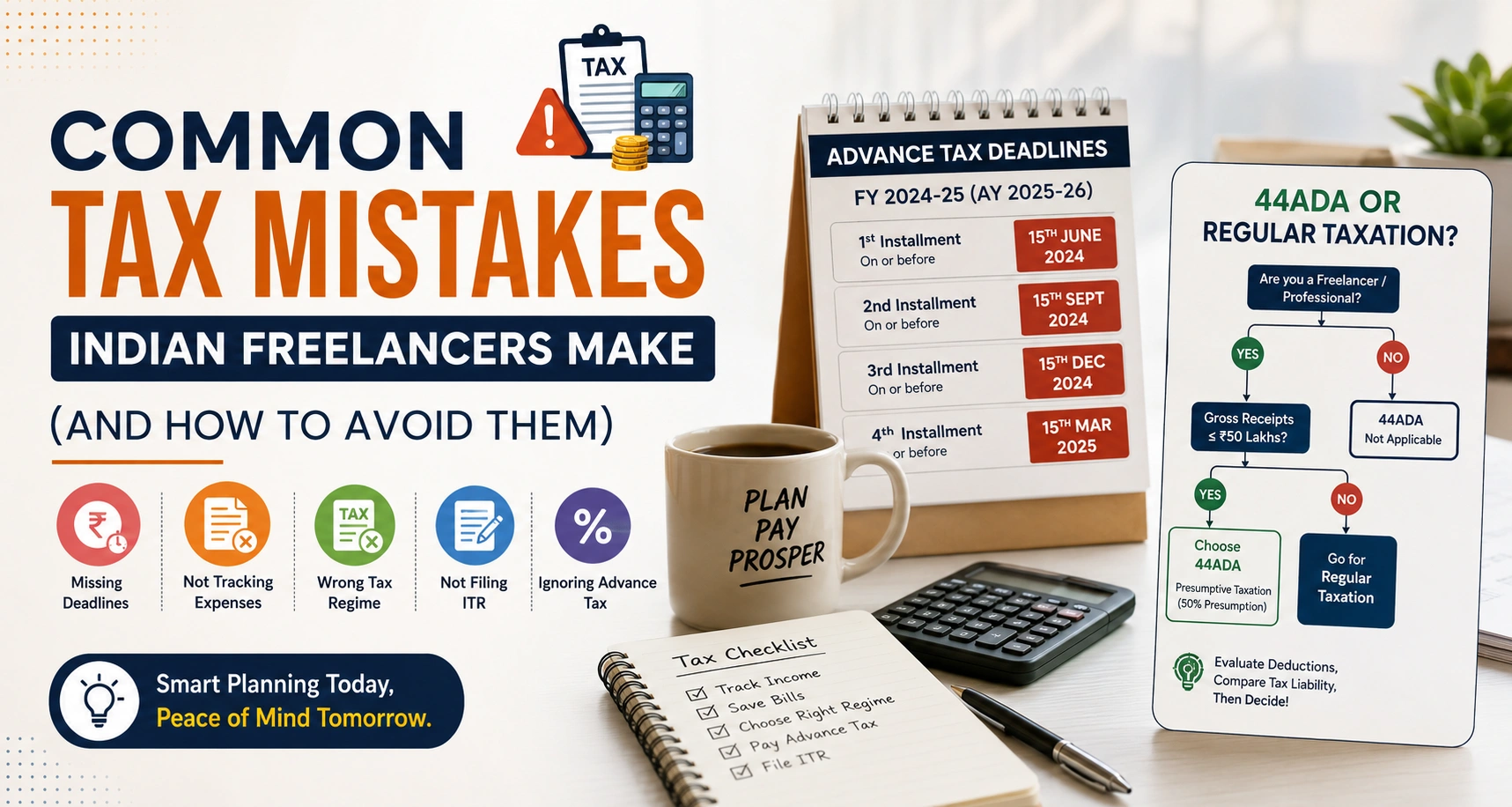
Nobody deducts tax at source for you automatically as a freelancer the way an employer does for a salaried job — which means the tax mistakes that would never happen to a salaried employee happen to freelancers constantly, usually because nobody explained the rules in the first place. None of these mistakes are exotic. They’re the same handful of errors, repeated year after year, and every one of them is avoidable with a bit of planning.
Quick answer: The most common tax mistakes Indian freelancers make are filing the wrong ITR form, missing advance tax deadlines, using Section 44ADA without checking if they’re actually eligible or if it’s even beneficial, not reconciling TDS credits against Form 26AS, mixing personal and business finances, and ignoring GST registration once they cross the ₹20 lakh threshold. Each one is fixable with a simple habit — the hard part is knowing they exist before a notice arrives.
This article is educational and not a substitute for personalized tax advice — consult a chartered accountant for guidance specific to your income, profession, and situation before filing.
Why Freelancers Are More Exposed to Tax Mistakes Than Salaried Employees
A salaried employee’s employer deducts TDS monthly and handles most of the compliance heavy lifting. Freelancers get none of that structure by default — clients may deduct TDS under Section 194J, but it rarely covers your full tax liability, and no one is tracking your advance tax deadlines or reconciling your records for you. That gap is exactly where these mistakes creep in.
8 Common Tax Mistakes Freelancers Make
| # | Mistake | Consequence |
|---|---|---|
| 1 | Filing ITR-1 instead of ITR-3 or ITR-4 | Defective return notice from the Income Tax Department |
| 2 | Missing advance tax deadlines | Interest under Sections 234B and 234C |
| 3 | Using Section 44ADA without checking eligibility | Reassessment risk and potential penalties |
| 4 | Opting into 44ADA without comparing actual expenses | Paying more tax than necessary |
| 5 | Not reconciling TDS with Form 26AS | Losing legitimate TDS credit |
| 6 | Mixing personal and business finances | Difficult ITR filing, higher scrutiny risk |
| 7 | Ignoring GST registration past ₹20 lakh turnover | Penalties for non-compliance |
| 8 | Selecting the wrong assessment year when paying tax | Payment mismatches that take weeks to resolve |
1. Filing the Wrong ITR Form
Even a single freelance invoice counts as professional income — it’s a common misconception that small or occasional freelance earnings can still be filed under the simpler ITR-1 used for salary income. If you have any freelance income, you need ITR-4 (if opting for presumptive taxation under 44ADA or 44AD) or ITR-3 (if computing actual profit, or if you have capital gains, foreign income, or multiple house properties). Filing the wrong form typically triggers a defective return notice, which then needs to be corrected and refiled.
2. Missing Advance Tax Deadlines
If your total tax liability after TDS exceeds ₹10,000 for the year, you’re required to pay advance tax during the year itself, not just at filing time. Freelancers using regular taxation (ITR-3) follow the standard four-installment schedule — 15% by June 15, 45% by September 15, 75% by December 15, and 100% by March 15. Freelancers using Section 44ADA get a real simplification here: the entire advance tax can be paid in a single installment by March 15. Miss either schedule, and interest under Sections 234B and 234C accrues at roughly 1% per month on the shortfall — a cost that adds up faster than most freelancers expect.
3. Using Section 44ADA Without Checking Eligibility
Section 44ADA is restricted to a specific list of professions — legal, medical, engineering, architecture, accountancy, technical consultancy, interior decoration, and a handful of others defined under Section 44AA. Many freelancers assume it applies broadly, but content writers, digital marketers, social media managers, and graphic designers generally fall outside this specified list and technically fall under Section 44AD (business income) instead. This distinction matters: incorrectly using 44ADA when you’re not eligible can trigger scrutiny, particularly since the tax department can cross-reference TDS deducted under Section 194J against your filed return.
4. Choosing 44ADA Without Comparing Actual Expenses
Section 44ADA lets you declare 50% of gross receipts as taxable income, regardless of your real expenses — which is a genuine benefit if your actual costs are low, but a poor choice if they’re not. If your real expenses run higher than 50% of your receipts (common for freelancers with significant subcontractor costs, equipment, or rent), the presumptive scheme can leave you paying tax on income you didn’t actually keep. This is worth recalculating every year rather than assuming last year’s choice is still the better one — the more favorable route can change as your expense structure changes.
5. Not Reconciling TDS With Form 26AS
Clients may deduct TDS from your payments but fail to deposit it correctly, deposit it late, or file it against the wrong PAN. If that TDS doesn’t show up in your Form 26AS, you can’t claim credit for it — even though it was genuinely deducted from your payment. Checking your 26AS quarterly, rather than only at filing time, gives you enough runway to follow up with a client about a mismatch before it becomes a filing-season scramble.
6. Mixing Personal and Business Finances
Running all your freelance income and expenses through your personal bank account makes it genuinely difficult to track what’s actually a business expense come filing time, and it raises your scrutiny risk if the tax department wants to verify your numbers. A dedicated current account for freelance income and expenses, even a basic one, makes reconciliation dramatically simpler and creates a cleaner audit trail if you’re ever asked to substantiate your numbers.
7. Ignoring GST Registration Past the Threshold
GST registration becomes mandatory once your turnover crosses ₹20 lakh for most services (lower thresholds and different rules apply in a few special category states, and cross-border or interstate service providers may need to register even earlier). Many freelancers don’t realize they’ve crossed this line until a client specifically asks for a GST invoice — by which point they may already be non-compliant. If you are GST-registered, make sure your ITR gross receipts figure matches what you’ve reported in your GSTR-3B filings; a mismatch between the two is a well-known red flag that can invite scrutiny.
8. Selecting the Wrong Assessment Year
This is a small but surprisingly common clerical error: FY 2025–26 income is reported under Assessment Year 2026–27, not AY 2025–26. Selecting the wrong assessment year when paying advance tax through the e-Pay Tax portal creates a payment mismatch that can take weeks to sort out, even though the underlying tax was actually paid correctly and on time.
A Simple System to Avoid Most of These
- Open a dedicated current account for all freelance income and expenses.
- Set aside 10–15% of every client payment into a separate account as it comes in, so advance tax deadlines never require a last-minute scramble.
- Check Form 26AS and AIS quarterly, not just at filing time, and follow up on any TDS mismatch immediately.
- Recalculate whether 44ADA is still your best option every year rather than defaulting to whatever you used last year.
- Track your rolling 12-month turnover so you’re not caught off guard by the GST registration threshold.
Frequently Asked Questions
Q.1 Do freelancers need to pay tax even if clients already deduct TDS?
Usually yes. TDS deducted by clients (commonly under Section 194J) rarely covers your entire tax liability, so most freelancers still owe additional advance tax during the year.
Q.2 Which ITR form should freelancers use?
ITR-4 if you’re using presumptive taxation under Section 44ADA or 44AD, or ITR-3 if you’re computing actual profits, have capital gains, foreign income, or don’t qualify for the presumptive scheme. ITR-1 is not valid if you have any freelance income, regardless of the amount.
Q.3 Is Section 44ADA available to all freelancers?
No — it’s restricted to specified professionals listed under Section 44AA, including legal, medical, engineering, architecture, and technical consultancy fields. Many common freelance categories, like content writing or digital marketing, generally fall under Section 44AD instead, not 44ADA.
Q.4 What happens if I miss an advance tax deadline?
Interest applies under Sections 234B and 234C, generally around 1% per month on the shortfall, calculated from the relevant due date until the tax is actually paid.
Q.5 When do freelancers need to register for GST?
Generally once annual turnover crosses ₹20 lakh for most services, though this can vary by state and by the nature of your clients (interstate or export services can trigger registration requirements earlier).
Conclusion
Most freelancer tax mistakes in India come down to the same handful of gaps: the wrong form, a missed deadline, or an assumption about eligibility that was never actually checked. Build a simple quarterly habit — reconcile TDS, recheck your turnover against the GST threshold, and confirm 44ADA still makes sense — and most of these problems never happen in the first place. For more on the fundamentals of freelancing in India, read our guide on How to Start Freelancing in 2026, or explore the full Business, Money & Career Guide.