

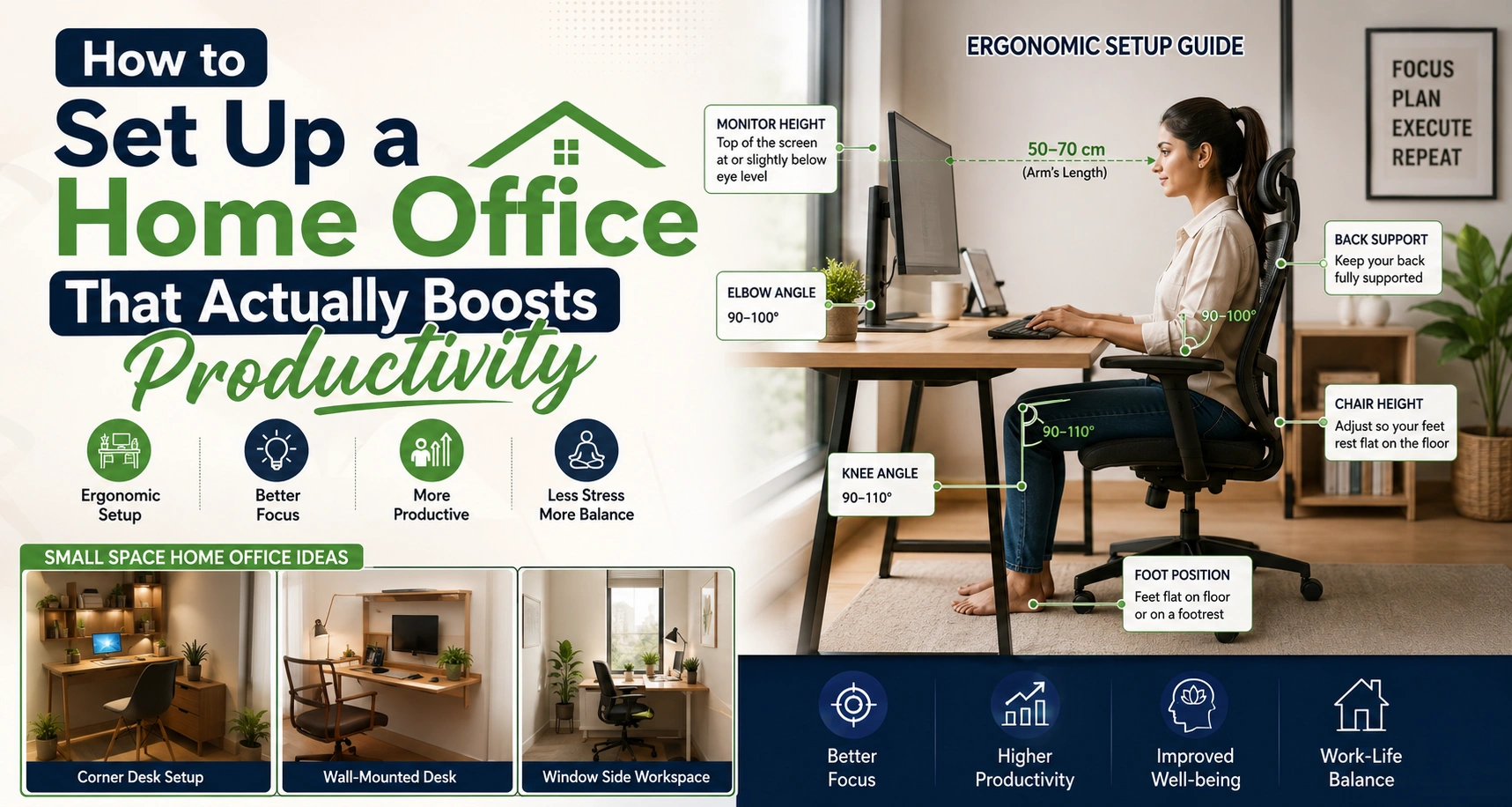
Most home office setups in India start the same way: a laptop on the dining table, borrowed for “just this week” two years ago. It works, technically — until 3 p.m. rolls around and your back is aching, your neck is stiff, and you’ve lost track of the last hour entirely. The setup isn’t a background detail. It’s actively shaping how well you work.
Quick answer: A productive home office needs four things done right, in priority order: an ergonomically correct chair, a desk at the right height with your monitor at eye level, good lighting that avoids screen glare, and a clearly defined work zone — even if it’s just a corner of a room. You don’t need a spare room or a premium budget; a functional, ergonomically sound setup in India can be built for roughly ₹17,000–₹35,000, with a chair worth prioritizing over almost everything else.
Why Your Setup Actually Affects Your Output
Proper ergonomics are about more than comfort. If your back isn’t supported properly, your screen is set too high or too low, or your desk is built incorrectly, you’ll be using extra muscle energy all day long and will be fatigued unnecessarily. These practices can lead to back pain, neck stiffness and shoulder tightness over time, which is a common problem among remote workers and is frequently associated with suboptimal home workstations.
The fix isn’t expensive furniture for its own sake — it’s getting the measurements and layout right, in the correct order of priority.
Budget Tiers for a Home Office Setup in India
| Tier | Approx. Budget | What You Get |
|---|---|---|
| Basic | ₹17,000–₹32,000 | Simple study table, entry-level ergonomic chair with lumbar support, a desk lamp, basic storage |
| Mid-range | ₹35,000–₹80,000 | Better-built desk, a proper ergonomic mesh chair, monitor stand or arm, improved lighting, organized cable management |
| Premium | ₹80,000+ | Height-adjustable standing desk, premium ergonomic chair, dual-monitor setup, dedicated soundproofing or acoustic treatment |
Costs vary by city and brand — treat these as planning ranges, not fixed prices, and verify current pricing before publishing specific product recommendations.
The Ergonomic Checklist (Do These in Order)
1. Fix Your Chair First
If you want to do one ergonomic adjustment, it’s your chair. Having a chair that can support the lower back, have the feet flat on the floor, and make the thighs level with the floor can help to minimize strain over long periods of time. Pick one that is adjustable in height and lumbar support, or a small cushion or rolled up towel behind your lower back as an effective and inexpensive option.
Climate tip specific to India: mesh-backed chairs breathe far better than leather or leatherette, which trap heat and become uncomfortable within an hour in most Indian summers.
2. Get Your Desk Height Right
Your elbows should bend at roughly 90 degrees when typing, with forearms resting parallel to the floor. Most dining tables sit too high for this — if you’re using one, a footrest or a slightly raised chair can correct the mismatch without buying new furniture immediately.
3. Position Your Keyboard and Mouse for Neutral Wrists
Wrists should stay straight, not bent up or down, while typing. If your desk is too high for this even after adjusting your chair, a keyboard tray solves it more reliably than trying to compensate with posture alone.
Small Home Office Ideas for Indian Apartments
You don’t need a spare room — most Indian homes don’t have one to spare, and that’s genuinely fine.
- Claim a defined corner, not a random surface. A rug, a room divider, or simply facing a wall helps signal “this is the work zone” even within a bedroom or living room.
- Go vertical. Wall-mounted shelves and floating desks reclaim floor space in smaller rooms without sacrificing storage.
- Use foldable or drop-leaf desks in multi-purpose rooms. These let a work corner disappear when it’s not in use — useful if your “office” doubles as a guest room or storage space outside work hours.
- Face away from high-traffic areas. Especially in joint families or homes with children around during work hours, positioning your desk to face a wall (not the doorway) meaningfully cuts visual distraction.
Lighting for Indian Homes and Climate
Lighting mistakes are common and easy to fix:
- Position your desk so light comes from the side, not directly behind or in front of your screen — light from behind creates glare, and light from the front casts your own shadow over your workspace.
- Use sheer curtains, not blackout blinds, in south-facing rooms common in cities like Chennai, Hyderabad, or Pune, where harsh afternoon sun needs diffusing rather than fully blocking.
- Add a warm-white LED desk lamp (around 4000K) positioned opposite your writing hand to avoid shadows falling across your work.
- Plan around power fluctuations. A small inverter or UPS for your desk setup avoids losing work mid-task during outages, which remain a real consideration in many Indian cities and towns.
Cable Management and Small Finishing Touches
A clutter-free workspace improves focus, even if your desk is already ergonomically set up. Simple, affordable upgrades—such as routing cables with clips or a cable sleeve, keeping a charging station off the desktop, and organizing pens and accessories in a tray or drawer—can significantly reduce visual distractions. The goal isn’t an expensive setup but a cleaner, more organized workspace that helps you stay focused and productive.
A small plant (a pothos or snake plant tolerates indoor conditions well and needs minimal care) or a personal object you actually like looking at also helps signal “this is my space” psychologically, which matters more for focus than it might seem, especially in a shared or multi-purpose room.
Managing Noise and Distractions
Indian homes are often full of people during work hours — family, domestic help, deliveries — and that’s a genuine, different challenge from the “quiet home office” most Western guides assume. A few practical fixes: noise-cancelling headphones for focus-heavy tasks, a simple “do not disturb” signal (even a closed door or a small sign) communicated clearly to household members, and scheduling focus blocks around predictable quiet windows in your household’s daily rhythm rather than fighting the noise constantly.
Common Mistakes to Avoid
- Buying an expensive chair without adjusting it correctly. A great chair set up wrong (seat too deep, lumbar support not actually touching your back) still leaves you unsupported.
- Skipping the monitor height fix because it feels like a minor detail. It’s usually the single highest-impact, lowest-cost change available.
- Prioritizing aesthetics over ergonomics. A beautiful desk setup that photographs well but ignores elbow angle and monitor height will still leave you sore by afternoon.
- Treating the setup as “done” after the first purchase. Your needs change — revisit chair height, monitor position, and lighting every few months, especially after any change in your work routine or hours.
Frequently Asked Questions
Q.1 What’s the minimum budget for a functional home office in India?
A basic but ergonomically sound setup — desk, entry-level ergonomic chair, lamp, and simple storage — can be built for roughly ₹17,000–₹32,000 in most Indian cities.
Q.2 Do I need a separate room for a home office?
No. A well-defined corner in a bedroom or living room works just as well — use a rug or divider to visually separate the space, and face a wall to minimize distraction.
Q.3 Which is better for Indian weather: a mesh chair or a leather chair?
Mesh, generally without much debate. Leather and leatherette trap heat and become uncomfortable quickly in Indian summers, while mesh breathes and stays cooler over long sitting sessions.
Q.4 What should I prioritize if I only have a small budget?
Your chair first, always. A mediocre desk is an inconvenience; a bad chair is a genuine long-term health problem. Spend the most here, then the desk, then upgrade lighting and accessories gradually.
Q.5 How do I stay productive with family or noise around during work hours?
Use noise-cancelling headphones for deep-focus tasks, communicate a clear “do not disturb” signal to household members, and where possible, schedule your most demanding work during your household’s naturally quieter windows.
Conclusion
A productive home office isn’t about spending big — it’s about getting the chair, desk height, and monitor position right before anything else. Start with the ergonomic checklist above, build within a budget tier that fits you, and revisit the setup periodically as your needs change. If work stress is part of what’s making your days harder, our guide on How to Manage Stress at Work India pairs well with this one, or explore the full Lifestyle, Fashion & Travel Guide for more practical living guides.